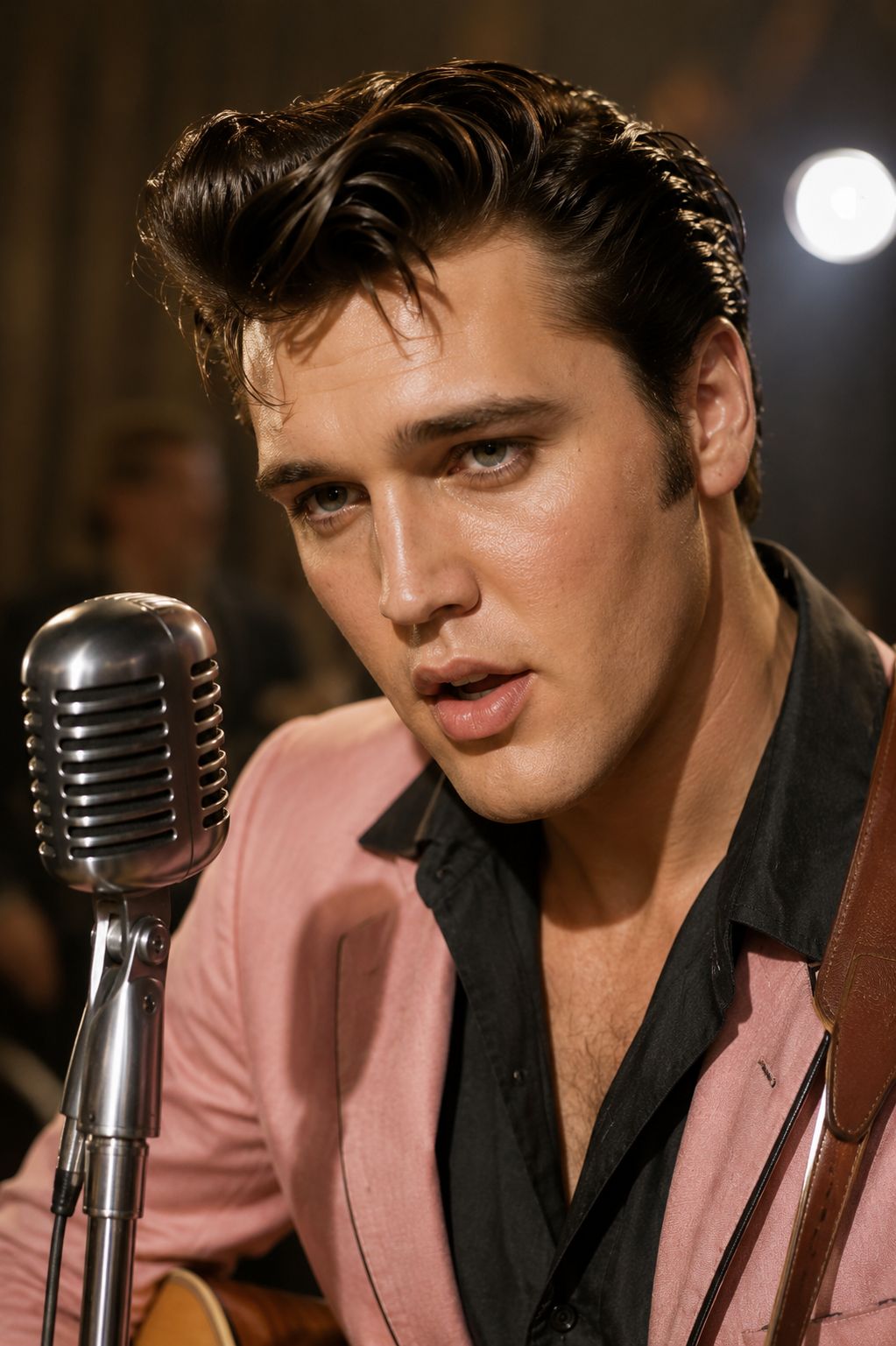
1955 — Elvis Presley Played Small Shows Before Becoming the Biggest Star in America
Before the screaming crowds.
Before the gold records.
Before the white jumpsuits, the television specials, and the worldwide fame…
There was a skinny young man driving across the South in a beat-up car, carrying a guitar, hoping someone would listen.
In 1955, Elvis Presley was not yet “The King.” He was just another hungry kid trying to survive one tiny show at a time.
And that may be the most emotional part of his story.
Because America remembers the legend.
But few remember the loneliness, exhaustion, and rejection that came before it.
The Year Everything Almost Didn’t Happen
In 1955, Elvis was only 20 years old.
He had recorded a few songs with Sun Records in Memphis. Songs like That’s All Right and Good Rockin’ Tonight were starting to create noise in certain Southern cities. Teenagers felt something different when they heard him.
But outside those pockets of excitement?
Most people had no idea who he was.
He wasn’t performing in giant arenas.
He was playing school gyms, tiny theaters, dusty fairgrounds, and local country shows where audiences sometimes stared at him in confusion.
Sometimes they laughed.
Sometimes they walked out.
And sometimes… they went completely wild.
That unpredictability became the foundation of Elvis Presley’s rise.
“Nobody knew whether he was going to become a star or disappear in six months.”
That uncertainty followed Elvis everywhere in 1955.
Night after night, he traveled through small Southern towns with guitarist Scotty Moore and bassist Bill Black, performing multiple shows a week for very little money.
The roads were long.
The crowds were inconsistent.
And the future was unclear.
But something magical was beginning to happen.
Teenage Girls Started Screaming — And America Didn’t Understand Why
At first, it made no sense to older audiences.
Elvis looked different.
He moved differently.
He sounded different.
Country music had always been polished and controlled. Pop singers stood still. Men in entertainment were expected to behave a certain way.
Then Elvis walked onstage.
He shook his legs nervously while playing guitar — a movement that unintentionally became part of his signature style. Teen girls exploded with excitement. Parents were horrified.
Even Elvis himself reportedly seemed surprised by the reaction.
The louder the girls screamed, the more confident he became.
And the more confident he became… the more dangerous he looked to conservative America.
In tiny venues across the South, history was quietly changing.
The Small Shows Built the Monster America Couldn’t Stop
One of the biggest myths about Elvis Presley is that fame arrived overnight.
It didn’t.
1955 was a grind.
He performed relentlessly. Some nights he barely slept. He traveled constantly between states, often eating cheap meals and living out of suitcases.
There were no luxury buses.
No bodyguards.
No million-dollar contracts.
Just ambition.
Colonel Tom Parker saw the potential before much of the country did. Parker began aggressively booking Elvis into every possible show he could find.
The strategy was simple:
Get Elvis in front of people.
Again.
And again.
And again.
Because once audiences saw him live, they rarely forgot him.
That raw electricity could not be captured fully on radio in 1955.
You had to witness it.
“The crowds came curious… and left obsessed.”
That became the pattern everywhere Elvis went.
At first, promoters weren’t sure he belonged on country bills. Some thought he was too strange. Others believed he was ruining traditional music.
But young audiences disagreed.
They saw freedom in him.
They saw rebellion.
They saw emotion.
Most importantly…
They saw someone who didn’t pretend to be perfect.
Elvis still looked nervous sometimes. He still smiled awkwardly. He still seemed like a regular Southern kid.
That humanity made him even more powerful.
The Louisiana Hayride Changed Everything
One of the most important moments of Elvis’s early career happened through the famous Louisiana Hayride.
Unlike the more conservative Grand Ole Opry establishment, the Hayride gave younger and riskier performers opportunities.
Elvis became a recurring performer there in 1955.
And suddenly, larger audiences started paying attention.
The reactions grew louder.
The crowds got younger.
The headlines became more dramatic.
Adults called him inappropriate.
Teenagers called him exciting.
America was splitting in two.
And Elvis Presley stood directly in the middle of that cultural earthquake.
Behind the Fame Was a Deeply Insecure Young Man
This is the part many people forget.
Even during those early explosions of popularity, Elvis remained incredibly insecure.
Friends and musicians around him often described a young man desperate to be accepted.
He wanted audiences to love him.
He wanted respect from country musicians.
He wanted to prove he belonged.
That emotional hunger fueled his performances.
When Elvis sang in those tiny 1955 venues, he wasn’t performing like a man who already believed he was a superstar.
He performed like someone afraid the dream could disappear tomorrow.
And maybe that’s why audiences connected so deeply to him.
Because underneath the charisma was vulnerability.
“He sang like his whole life depended on it.”
In many ways, it did.
Elvis came from poverty in Tupelo and later Memphis. His family struggled financially for years. Fame wasn’t simply about ego — it was survival.
Every small show mattered.
Every crowd mattered.
Every applause mattered.
By late 1955, the momentum became unstoppable.
Record sales exploded across the South.
Crowds became larger and more chaotic.
Promoters realized they were witnessing something unprecedented.
A new kind of American star was being born.
America Was About to Change Forever
In 1956, everything would explode nationally.
Television appearances.
Chart-topping records.
Mass hysteria.
International fame.
But none of it would have happened without the exhausting small shows of 1955.
That year created the Elvis Presley the world would eventually worship.
The confidence.
The stage presence.
The connection with audiences.
The danger.
The emotion.
It was all forged in cramped auditoriums and tiny Southern stages where nobody knew they were watching history.
Why This Story Still Hits So Hard Today
People often look at legends and assume success was inevitable.
But Elvis Presley’s story reminds us that greatness usually begins invisibly.
Before the fame comes uncertainty.
Before the spotlight comes struggle.
Before millions believe in you…
you often have to believe in yourself completely alone.
That’s what makes 1955 so emotional.
Elvis wasn’t yet “The King.”
He was just a young man with fear, ambition, and a guitar.
Driving from town to town.
Hoping one more audience might care.
And somehow…
those tiny shows changed American music forever.
“The biggest star in America was once just a nervous kid playing small Southern stages.”
That’s the part of the Elvis Presley story people never forget once they truly understand it.
Because the legend wasn’t born in Hollywood.
It was born in small rooms filled with uncertainty, sweat, screaming teenagers, and impossible dreams.
And in 1955…
America had no idea what was coming.