Introduction
In January 1973, the world stopped to watch one man in a white jumpsuit standing under the lights in Honolulu. By then, Elvis Presley was no longer just a singer. He was a phenomenon battling time, pressure, exhaustion, and the impossible burden of being Elvis Presley every single day.
And yet somehow… he made history again.
What happened that night during Aloha from Hawaii wasn’t just another concert. It became one of the most ambitious live music broadcasts ever attempted — a moment where music, television, celebrity, and emotion collided on a global scale.
But behind the glittering eagle jumpsuit and thunderous applause was a man desperately trying to prove he still belonged at the top of the world.
1973 — Elvis Presley Performed Aloha from Hawaii and Made History Again
By 1973, many critics believed Elvis had already lived several careers.
He had revolutionized rock and roll in the 1950s.
He conquered Hollywood in the 1960s.
Then he shocked the world with his explosive 1968 comeback special.
But fame moves fast. Trends change. New stars rise.
And by the early ’70s, younger audiences were obsessed with bands like Led Zeppelin and The Rolling Stones. The music industry had become louder, wilder, and more rebellious.
Some wondered if Elvis was becoming a relic of another era.
That question haunted him.
Because beneath the rhinestones and charisma, Elvis always carried a deep fear: being forgotten.
So when the idea emerged to broadcast a live Elvis concert globally via satellite, it sounded almost impossible.
No artist had ever attempted something this massive before.
The show would air across Asia and Europe and eventually reach millions worldwide. It was promoted as a technological milestone — but for Elvis, it was something more personal.
It was a chance to remind the world who he was.
And perhaps… remind himself too.
The Pressure Was Enormous
The concert was scheduled at the Honolulu International Center in Hawaii.
The production costs were staggering for the era. Satellite coordination was incredibly complicated. Every detail mattered. One mistake could become an international embarrassment broadcast live across continents.
Colonel Tom Parker marketed the event like a global coronation.
But Elvis wasn’t entering the show at his strongest physically.
Behind the scenes, he was exhausted.
Years of nonstop performing, prescription medication, poor sleep, and emotional isolation had begun taking a visible toll. Friends noticed mood swings. Some nights he seemed energetic and unstoppable. Other nights he looked fragile and distant.
Yet when rehearsal began, something changed inside him.
Witnesses said Elvis became intensely focused.
Almost possessed.
He understood the magnitude of what was about to happen.
“This wasn’t just another Vegas show,” one insider later recalled.
“Elvis knew the entire world was watching.”
And maybe that pressure awakened the competitor inside him one more time.
The Eagle Jumpsuit Became Legendary
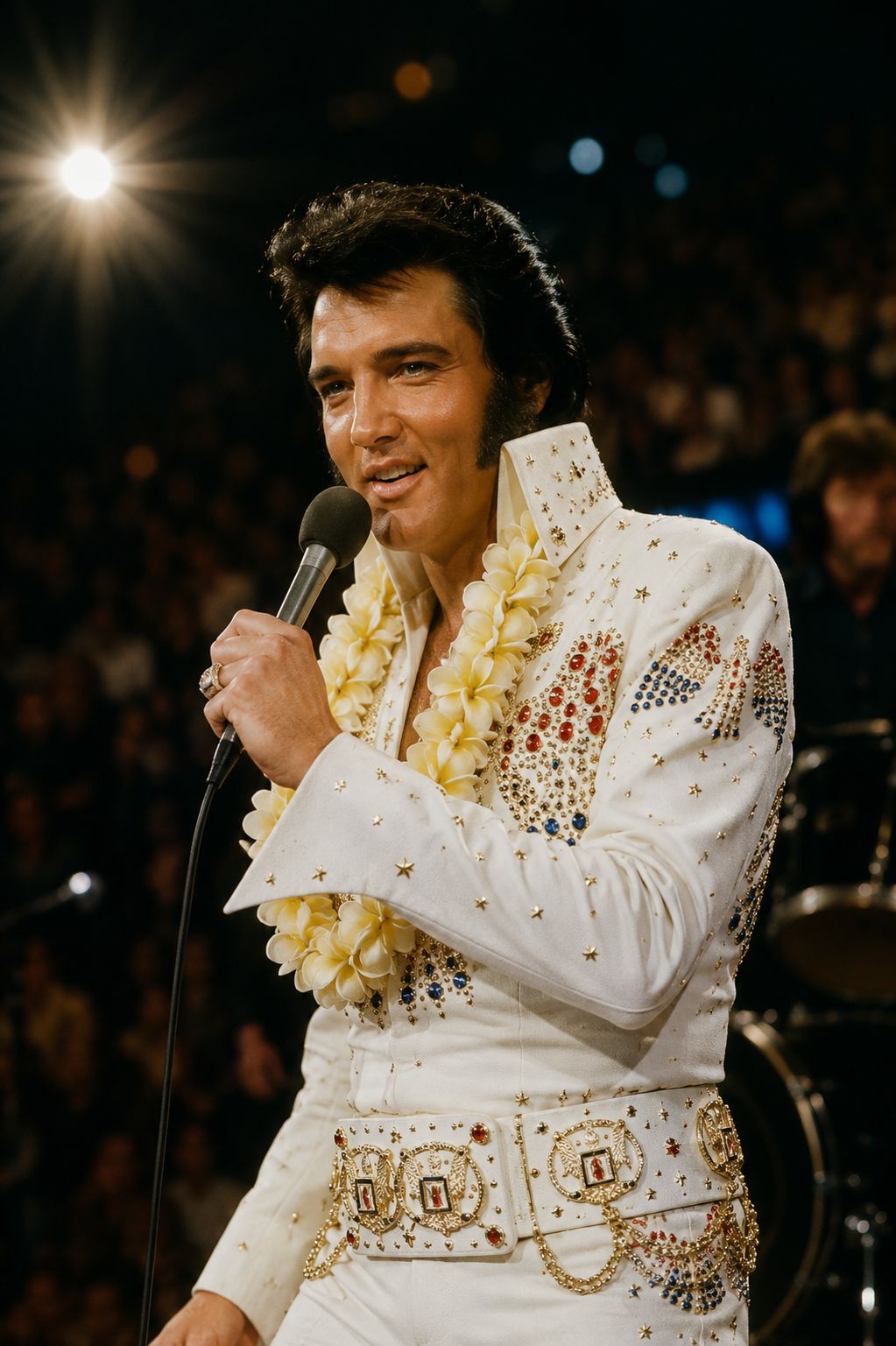
When Elvis walked onto the stage wearing the now-iconic white American Eagle jumpsuit, the audience erupted instantly.
The outfit itself looked larger than life.
The eagle stretched across his chest like a symbol of power, freedom, and mythology. Under the bright lights, Elvis didn’t merely look like a performer.
He looked immortal.
The opening notes hit.
And suddenly, the years disappeared.
His voice was powerful. Rich. Emotional.
He moved with confidence and authority, commanding every inch of the stage.
Songs like Burning Love, Suspicious Minds, and Steamroller Blues electrified the crowd. But there were also quieter moments — moments where Elvis sounded almost vulnerable beneath the spectacle.
That contrast is what made the concert unforgettable.
He wasn’t just singing.
He was fighting.
Fighting age. Fighting doubt. Fighting decline. Fighting the impossible expectations attached to his own legend.
And for one night, he won.
A Global Event Before the Internet Existed
Today, global livestreams happen every day.
But in 1973, this was revolutionary.
The satellite broadcast reached dozens of countries, reportedly drawing over a billion potential viewers worldwide through delayed and live broadcasts combined. Whether every estimate was accurate hardly mattered.
The feeling was real:
The entire planet seemed tuned into Elvis.
Families gathered around televisions in Japan, Australia, Europe, and beyond. For many viewers overseas, this became their defining Elvis memory.
Not the rebellious young man from the 1950s.
But the grand, almost mythical performer dressed in white, standing beneath Hawaiian lights while delivering music with fierce intensity.
It turned Elvis into something bigger than an American icon.
It made him global royalty.
“There are entertainers… and then there was Elvis,” one television executive reportedly said afterward.
“Nobody else could make the world stop like that.”
And honestly, they were right.
The Emotional Moment Most Fans Never Forgot
Near the end of the concert came one of the evening’s most emotional performances: An American Trilogy.
By then, Elvis appeared deeply connected to the music.
His face tightened with emotion. His voice trembled at times. The performance carried exhaustion, pride, loneliness, and longing all at once.
It felt bigger than entertainment.
It felt human.
That’s part of why Aloha from Hawaii still resonates decades later.
People weren’t simply watching a superstar.
They were watching a man carrying the unbearable weight of being Elvis Presley.
And somehow still delivering magic anyway.
There’s something heartbreaking about that in hindsight.
Because modern audiences know what came next.
The health struggles worsened.
The isolation deepened.
The physical decline accelerated.
Only four years later, the world would lose him forever.
Which makes Aloha from Hawaii feel almost frozen in time — the last truly global triumph before the darkness closed in.
Elvis Needed the World’s Love
One reason the concert became so emotionally powerful is because Elvis genuinely needed audience connection.
More than most stars.
People close to him often described him as deeply sensitive despite his fame. Applause energized him. Fans validated him. Performing gave him purpose.
Offstage, he frequently battled insecurity and loneliness.
Onstage, he became superhuman.
And during Aloha from Hawaii, the world gave him exactly what he craved most:
Belief.
For a few hours, nobody talked about his weight.
Nobody discussed the pills.
Nobody predicted decline.
They simply watched Elvis Presley dominate the planet again.
The Legacy Still Feels Untouchable
More than fifty years later, the concert remains one of the defining moments of live music history.
Modern artists perform for huge streaming audiences now, but few events carry the same mythic feeling.
Because this wasn’t only about technology.
It was about timing.
About redemption.
About a man refusing to fade quietly into nostalgia.
The performance proved Elvis still possessed something raw and irreplaceable — a magnetic emotional force that cameras could barely contain.
Even today, younger generations discovering the footage often react the same way:
“How was one person this captivating?”
That’s the mystery of Elvis.
You can analyze the voice, the charisma, the style, the timing, the beauty, the tragedy…
…but eventually logic stops explaining it.
Some stars entertain.
Others change culture.
Elvis Presley changed gravity itself.
And on that unforgettable night in Hawaii in 1973, under satellite signals crossing oceans and continents, he reminded the entire world exactly why nobody could ever truly replace him.