Introduction
The year was 1956, and America was terrified.
Not of war.
Not of politics.
Not even of economic collapse.
America was terrified of a young man from Mississippi who moved his hips.
His name was Elvis Presley.
Today, it’s almost impossible to imagine. Elvis is remembered as a cultural icon, a beloved entertainer, and one of the most influential performers in music history. But in the mid-1950s, many authority figures viewed him as a genuine threat to American society.
Parents worried.
Religious leaders protested.
Politicians complained.
Television executives panicked.
And eventually, a national effort emerged to censor the man who would become the King of Rock and Roll.
What happened next became one of the greatest examples in entertainment history of censorship backfiring spectacularly.
The Rise of a Cultural Earthquake
Before Elvis Presley arrived, popular music looked very different.
Most mainstream performers stood still behind microphones. Their movements were restrained. Their appearances were polished. Their performances were considered respectable.
Then Elvis exploded onto the scene.
He blended country music, rhythm and blues, gospel, and raw youthful energy into something America had never seen before.
But it wasn’t just the music.
It was the movement.
The way he twisted, swayed, and gyrated during performances shocked audiences and outraged critics.
Newspapers called him dangerous.
Community groups condemned him.
Some religious leaders labeled his performances immoral.
To millions of teenagers, however, Elvis represented freedom.
For the first time, young people felt like they had a star who belonged to them rather than to their parents’ generation.
And that frightened the establishment.
Television’s Biggest Problem
By 1956, Elvis had become a ratings machine.
Every television appearance attracted massive audiences.
Yet television executives found themselves trapped between two realities.
On one hand, viewers couldn’t get enough of Elvis.
On the other hand, advertisers and conservative groups were flooding networks with complaints.
Many critics focused on one thing above all else:
His hips.
The controversy reached such a fever pitch that some commentators began referring to him as “Elvis the Pelvis.”
The nickname was intended as an insult.
Instead, it became free publicity.
Every criticism made curious Americans want to see what the fuss was about.
Every complaint increased public interest.
Every attack strengthened Elvis’s mystique.
The establishment was unknowingly creating a superstar.
The Censorship Order
Then came one of the most famous censorship decisions in television history.
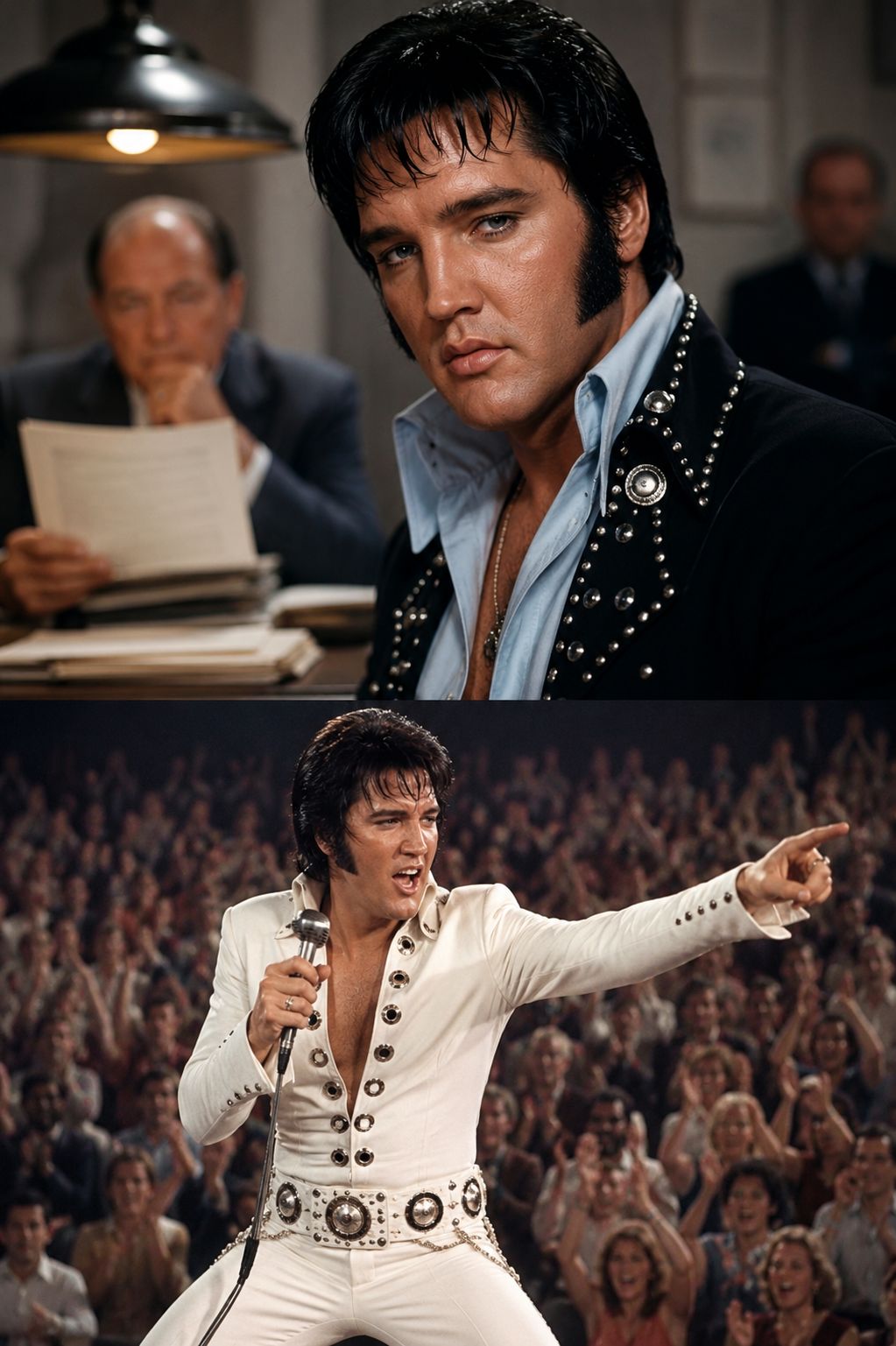
When Elvis appeared on national television, network executives took extraordinary measures to limit what audiences could see.
The most famous example occurred during his appearance on The Ed Sullivan Show.
Executives were so concerned about his dancing that cameras were instructed to avoid showing his full body.
Viewers would largely see Elvis from the waist up.
The intention was obvious.
If audiences couldn’t see the controversial movements, the controversy would disappear.
Problem solved.
At least, that’s what the censors believed.
They couldn’t have been more wrong.
“The moment authorities try to hide something, people become desperate to see it.”
That principle would prove devastatingly true.
The Public’s Reaction
Instead of calming the situation, the censorship transformed Elvis into something even bigger.
Americans immediately noticed what was happening.
People talked about it at school.
They talked about it at work.
They talked about it around dinner tables.
Why was television hiding Elvis?
What exactly were they afraid viewers might see?
The censorship itself became the story.
Millions who had never cared about Elvis suddenly became curious.
Teenagers felt validated.
If powerful institutions were trying to suppress him, then Elvis must represent something important.
The attempt to limit his influence ended up magnifying it.
Every newspaper article discussing censorship gave him more publicity.
Every television debate increased his visibility.
Every protest expanded his audience.
The Numbers Were Astonishing
The most incredible part?
The censored appearances generated enormous ratings.
When Elvis appeared on The Ed Sullivan Show, audience numbers reached historic levels.
An estimated 60 million Americans watched one of his appearances.
Think about that for a moment.
The United States population at the time was roughly 170 million.
More than one-third of the nation tuned in.
The very broadcasts designed to contain Elvis helped make him a national obsession.
Television executives wanted less controversy.
Instead, they created a cultural phenomenon.
The cameras tried to shrink Elvis.
America made him bigger.
Why Censorship Failed
The failure wasn’t simply about music.
It was about human nature.
People have always been fascinated by forbidden things.
When authorities declare that something is too dangerous, too controversial, or too inappropriate to see, curiosity skyrockets.
Psychologists often refer to this phenomenon as “reactance.”
When individuals feel their freedom is being restricted, they become more motivated to pursue the very thing being restricted.
That’s exactly what happened with Elvis.
The censorship communicated a powerful message:
“This performer is so influential that we need to control what you see.”
For young audiences, that message was irresistible.
Elvis stopped being just a singer.
He became a symbol.
A symbol of rebellion.
A symbol of youth culture.
A symbol of generational change.
The Country Music Connection
As country music historians know, Elvis’s story is deeply connected to the evolution of country music itself.
Long before he became the King of Rock and Roll, Elvis absorbed the sounds of Southern gospel, country, and hillbilly music.
Many traditionalists worried that his style threatened established musical traditions.
Ironically, his success ended up expanding the reach of country-influenced music around the world.
The backlash that sought to stop him ultimately accelerated the transformation of American popular music.
Artists who came later—from outlaw country legends to modern crossover stars—would benefit from doors that Elvis helped kick open.
His battle wasn’t simply about dancing.
It was about who gets to define culture.
The gatekeepers?
Or the audience?
History delivered a clear answer.
The Ultimate Irony
Perhaps the greatest irony is that modern audiences rarely find those infamous performances shocking.
Compared to today’s entertainment landscape, Elvis’s movements appear remarkably tame.
What once triggered national outrage now seems almost innocent.
Yet that contrast reveals something important.
The controversy was never really about dance moves.
It was about change.
Elvis represented a future that many people weren’t ready to accept.
And no amount of censorship could stop that future from arriving.
The Legacy of a Backfire
Decades later, the attempted censorship of Elvis Presley remains one of entertainment’s most famous cautionary tales.
Authorities believed they could reduce his influence by limiting exposure.
Instead, they increased public fascination.
They transformed a popular singer into a cultural legend.
They turned controversy into marketing.
And they proved a lesson that continues to echo throughout modern media:
Sometimes the fastest way to make something famous is to try to suppress it.
The cameras framed Elvis from the waist up.
History remembers him larger than life.
The censorship order was supposed to stop a movement.
Instead, it immortalized one.
And that is why one of the most famous attempts to control a performer became one of the greatest promotional gifts any artist has ever received.
The establishment tried to hide Elvis Presley.
America couldn’t stop looking.
Video