Introduction
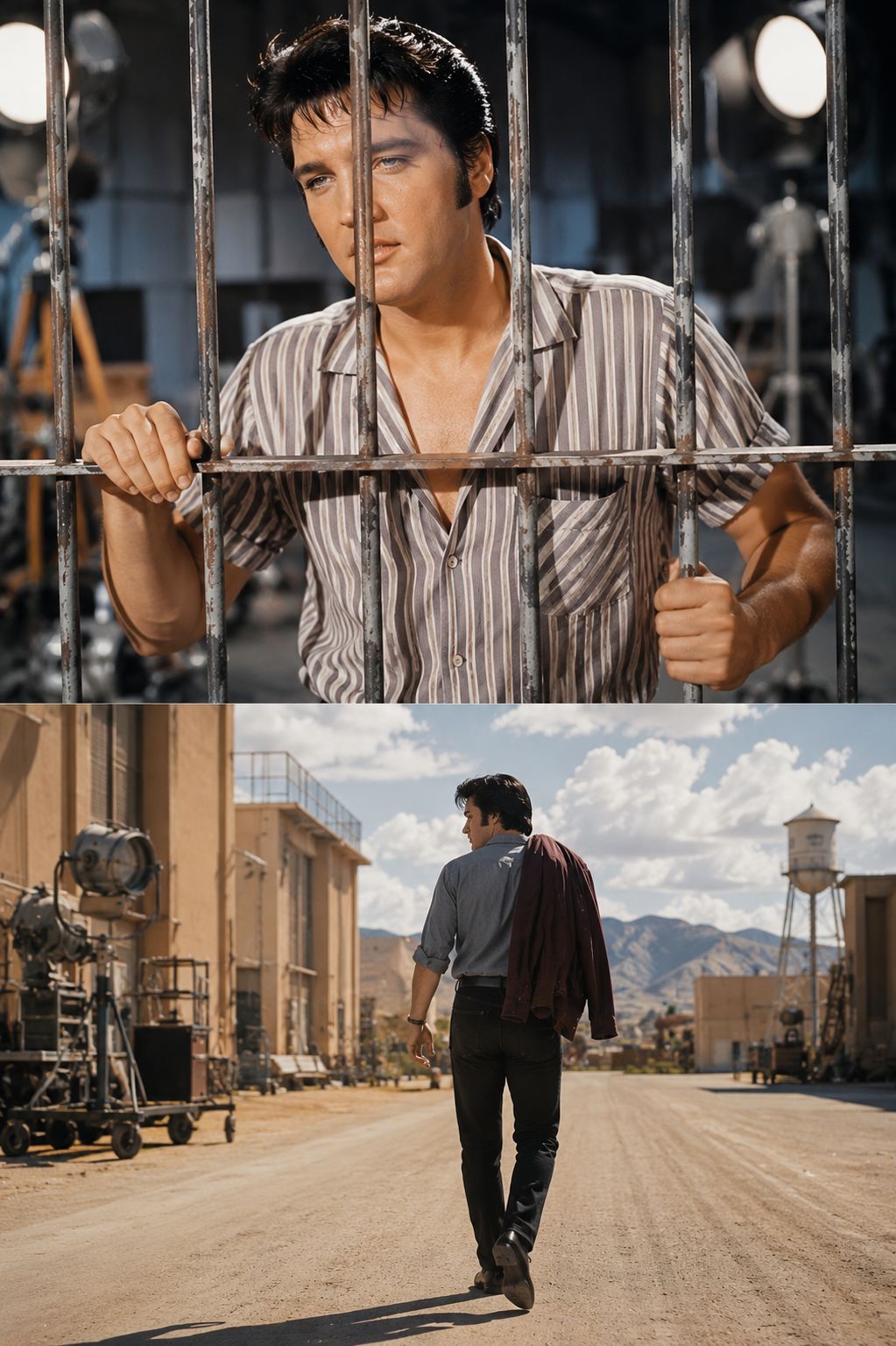
There are few artists in American history whose image became larger than their own ambitions. For Elvis Presley, the title of “The King” brought worldwide fame, unimaginable wealth, and a place in popular culture that remains unmatched decades after his death. Yet hidden behind the glittering movie premieres, screaming fans, and box-office success was a quieter, more painful story—a story of an artist trapped inside a golden cage built by Hollywood itself.
Ironically, the man who revolutionized music spent much of the 1960s fighting to escape a machine that wanted him to stop being an artist and become a product.
This is the story of the creative prison Elvis Presley desperately tried to break out of.
The Rebel Who Changed Music
When Elvis burst onto the national scene in the mid-1950s, he wasn’t simply another singer. He was a cultural earthquake.
His recordings blended gospel, blues, country, and rhythm & blues into something entirely new. His performances felt dangerous. His voice carried both vulnerability and power. Most importantly, he seemed unpredictable.
Fans never knew exactly what Elvis might do next.
That unpredictability was the source of his magic.
Then Hollywood arrived.
Movie producers saw something beyond the musician. They saw a handsome young star capable of generating millions at the box office. Soon, film offers flooded in.
At first, Elvis welcomed the opportunity.
Movies represented a chance to grow, to explore new artistic territory, and perhaps even become a serious actor.
He admired legends like Marlon Brando and James Dean. He dreamed of making films that challenged audiences and proved he possessed depth beyond his stage persona.
For a brief moment, it seemed possible.
The Promise of Something Greater
Elvis’s early dramatic performances hinted at genuine potential.
Films like King Creole revealed a performer capable of emotional complexity. Critics who expected little from a rock-and-roll singer were surprised.
Some even believed Elvis could eventually become a respected dramatic actor.
The young star himself shared that belief.
According to friends and associates, Elvis frequently spoke about wanting more demanding roles.
He wasn’t interested in spending his career singing lightweight songs on tropical beaches.
He wanted characters.
He wanted stories.
He wanted artistic respect.
But there was one problem.
The people managing his career had different priorities.
Colonel Parker’s Formula
At the center of the story stood Elvis’s longtime manager, Colonel Tom Parker.
To Parker, movies were not primarily artistic ventures.
They were business opportunities.
The formula was simple:
- Cast Elvis as a charming leading man.
- Add a few catchy songs.
- Include romance and comedy.
- Release soundtrack albums.
- Collect profits.
The formula worked.
Again.
And again.
And again.
Soon, Elvis found himself starring in a seemingly endless assembly line of films.
The titles changed.
The locations changed.
The female co-stars changed.
But the formula remained the same.
Each movie became another link in a chain that slowly tightened around his creativity.
“They wanted Elvis Presley the brand. Elvis Presley the artist was becoming an inconvenience.”
As the decade progressed, audiences began noticing the repetition.
So did Elvis.
The Growing Frustration
Behind the scenes, frustration grew.
Friends later recalled Elvis joking about some of the scripts he received.
The jokes masked genuine disappointment.
He knew he was capable of more.
Imagine revolutionizing popular music before the age of twenty-five and then spending years performing songs about beaches, race cars, and vacations while acting in increasingly predictable stories.
For an artist driven by passion, the experience became exhausting.
Many insiders described Elvis arriving on movie sets already aware that the project offered little creative challenge.
He would complete the work professionally.
He would charm the cast and crew.
He would deliver what was expected.
But something inside him was fading.
The excitement that once fueled his artistry began to disappear.
“Success became a prison because it rewarded the very thing he no longer wanted to do.”
The cage wasn’t built from failure.
It was built from success.
That made it much harder to escape.
The Cost of Playing It Safe
Hollywood loved certainty.
Elvis’s movies generated predictable profits.
Why risk experimenting when the existing formula kept working?
Studio executives saw numbers.
Fans saw entertainment.
But Elvis saw lost opportunities.
Every lightweight musical represented another dramatic role he wasn’t playing.
Every repetitive soundtrack represented another meaningful recording session that never happened.
Every year spent following the formula felt like a year drifting away from the artist he wanted to become.
Meanwhile, the music world was changing.
The 1960s introduced a new generation of musicians pushing creative boundaries.
Rock music evolved rapidly.
Artists experimented with lyrics, production, and personal expression.
Many observers began asking an uncomfortable question:
Had Elvis fallen behind?
The answer wasn’t simple.
His talent hadn’t disappeared.
His ambition hadn’t vanished.
But the system surrounding him had become resistant to change.
The Breaking Point
By the late 1960s, Elvis reached a crossroads.
He could continue making the same movies indefinitely.
The money would keep flowing.
The studios would remain happy.
The machine would continue operating.
Or he could fight for something more.
The turning point arrived in 1968.
After years trapped in Hollywood’s predictable cycle, Elvis agreed to participate in a television special.
What happened next changed everything.
The program would eventually become known as the ’68 Comeback Special.
Instead of presenting a polished movie-star image, Elvis returned to what made him famous in the first place.
Music.
Raw emotion.
Authentic performance.
The special stripped away the artificial layers accumulated throughout the decade.
For the first time in years, audiences saw the hungry artist underneath the Hollywood packaging.
And the result was electric.
“It wasn’t a comeback. It was an escape.”
Viewers witnessed a performer who looked energized, inspired, and liberated.
The difference was impossible to ignore.
The special reminded the world—and perhaps Elvis himself—what had been missing.
Breaking the Bars
The success of the Comeback Special gave Elvis confidence.
He began moving away from the formula that had defined much of his Hollywood career.
Soon, he returned to live performance.
The stage reignited something powerful inside him.
Night after night, audiences witnessed a performer reconnecting with his artistic identity.
No script.
No manufactured movie plot.
No artificial character.
Just Elvis.
The freedom transformed him.
His recordings gained emotional depth.
His performances carried renewed intensity.
Many fans and historians consider this period among the strongest of his career.
It was proof that the creative spirit Hollywood had attempted to contain was still alive.
The Legacy of the Cage
Today, when people look back at Elvis Presley’s career, they often focus on the records sold, the concerts performed, or the cultural impact he created.
But one of the most fascinating chapters remains his struggle against artistic confinement.
The Hollywood years serve as a reminder that success can sometimes become its own obstacle.
The world saw a superstar living a dream.
Elvis often saw an artist fighting for creative freedom.
That tension shaped much of his life.
It also makes his story deeply human.
Because who hasn’t felt trapped by expectations?
Who hasn’t feared becoming known for one thing while longing to pursue another?
Elvis’s battle wasn’t merely against movie studios or management decisions.
It was a battle for self-expression.
A battle to remain an artist in a system that preferred a product.
And although the cage held him longer than he wanted, it never completely defeated him.
The roar of the 1968 Comeback Special proved that.
The triumphant return to live performance proved that.
History itself proved that.
In the end, Hollywood may have built the cage.
But Elvis Presley never stopped rattling the bars.
Video