Introduction
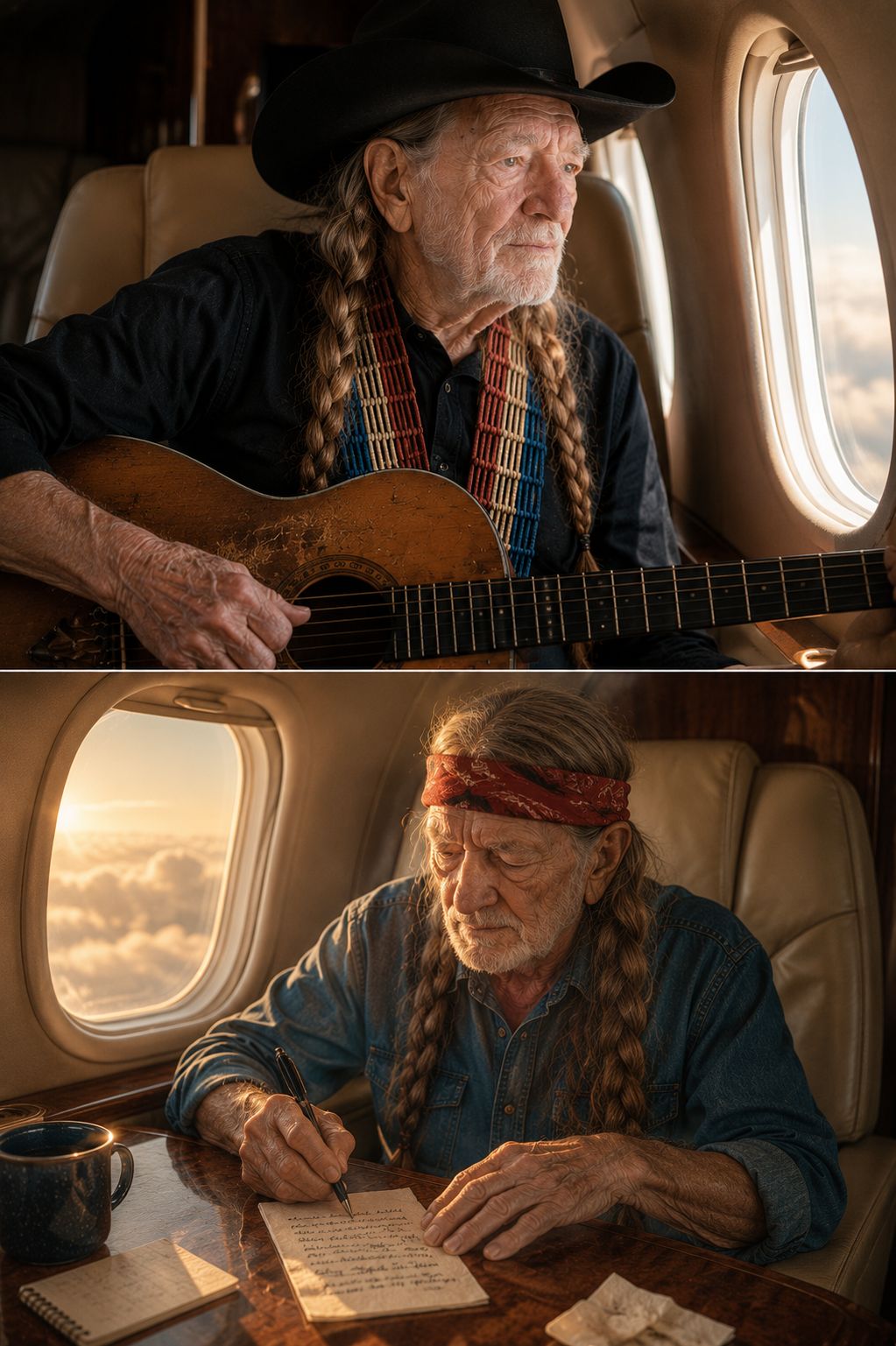
The story sounds almost too perfect to be true: a weary songwriter, thousands of feet above the American heartland, scribbling lyrics on an airplane barf bag. Yet that unlikely scene has become one of the most beloved legends in country music history—the creation of Willie Nelson’s enduring anthem, “On the Road Again.”
What makes the tale remarkable isn’t just where the song was written. It’s what the song came to represent: freedom, friendship, wanderlust, and the restless spirit of America itself. Decades after its release, the anthem remains inseparable from the image of a tour bus rolling down a lonely highway while Willie Nelson smiles beneath his trademark braids.
The Flight That Changed Country Music
By 1980, Willie Nelson was already a towering figure in country music. He had survived the Nashville machine, reinvented himself as an outlaw artist, and built a fiercely loyal fan base.
But even legends receive unusual assignments.
Willie had been approached to contribute a song for the film Honeysuckle Rose, a drama centered around the life of a traveling musician. The film’s producers wanted a theme song that captured the essence of life on tour.
There was only one problem.
They needed it quickly.
According to the story Willie later shared, the request came while he was traveling by plane. The producers wanted something that embodied the joy and excitement of constantly moving from city to city. Willie listened, nodded, and began thinking.
Then inspiration struck.
Looking around for something to write on, he reportedly grabbed an airsickness bag from the seat pocket.
On that humble piece of paper, one of the most recognizable songs in American music history began to take shape.
“On the road again…
Just can’t wait to get on the road again…”
Simple.
Direct.
Timeless.
The words felt less like lyrics and more like a personal confession.
Because for Willie Nelson, they were.
A Song Born From Real Life
The genius of “On the Road Again” lies in its authenticity.
Many songwriters spend months crafting elaborate metaphors. Willie often preferred something different. He wrote what he knew.
And few people knew life on the road better.
For years, Willie had lived out of buses, hotel rooms, backstage dressing rooms, and roadside diners. His career wasn’t built in glamorous boardrooms. It was built mile by mile across America.
Every lyric reflected that reality.
“The life I love is making music with my friends.”
That line may be one of the most honest sentences ever written in country music.
No complicated poetry.
No hidden meaning.
Just the truth.
The road wasn’t merely part of Willie’s career.
The road was his home.
Why America Fell in Love With It
When “On the Road Again” was released, audiences immediately connected with it.
The song arrived during a period when America was wrestling with economic uncertainty, cultural change, and shifting identities. Yet here was a tune that celebrated something deeply familiar:
Movement.
Adventure.
Possibility.
Whether listeners were truck drivers crossing state lines, traveling salespeople chasing opportunities, military families relocating, or musicians heading to their next gig, the song felt like it belonged to them.
The melody was cheerful without being naive.
The lyrics were optimistic without being sentimental.
Most importantly, the song made everyday travel feel heroic.
Suddenly, the endless miles between destinations became part of a larger story.
A uniquely American story.
The Sound of Freedom
Many songs have attempted to define America.
Few have succeeded as naturally as “On the Road Again.”
Unlike patriotic anthems filled with grand declarations, Willie’s song approached the nation from a different angle.
It celebrated freedom through motion.
The freedom to leave.
The freedom to explore.
The freedom to chase dreams beyond the horizon.
That idea has always been deeply woven into the American identity.
From pioneers heading west to musicians touring the interstate system, movement has long symbolized opportunity.
Willie’s song distilled that spirit into just a few verses.
That simplicity became its power.
Freedom wasn’t described.
It was experienced.
Every guitar strum felt like tires rolling across asphalt.
Every chorus sounded like another state line disappearing in the rearview mirror.
The Unexpected Hit
Even Willie couldn’t have fully predicted what would happen next.
“On the Road Again” became a massive commercial success.
The song climbed the charts, crossed genre boundaries, and introduced Willie Nelson to even larger audiences.
It earned major award recognition and became one of the defining recordings of his career.
For many artists, a signature song can become a burden.
For Willie, it became a badge of honor.
Night after night, decade after decade, audiences demanded to hear it.
And Willie kept delivering.
Not because the song was expected.
But because it still reflected who he was.
The Irony of the Barf Bag
Part of what keeps this story alive is the delicious irony behind it.
Songwriting is often portrayed as a mystical process requiring solitude, expensive studios, or carefully curated creative environments.
Yet one of America’s most enduring songs emerged from one of the least glamorous places imaginable.
An airplane seat.
An airsickness bag.
A deadline.
No elaborate setup.
No perfectionism.
No waiting for inspiration to arrive.
Willie simply captured the idea the moment it appeared.
For aspiring songwriters, that lesson may be even more valuable than the song itself.
Great art often comes from being ready when inspiration strikes.
Not from waiting for ideal conditions.
A Legacy Beyond Country Music
Today, “On the Road Again” belongs to far more than country music.
The song has become part of American culture itself.
It appears in films, television shows, sporting events, travel montages, and road-trip playlists. Generations who may know little about country music still recognize those opening words instantly.
That’s the mark of a true anthem.
It transcends its genre.
It transcends its era.
It becomes part of the national soundtrack.
Few country songs have achieved that status.
Even fewer were written in such improbable circumstances.
The Perfect Willie Nelson Story
There are many reasons the barf-bag legend continues to endure.
Partly because it’s funny.
Partly because it’s surprising.
But mostly because it perfectly captures Willie Nelson’s character.
Throughout his career, Willie has never seemed interested in following conventional rules. He built his own path, trusted his instincts, and remained authentic even when the industry pushed him in other directions.
Writing a legendary anthem on an airplane airsickness bag feels exactly like something Willie Nelson would do.
No drama.
No self-importance.
Just a songwriter doing what songwriters do.
Finding a melody.
Finding a truth.
Writing it down before it disappears.
Somewhere above the clouds, a simple idea landed on a paper bag.
A few minutes later, it became a song.
A few years later, it became an anthem.
Decades later, it remains one of the most recognizable celebrations of freedom ever recorded.
And perhaps that’s the most Willie Nelson ending imaginable.
A masterpiece born not in a mansion, not in a studio, not in a boardroom—but in the seat pocket of an airplane, carried by a man who spent his life proving that the road itself could be home.
Video