Introduction
There are country music legends, and then there is Willie Nelson.
Some artists sang about America. Some artists documented it. Willie Nelson somehow became it.
For more than six decades, he has wandered through the American imagination like a dusty traveler moving down an endless highway. His songs have rolled through truck stops, honky-tonks, desert roads, city streets, and lonely farmhouses. Yet what made Willie different wasn’t merely his voice, his songwriting genius, or his iconic braided hair.
It was rhythm.
Not the polished rhythm of Nashville’s assembly line. Not the slick pulse of commercial radio.
It was something looser.
Something freer.
Something that sounded exactly like America on the move.
And nowhere was that more apparent than in the infectious highway rhythm Willie Nelson used to capture an entire nomad nation.
A Beat That Refused to Stay in One Place
By the time Willie Nelson emerged as a major recording artist in the 1970s, country music had become increasingly polished.
The Nashville Sound was dominating the airwaves. Producers favored orchestras, backing vocalists, and carefully arranged recordings. Songs were often beautiful—but predictable.
Willie wanted movement.
He wanted space.
He wanted songs that breathed like open roads.
When listeners first heard records such as On the Road Again, they weren’t just hearing a catchy melody. They were hearing motion itself.
The guitar strummed with a rolling momentum.
The rhythm section pushed forward like tires humming across asphalt.
Willie’s phrasing danced behind and ahead of the beat simultaneously, creating a sensation that felt almost impossible to describe.
You weren’t listening to travel.
You were traveling.
“On the road again, just can’t wait to get on the road again…”
Those words became more than lyrics.
They became a national mantra.
The Secret Hidden Inside His Timing
Most singers lock themselves neatly into a rhythm.
Willie Nelson never seemed interested in doing that.
His musical timing often baffled musicians who tried to imitate him.
He would stretch a line unexpectedly.
Pause where no pause should exist.
Rush a phrase.
Then settle back into the groove as if nothing unusual had happened.
The result was magical.
His songs felt human rather than mechanical.
Like conversations taking place through a windshield.
Like thoughts arriving during a long drive somewhere between Texas and nowhere.
Jazz musicians understood what Willie was doing long before many country critics did.
He wasn’t simply singing songs.
He was improvising around them.
Every performance felt like a journey with unexpected turns.
Just like life itself.
The Soundtrack of America’s Wanderers
The timing of Willie’s rise couldn’t have been more perfect.
America was changing.
The postwar dream of permanence was beginning to crack.
People were moving more frequently.
Jobs shifted.
Families relocated.
Truckers crisscrossed the country.
Young people chased opportunities hundreds of miles from home.
Millions increasingly viewed life as movement rather than destination.
Willie Nelson understood this before marketers, politicians, or cultural commentators did.
His songs gave those restless Americans an anthem.
Not because he told them where they belonged.
But because he told them it was okay not to belong anywhere.
That message was revolutionary.
Country music traditionally celebrated roots.
Willie celebrated roads.
The Birth of an American Folk Hero
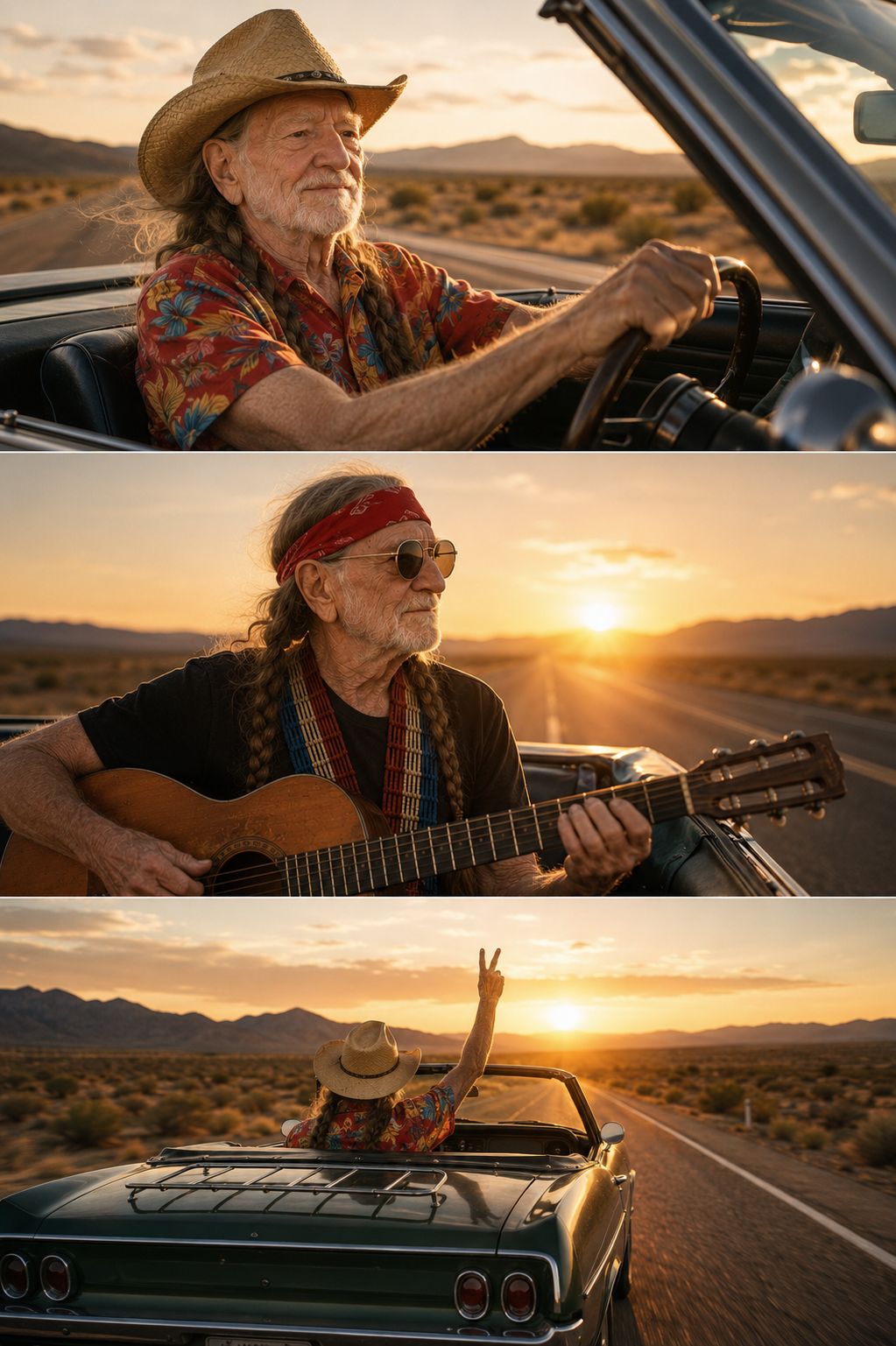
The image mattered too.
Willie never looked like a polished Nashville star.
His appearance communicated freedom.
The bandana.
The braids.
The weathered face.
The casual clothing.
He looked less like a celebrity and more like the guy parked next to you at a gas station somewhere in New Mexico.
That authenticity amplified the power of his music.
Audiences believed him.
When Willie sang about traveling, they knew he wasn’t pretending.
He had spent decades sleeping in buses, driving endless miles, and living life outside conventional expectations.
His songs carried mileage.
And listeners could hear it.
“Willie didn’t sing about the highway from a distance. He sounded like he had just stepped off it.”
That distinction made all the difference.
Trigger: The Guitar That Kept Rolling
No discussion of Willie’s highway rhythm is complete without mentioning Trigger.
His beloved acoustic guitar became one of the most recognizable instruments in American music history.
Trigger didn’t sound pristine.
It sounded lived-in.
Scarred.
Weathered.
Alive.
Each strum produced a rhythmic bounce that became central to Willie’s musical identity.
While many country artists relied heavily on studio arrangements, Willie often built songs around the conversational interaction between his voice and Trigger.
Together they created motion.
The guitar pushed.
The voice floated.
The listener followed.
Like watching lane markers disappear beneath headlights at midnight.
Why “On the Road Again” Became Immortal
Few songs have captured a cultural feeling as completely as On the Road Again.
The track’s brilliance lies in its simplicity.
There is no complicated philosophy.
No grand political statement.
No elaborate storytelling.
Instead, Willie distilled a universal emotion into a few unforgettable minutes.
The joy of movement.
The excitement of possibility.
The belief that something wonderful might exist around the next bend.
That emotional formula proved timeless.
Truck drivers embraced it.
Touring musicians embraced it.
Vacationing families embraced it.
Dreamers embraced it.
Even people who hated travel somehow found themselves smiling when it played.
Because beneath its literal meaning lies a deeper truth.
The song isn’t really about roads.
It’s about freedom.
Capturing a Nomad Nation
Long before remote work, digital nomads, van life influencers, and location-independent careers became trendy concepts, Willie Nelson was singing directly to people who felt untethered.
His audience wasn’t defined by geography.
It was defined by spirit.
These were individuals who carried home inside themselves.
People comfortable with uncertainty.
People who believed movement could be meaningful.
The remarkable thing is that Willie never judged this lifestyle.
He celebrated it.
His music suggested that wandering wasn’t a flaw.
It was a form of wisdom.
A way of understanding the world.
For countless Americans, that message arrived exactly when they needed it.
The Emotional Power Beneath the Groove
The greatest misconception about Willie Nelson is that his music is carefree.
Listen carefully and another emotion emerges.
Loneliness.
Distance.
Yearning.
The highway rhythm that made listeners feel free also carried traces of sadness.
Every mile traveled means something left behind.
Every new destination means an old destination fading into memory.
Willie understood this paradox better than almost anyone.
His songs often balanced joy and melancholy simultaneously.
The road offered adventure.
But it also demanded sacrifice.
That emotional complexity gave his music extraordinary depth.
People weren’t simply dancing to the rhythm.
They were recognizing themselves inside it.
The Legacy That Still Rolls Forward
Today, generations who weren’t even born when Willie Nelson first became famous still connect with his music.
The reason is simple.
The world continues moving.
People still chase dreams.
Still leave home.
Still search for meaning.
Still wonder what exists beyond the horizon.
And Willie Nelson’s highway rhythm continues providing the soundtrack.
His music reminds us that life is not a straight line.
It’s a winding road.
Sometimes joyful.
Sometimes heartbreaking.
Always moving.
That infectious rhythm—the one embedded inside On the Road Again and countless other classics—became far more than a musical style.
It became a cultural heartbeat.
A rolling pulse that connected truckers, farmers, musicians, dreamers, rebels, and ordinary people from coast to coast.
In the end, Willie Nelson didn’t merely write songs about the American road.
He transformed the road into music.
And in doing so, he captured something larger than a generation.
He captured a nation of wanderers forever searching for the next horizon, listening to the hum of tires, feeling the wind through open windows, and hearing Willie Nelson somewhere in the distance, still singing them forward.
Video