Int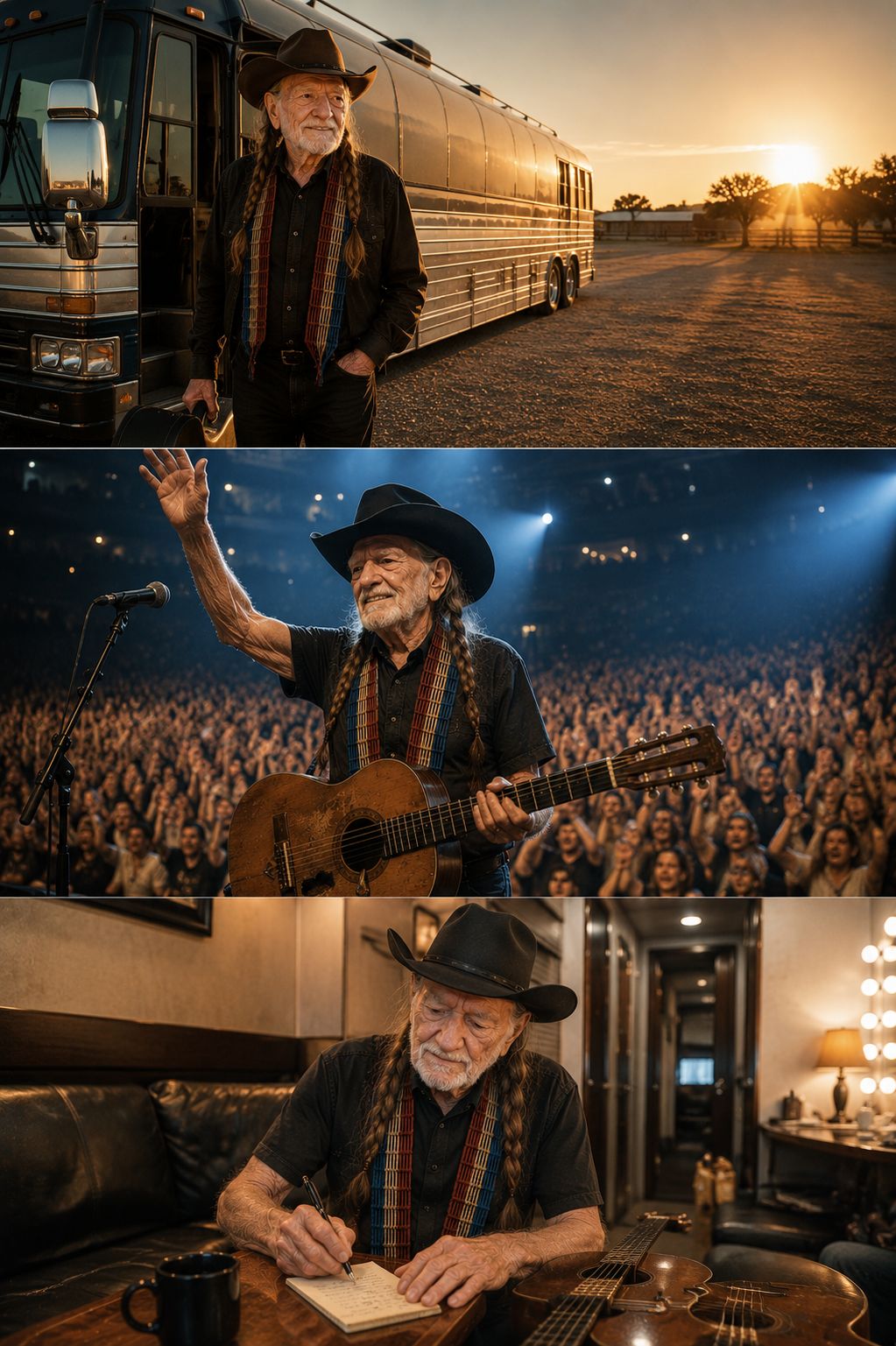 roduction
For most people, life on the road sounds glamorous for about three days.
Then reality arrives.
The endless highways. The cramped buses. The sleepless nights. The lonely hotel rooms. The thousands of miles that blur together until every city begins to look the same.
Yet somehow, for decades, one man transformed that exhausting existence into something extraordinary. While other artists dreamed of escaping the road, Willie Nelson embraced it. He didn’t merely survive touring—he made it his home.
The story of Willie Nelson’s lifelong relationship with the road is one of the most fascinating chapters in country music history. It is a tale of sacrifice, freedom, endurance, and a restless spirit that could never be confined by four walls.
The Man Who Was Never Meant to Stand Still
Long before he became a country music icon, Willie Nelson was already moving.
Born in the small town of Abbott, Texas, he learned early that life rarely followed a straight path. He worked odd jobs, served in the military, struggled as a songwriter, and bounced between opportunities that seemed to disappear as quickly as they appeared.
Even after writing massive hits for other artists, stability remained elusive.
What many people don’t realize is that success didn’t suddenly calm Willie’s wandering spirit.
If anything, fame made it stronger.
While other stars saw touring as a necessary evil to promote records, Willie viewed it differently. The stage wasn’t a workplace.
It was where he felt most alive.
“Some people go home to rest. Willie went on stage to feel at home.”
As his career exploded throughout the 1970s, he could have slowed down. He could have built a comfortable routine around recording studios, luxury homes, and industry events.
Instead, he chose motion.
Constant motion.
Thousands of Nights Under Stage Lights
Few artists in any genre have maintained the relentless touring pace Willie Nelson sustained over the decades.
Year after year, he piled up performances at a rate that would exhaust musicians half his age.
The numbers became almost mythical.
Hundreds of shows.
Thousands of stages.
Millions of miles.
Entire generations watched Willie appear in their hometowns over and over again, often wondering how he was still doing it.
The answer wasn’t physical endurance alone.
It was emotional necessity.
For Willie, touring wasn’t simply part of the job description.
It was the job.
Many musicians build their careers around albums and use concerts to support them.
Willie often seemed to operate in reverse.
The road was the center of his universe.
Everything else revolved around it.
The Bus Became More Than Transportation
One of the enduring images of Willie Nelson is his legendary tour bus.
To outsiders, a bus is simply a vehicle.
To Willie, it became something much deeper.
It became a living room.
A workplace.
A sanctuary.
A home.
Over the years, countless friends, musicians, family members, and fellow travelers stepped aboard those rolling homes. Stories were shared. Songs were written. Friendships were forged somewhere between one city and the next.
The road itself became a permanent address.
Imagine spending decades waking up in different states every morning.
Imagine watching America pass by your window one mile at a time.
Most people would find it exhausting.
Willie found comfort in it.
“Home wasn’t a destination. Home was wherever the wheels stopped for the night.”
That mindset separated him from many of his contemporaries.
While others counted the days until they could return home, Willie often seemed happiest when heading toward the next show.
Escaping the Traps of Stardom
Success can become its own prison.
Many artists eventually find themselves trapped inside the machinery of fame. Meetings replace music. Business obligations replace creativity.
Willie Nelson discovered a way around that trap.
Touring kept him connected to the reason he started making music in the first place.
The audience.
Every night brought new faces.
New stories.
New energy.
A sold-out arena in one city might be followed by a smaller venue somewhere else. It didn’t matter.
The connection remained real.
The stage stripped away the artificial layers of celebrity.
Standing before thousands of fans with only a guitar and a song leaves little room for pretense.
That authenticity became one of Willie’s defining traits.
People didn’t feel like they were watching a distant superstar.
They felt like they were spending an evening with an old friend.
The Cost Few People Saw
Of course, there was a price.
There always is.
The romantic image of endless touring often hides the sacrifices underneath.
Birthdays missed.
Family moments postponed.
Relationships tested by distance.
Physical exhaustion that accumulates year after year.
Even the strongest performers eventually feel the weight of those miles.
Willie certainly did.
Yet he repeatedly chose the road anyway.
Not because it was easy.
Because it mattered.
Because every concert represented an opportunity to connect with people whose lives had been shaped by his music.
Fans weren’t simply ticket buyers.
They were companions on the journey.
Many attended multiple Willie Nelson concerts across decades, growing older alongside the man on stage.
That relationship created something unique.
The audience wasn’t watching a performer age.
They were aging with him.
Why Fans Kept Coming Back
Part of Willie Nelson’s enduring appeal comes from the feeling that every performance matters.
Even after thousands of shows, he rarely approached a concert like an obligation.
Fans sensed that.
There was always an authenticity that couldn’t be manufactured.
His voice changed over the years.
His appearance evolved.
The music industry transformed around him.
But the spirit remained remarkably consistent.
The same Texas troubadour who once chased songwriting dreams across the country still stood beneath the lights, guitar in hand, searching for another meaningful night of music.
“The road didn’t wear Willie Nelson down. It revealed who he truly was.”
That distinction is important.
Many artists survive touring.
Willie Nelson was shaped by it.
The Road as a Philosophy
Perhaps the deepest lesson from Willie’s touring life has little to do with music.
The road became a philosophy.
Movement represented freedom.
The next town represented possibility.
The next audience represented connection.
In a world obsessed with permanence, Willie embraced impermanence.
Every concert ends.
Every city fades into the distance.
Every highway eventually disappears behind you.
Yet there is beauty in that constant motion.
The journey itself becomes the destination.
That idea resonates deeply with fans because it mirrors life.
None of us stay in one place forever.
We’re all moving through seasons, experiences, relationships, and memories.
Willie simply lived that truth more visibly than most.
The Legacy of a Man Who Never Stopped Traveling
Today, when people discuss Willie Nelson’s legacy, they often focus on the obvious achievements.
The hit records.
The songwriting.
The awards.
The cultural impact.
All of those accomplishments deserve celebration.
But another achievement may be equally remarkable.
He transformed one of the most exhausting lifestyles imaginable into a source of joy.
He found peace inside perpetual motion.
He found belonging on endless highways.
He found family among audiences scattered across America.
And perhaps most importantly, he proved that home isn’t always a house.
Sometimes home is a guitar resting on your lap.
Sometimes it’s a trusted bus rolling through the darkness.
Sometimes it’s the roar of a crowd waiting for the first note.
For Willie Nelson, home was never tied to a single place on a map.
It was found in the miles between destinations.
And for decade after decade, while the rest of the world searched for somewhere to settle down, Willie Nelson kept moving forward—turning every road into a driveway, every stage into a living room, and every audience into family.
That exhausting lifelong tour schedule could have broken him.
Instead, it became the place where he truly belonged.