Introduction
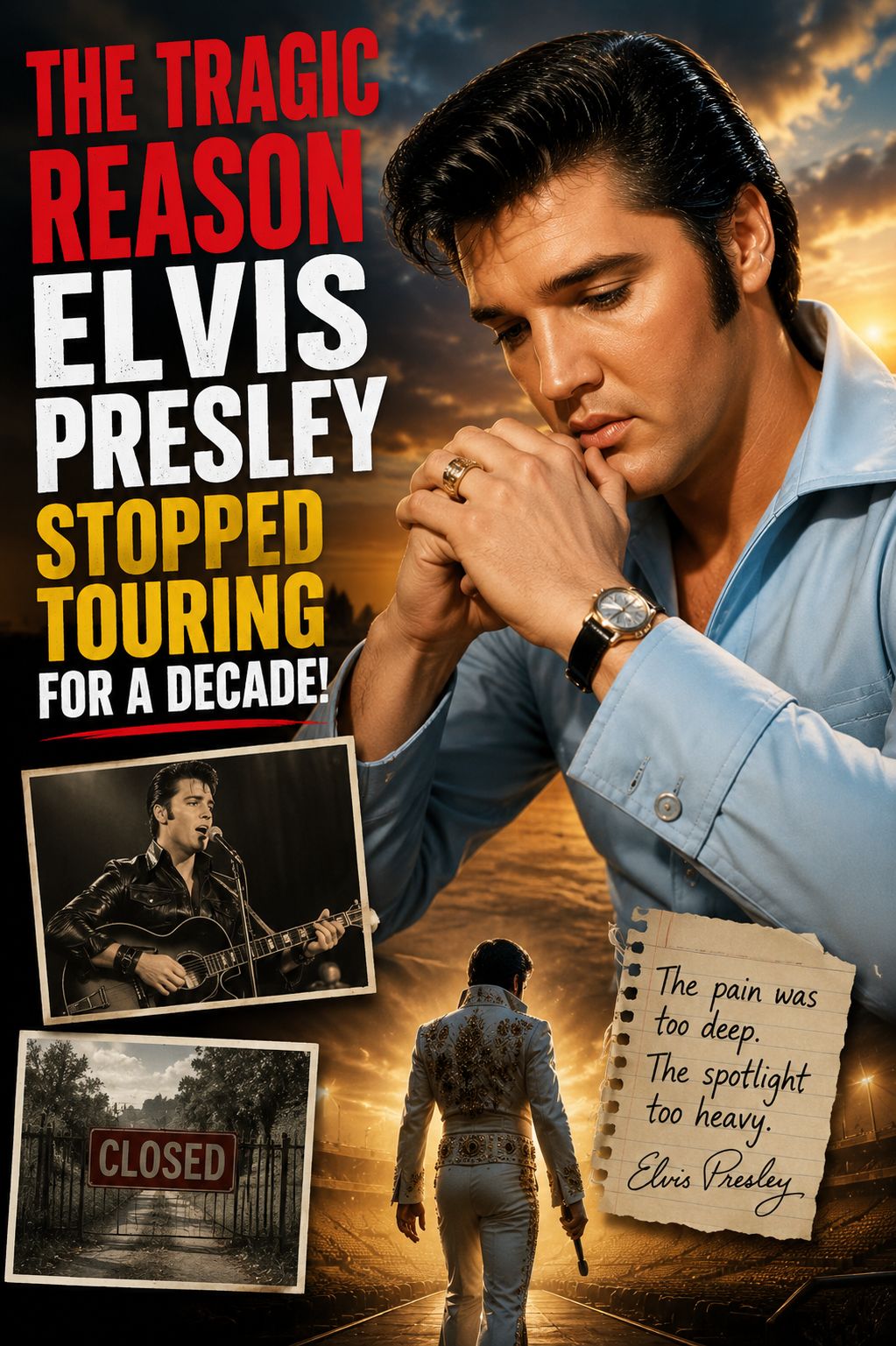
For many younger fans, it’s hard to imagine a world where Elvis Presley—the King of Rock and Roll—was not constantly performing before screaming crowds. Yet one of the most astonishing chapters in his career is that from 1958 to 1969, Elvis barely toured at all. While his records continued to dominate charts and his movies filled theaters, the man who had once electrified stages across America vanished from the concert circuit for more than a decade.
Why?
The answer is far more tragic than most people realize.
It wasn’t simply a career decision. It wasn’t laziness. And it certainly wasn’t because audiences stopped loving him.
The real story is a heartbreaking combination of fear, control, exhaustion, and a changing music industry that left even the world’s biggest star feeling trapped.
The Boy Who Couldn’t Escape His Own Success
In the mid-1950s, Elvis was the hottest performer on Earth.
Every appearance created chaos. Teenage girls screamed until they fainted. Police departments struggled to control crowds. Newspapers debated whether his dancing was corrupting America’s youth.
For a young man who had grown up poor in Mississippi and Tennessee, the rise was almost unimaginable.
But with unprecedented fame came unprecedented pressure.
By 1957, Elvis’s touring schedule had become relentless. He was performing constantly while facing criticism from politicians, religious leaders, and television executives.
Behind the scenes, the excitement was becoming emotionally exhausting.
The crowds loved him.
The establishment feared him.
And Elvis was caught in the middle.
“He was carrying the weight of an entire cultural revolution on his shoulders.”
At just twenty-two years old, he had become more than a singer.
He had become a symbol.
The Army Changed Everything
In 1958, Elvis was drafted into the U.S. Army.
Many fans assumed this would be a temporary interruption.
Instead, it became the turning point that altered the entire trajectory of his career.
Before entering the military, Elvis had been a touring phenomenon.
After leaving the Army, he would become something very different.
While stationed in Germany, Elvis experienced profound personal changes. Most devastatingly, his beloved mother, Gladys Presley, died shortly before his deployment.
The loss shattered him.
Friends and associates later described Elvis as never fully recovering from her death.
Gladys had been his emotional anchor, the one person he trusted completely.
Without her, Elvis became increasingly vulnerable to the influence of those around him.
And no one wielded more influence than his manager.
Colonel Parker’s Greatest Fear
The central figure in this story is Colonel Tom Parker.
Parker had guided Elvis from regional sensation to global superstar.
But he also had secrets.
One of the biggest was his immigration status.
The man known as Colonel Tom Parker was actually a Dutch immigrant whose legal situation was far more complicated than the public understood.
Because of this, Parker reportedly avoided international travel.
That fear would have enormous consequences.
As the 1960s unfolded, artists such as The Beatles and The Rolling Stones were conquering the world through massive international tours.
Elvis should have been leading that movement.
Instead, he remained largely confined to Hollywood.
Parker preferred movie contracts because they were predictable, profitable, and didn’t require extensive touring.
The result?
Elvis spent much of the decade making films rather than performing live.
At first, the arrangement seemed beneficial.
Then it slowly became a prison.
The Golden Cage of Hollywood
Between 1960 and 1969, Elvis starred in a remarkable number of movies.
Many were commercially successful.
But artistically, something was disappearing.
The raw energy that had once made him dangerous and exciting was being replaced by formula.
The films often followed the same pattern:
- A handsome hero.
- A sunny location.
- A romantic storyline.
- A collection of lightweight songs.
Fans bought tickets.
Studios made money.
But Elvis himself was growing frustrated.
Again and again, he recorded songs that lacked the emotional depth of his earlier work.
The rebellious young performer who had shaken America now felt increasingly disconnected from his own music.
“The King was becoming a product.”
Perhaps the greatest tragedy wasn’t that Elvis stopped touring.
It was that he stopped feeling creatively alive.
Watching the World Move Without Him
The 1960s transformed popular music.
Psychedelic rock emerged.
Singer-songwriters gained influence.
Albums became artistic statements.
The cultural landscape changed rapidly.
Meanwhile, Elvis was stuck making movies that often felt out of step with the times.
Imagine being the most influential rock-and-roll performer in history and watching younger artists redefine music while you’re trapped on a studio lot.
That’s exactly what happened.
Many observers believe Elvis felt increasingly isolated during this period.
He remained famous.
He remained wealthy.
But he was no longer at the center of the musical conversation.
For an artist who thrived on audience connection, the absence of live performance became emotionally significant.
Night after night, there were no crowds.
No stage.
No electricity.
No direct bond with fans.
Only movie sets and recording sessions.
The Emotional Cost
What made the situation particularly tragic was that Elvis genuinely loved performing.
Those who witnessed his early concerts often described a performer transformed by the stage.
Live audiences energized him.
Their reactions fueled him.
Without that connection, something vital was missing.
Friends noticed periods of boredom and restlessness.
He had achieved everything he had dreamed of.
Yet fulfillment remained elusive.
The irony was painful.
Millions wanted to see him perform.
He wanted to perform.
But the machinery surrounding his career kept steering him elsewhere.
“Sometimes the biggest prison isn’t built from walls. It’s built from success.”
By the late 1960s, Elvis had become trapped inside the very empire created around him.
The Explosive Comeback
Everything changed in 1968.
NBC offered Elvis a television special.
Initially, plans called for a safe, family-friendly Christmas program.
But Elvis had other ideas.
The result became one of the most legendary comebacks in entertainment history: the Elvis ’68 Comeback Special.
Dressed in black leather, seated just feet from fans, Elvis looked reborn.
The energy was raw.
The charisma was undeniable.
The hunger was back.
Audiences suddenly remembered why he had become a phenomenon in the first place.
The special revealed something powerful:
Elvis had never lost his talent.
He had simply been away from the stage too long.
The response was overwhelming.
The King had returned.
Returning to the Road
In 1969, Elvis finally resumed live performances, beginning a celebrated engagement at the International Hotel in Las Vegas.
The reaction bordered on hysteria.
Fans packed the venue.
Critics praised his renewed intensity.
Musicians were stunned by his vocal power.
After ten years away, Elvis sounded liberated.
Many of the performances from this era rank among the finest of his career.
There was joy in his voice again.
Purpose.
Urgency.
Life.
Yet the lost decade could never be recovered.
The years when Elvis might have toured the world, evolved alongside the changing music scene, and continued breaking boundaries were gone forever.
The Real Tragedy
The tragic reason Elvis Presley stopped touring for a decade wasn’t a single event.
It was a chain reaction.
The death of his mother.
The influence of Colonel Parker.
Hollywood’s lucrative movie machine.
Creative frustration.
Personal isolation.
Fear of risk.
Together, these forces kept one of history’s greatest live performers away from the stage during the prime years of his career.
And that may be the saddest part of all.
Because when Elvis finally returned to performing, he proved that the magic had never disappeared.
It had merely been waiting.
Waiting for the lights to come up.
Waiting for the audience to roar.
Waiting for the King to remember who he truly was.
“For ten long years, the world had Elvis Presley the movie star. But what it really wanted was Elvis Presley the performer.”
When he finally stepped back into the spotlight, history witnessed a truth that had been buried beneath a decade of compromise:
The King of Rock and Roll belonged on a stage.
And no amount of fame, money, or Hollywood success could ever replace that.
Video