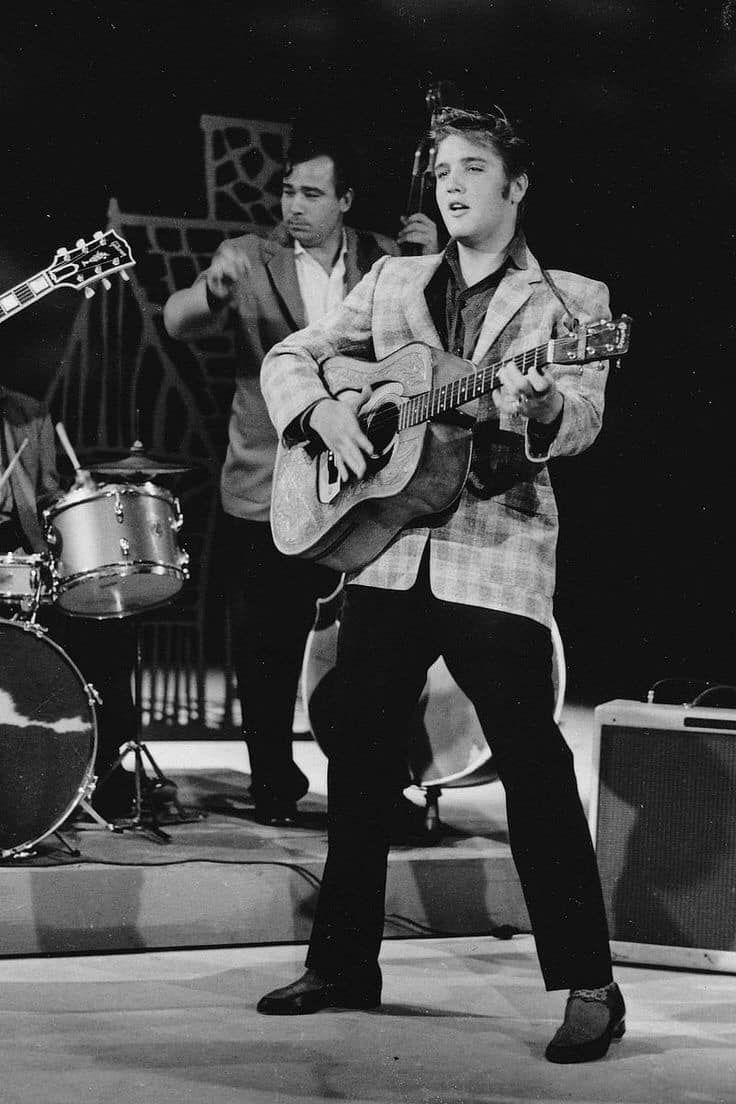
SEPTEMBER 9, 1956 — ELVIS PRESLEY WALKED ON STAGE… AND AMERICA WAS NEVER THE SAME AGAIN
There are performances that entertain.
There are performances that inspire.
And then there are performances that divide history into before and after.
September 9, 1956, belongs to that rare category.
When Elvis Presley walked onto the stage of The Ed Sullivan Show, he wasn’t simply another rising singer hoping for a hit record. He was the young man that parents feared, teenagers worshipped, critics mocked, and America simply couldn’t stop talking about.
No one watching that evening realized they were witnessing one of the most transformative moments in popular culture.
“The moment Elvis appeared, America wasn’t just watching television anymore—it was watching the future.”
Just months earlier, many television executives believed Presley was too controversial for family audiences. Newspapers criticized his stage movements. Religious leaders condemned his performances. Editorials warned that rock and roll represented moral decline.
Ironically, all the criticism only fueled the public’s curiosity.
By the time The Ed Sullivan Show finally welcomed him, anticipation had reached historic levels.
Then…
The curtain opened.
A shy smile.
A confident stride.
That unmistakable pompadour.
Within seconds, millions of living rooms became concert halls.
Elvis launched into “Don’t Be Cruel.”
Then came “Love Me Tender.”
His voice carried something unusual for the era—a blend of Southern gospel, country heartbreak, rhythm and blues, and youthful confidence. It wasn’t polished in the traditional sense. It felt alive.
Teenagers screamed.
Parents stared in disbelief.
Television had never looked—or sounded—quite like this.
“He didn’t ask America for permission to change music. He simply changed it.”
The power of that night wasn’t merely in the songs.
It was the emotion.
Elvis smiled like an ordinary young man from Mississippi who still couldn’t quite believe his own success. Yet when he sang, he possessed the stage with a magnetic confidence that seemed almost supernatural.
That contrast fascinated audiences.
He looked approachable.
But he performed like a revolution.
Across the country, families argued over what they had just seen.
Some insisted the performance represented the collapse of traditional values.
Others believed they had witnessed the birth of modern entertainment.
History would ultimately side with the second group.
The television ratings were astonishing.
Nearly every household with a television seemed to be watching.
For countless young musicians, that single broadcast became their origin story.
Some would later admit they picked up a guitar because of that evening.
Others decided they wanted to become singers.
Future legends—from rock icons to country stars—would point back to September 9, 1956, as the night everything suddenly felt possible.
The ripple effects stretched far beyond music.
Fashion changed.
Hairstyles changed.
Television programming changed.
Record companies rushed to find the next young performer capable of capturing even a fraction of Elvis’s electricity.
America itself was changing.
The postwar generation was discovering its own identity, and Elvis became its soundtrack.
What made the performance extraordinary wasn’t technical perfection.
Listen closely today and you’ll hear moments that feel wonderfully human.
A smile.
A glance.
An effortless laugh between songs.
He wasn’t performing from behind perfection.
He was performing from authenticity.
That authenticity became his greatest weapon.
Even those who disliked his music couldn’t ignore his charisma.
He commanded attention without demanding it.
And perhaps that’s why the performance continues to resonate nearly seventy years later.
Every generation discovers Elvis differently.
Some first hear “Heartbreak Hotel.”
Others fall in love with his gospel recordings.
Many discover his Las Vegas years.
But sooner or later, serious fans almost always return to September 9, 1956.
Because that’s where the phenomenon truly exploded into American homes.
That wasn’t merely a television appearance.
It was a cultural earthquake.
“Before that night, Elvis Presley was a rising star. After that night, he became an American legend.”
Today, it’s easy to underestimate the impact of a television broadcast in an age of streaming and social media.
But in 1956, families gathered around one screen.
Everyone watched together.
Everyone reacted together.
And together, they witnessed history.
Elvis didn’t just perform songs.
He challenged expectations.
He blurred musical boundaries between country, gospel, rhythm and blues, and pop.
He gave young people someone who sounded like them instead of their parents.
Most importantly, he proved that authenticity could be louder than convention.
Nearly seven decades later, that single evening still echoes through every arena, every recording studio, every aspiring musician who dreams of changing the world with one unforgettable performance.
September 9, 1956…
A young man walked onto a television stage.
He walked off as a legend.
And America was never the same again.