INTRODUCTION
Hollywood had almost forgotten him.
For years, the man who had once shaken America to its core had been buried beneath a mountain of predictable movie musicals, colorful costumes, and formulaic scripts. Critics whispered that he had become a relic. Younger audiences were discovering new heroes. Even loyal fans wondered whether the fire that had once defined Elvis Presley had finally faded.
But Elvis knew something they didn’t.
Somewhere beneath the polished Hollywood image was still the young man from Memphis who had terrified parents, electrified teenagers, and changed popular music forever.
And one day, standing inside a Hollywood soundstage preparing for what would become one of the most important performances of his career, he reportedly made his intentions unmistakably clear.
“I have to show them what rock ‘n’ roll really means.”
Those weren’t simply words.
They were a declaration of war against complacency.
They were the promise of a man determined to reclaim his identity.
By 1968, Elvis Presley was only thirty-three years old, yet many in the entertainment industry already treated him like yesterday’s headline.
His films still generated revenue, but the excitement was gone.
Meanwhile, rock music had evolved dramatically. The British Invasion had changed everything. Psychedelic music dominated the charts. Young artists were experimenting, taking risks, and redefining popular culture.
Many assumed Elvis no longer belonged in that conversation.
But they misunderstood something fundamental.
Rock ‘n’ roll wasn’t merely a genre.
It was an attitude.
And nobody had embodied that attitude more completely than Elvis Presley.
The television special being assembled inside NBC’s Hollywood studio wasn’t originally designed to be revolutionary.
Network executives envisioned a safe Christmas program.
A comfortable holiday showcase.
Nothing controversial.
Nothing dangerous.
Nothing unpredictable.
But Elvis had another idea.
Working closely with director Steve Binder, he pushed the production toward something far more authentic—something that reflected the artist he still believed himself to be.
Instead of hiding behind elaborate sets and scripted performances, Elvis wanted honesty.
He wanted sweat.
He wanted nerves.
He wanted music.
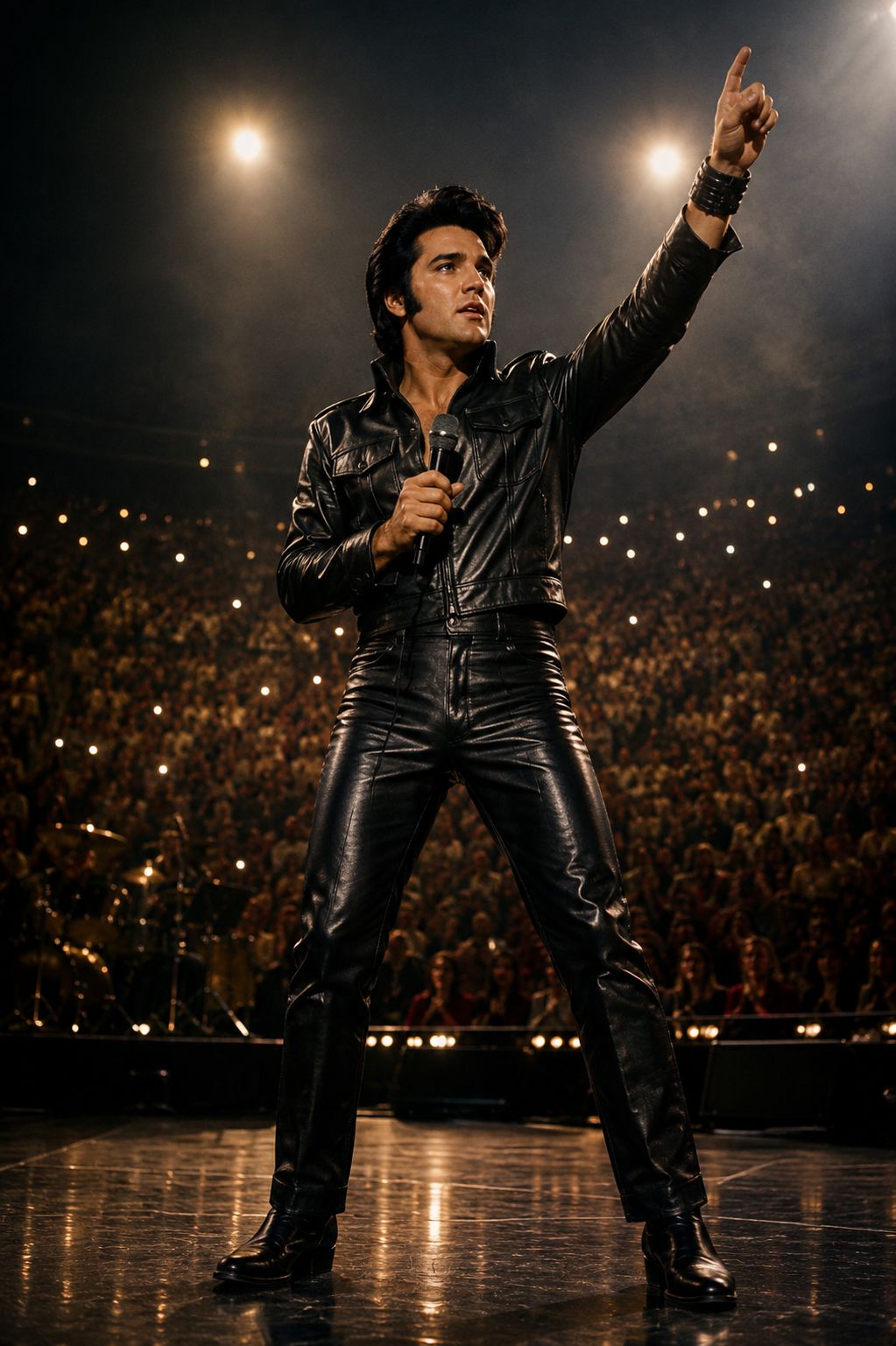
The famous black leather suit wasn’t chosen because it was fashionable.
It became armor.
Gone were the flashy movie costumes.
Gone were the theatrical disguises.
Standing beneath the lights, dressed almost entirely in black, Elvis looked less like a Hollywood actor and more like the hungry young performer who had once stunned audiences on Beale Street.
When the cameras rolled, something extraordinary happened.
The years seemed to disappear.
His voice carried urgency.
His movements became instinctive.
Every smile felt genuine.
Every note carried conviction.
The audience wasn’t watching an aging superstar trying to relive old glory.
They were witnessing a rebirth.
This wasn’t nostalgia.
This was resurrection.
Perhaps the most unforgettable moments came during the intimate “sit-down” sessions.
There were no massive orchestras.
No cinematic distractions.
Just Elvis.
His band.
His friends.
And the music that had changed history.
Laughter filled the room.
Improvised jokes blended with explosive performances.
Songs flowed naturally, almost like they were happening in someone’s living room rather than on a television set.
That authenticity became magnetic.
Fans could feel it through the screen.
For the first time in years, Elvis wasn’t playing a character.
He was simply being Elvis.
What made the performance unforgettable wasn’t technical perfection.
It was vulnerability.
Elvis had everything to lose.
If the special failed, critics would likely declare his career finished.
If audiences rejected him, there might never be another chance.
Instead, he walked directly into that uncertainty.
And transformed it into one of television’s defining musical moments.
Millions watching at home suddenly remembered exactly why this man had once frightened the establishment.
His charisma couldn’t be manufactured.
His voice couldn’t be copied.
His presence couldn’t be replaced.
Rock ‘n’ roll wasn’t just something Elvis performed.
It lived inside him.
The impact was immediate.
Viewers weren’t simply entertained.
They were astonished.
Music critics reversed their opinions.
Fans celebrated.
Record executives suddenly saw enormous possibilities.
The television special didn’t merely revive Elvis Presley’s career.
It reintroduced him to the world.
Within months, he returned to live concerts.
Soon afterward came his legendary Las Vegas performances, proving that his greatest years were far from over.
Everything changed because one man refused to accept the version of himself Hollywood had created.
Looking back today, that Hollywood soundstage represents far more than a successful television production.
It symbolizes artistic courage.
It reminds us that true legends aren’t defined by uninterrupted success.
They’re defined by what they do when the world doubts them.
Elvis didn’t answer criticism with interviews.
He answered with music.
He didn’t argue about his legacy.
He stepped onto a stage and reminded everyone why he had become “The King” in the first place.
Sometimes history changes with a speech.
Sometimes it changes with an election.
And sometimes… it changes because one man picks up a guitar, looks into a camera, and decides it’s time to show the world what rock ‘n’ roll really means.
That night wasn’t simply another television performance.
It was the moment Elvis Presley reclaimed his crown—not because someone handed it back to him, but because he earned it all over again.