Introduction
On the evening of January 14, 1973, something extraordinary happened.
It wasn’t just another concert.
It wasn’t simply another television special.
It wasn’t even just another Elvis Presley performance.
For one unforgettable night, the world seemed to stop and look toward Hawaii, where a single man in a dazzling white jumpsuit stood beneath the lights of the Honolulu International Center Arena and made entertainment history.
Before streaming.
Before YouTube.
Before social media could unite billions in real time.
There was Aloha from Hawaii.
And there was Elvis Presley.
“This is for all the people around the world.”
Those words carried a meaning few performers had ever attempted to embody.
The concert wasn’t only for America.
It wasn’t only for the thousands fortunate enough to sit inside the arena.
It was designed for an entire planet.
A Dream Too Big for Its Time
In the early 1970s, satellite broadcasting was still a technological marvel.
The idea that a live concert could be transmitted across continents sounded almost like science fiction.
Yet producer Marty Pasetta believed it could be done.
So did Elvis.
Instead of settling for another successful American television appearance, they envisioned something unprecedented—a live global broadcast reaching audiences across Asia, Europe, Australia, and beyond.
It would become the first entertainment concert transmitted live around the world via satellite on such a massive scale.
The risks were enormous.
Every camera.
Every microphone.
Every satellite connection.
Every musical cue.
Everything had to work perfectly.
There would be no second chance.
Why Hawaii Meant So Much
Elvis had always shared a special bond with Hawaii.
He loved the islands’ warmth, beauty, and welcoming spirit.
His films Blue Hawaii and Paradise, Hawaiian Style had strengthened that connection, while countless visits had made him feel almost like family to local audiences.
Choosing Honolulu wasn’t accidental.
It represented peace.
Hospitality.
A bridge between East and West.
There could hardly have been a better place to introduce a worldwide audience to a historic musical celebration.
And the title itself—Aloha from Hawaii—carried a universal message.
Not goodbye.
But love.
Compassion.
Connection.
“Aloha isn’t just a greeting. It’s a feeling.”
That feeling echoed throughout the arena.
The White Jumpsuit That Became a Symbol
Long before Elvis sang his first note, the audience erupted.
Then he appeared.
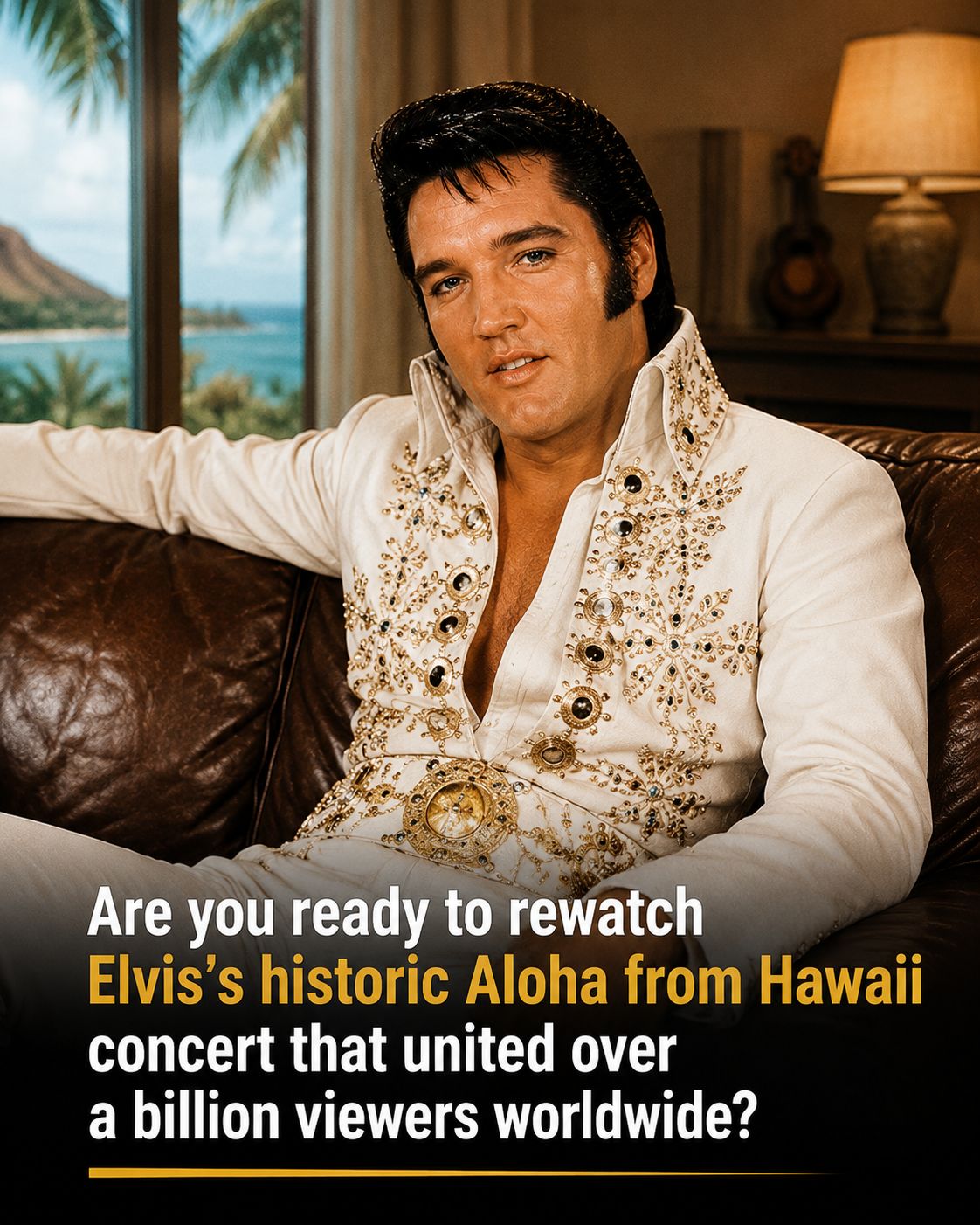
The iconic American Eagle jumpsuit shimmered beneath the lights.
Decorated with an eagle spreading its wings across his chest, the suit reflected confidence, patriotism, and grandeur.
Yet despite the dazzling costume, Elvis himself appeared calm.
Focused.
Determined.
He understood the magnitude of the evening.
This wasn’t about proving he could still fill arenas.
This wasn’t even about setting television records.
This was about representing American music before the largest audience any entertainer had ever attempted to reach.
A Voice That Traveled Across Oceans
The opening chords of “See See Rider” exploded through the arena.
Within seconds, millions around the globe were witnessing something remarkable.
Elvis wasn’t simply singing.
He was commanding the room.
Each performance blended rock, gospel, country, blues, and pop into one unmistakable voice.
His setlist became a journey through his career.
There were explosive rock numbers.
Tender ballads.
Soulful gospel moments.
Powerful emotional peaks.
Every song reminded viewers why Elvis had become known as “The King.”
Yet perhaps the most striking quality wasn’t his vocal power.
It was his generosity.
Throughout the concert, Elvis smiled warmly at the audience, thanked his musicians, acknowledged fans, and treated the event less like a spectacle and more like a shared celebration.
“Music is the universal language.”
That phrase is often repeated.
Few performances have ever demonstrated it as completely as Aloha from Hawaii.
Language barriers disappeared.
Cultures blended together.
For two extraordinary hours, millions experienced the same emotions simultaneously.
More Than Entertainment
The concert also carried a charitable purpose.
Elvis chose to dedicate proceeds from the event to the Kui Lee Cancer Fund, honoring the beloved Hawaiian songwriter who had died from cancer at a young age.
It was a gesture that reflected another side of Elvis rarely discussed.
Behind the fame and the headlines stood a man who quietly donated millions throughout his lifetime.
Hospitals.
Children.
Families in need.
Strangers he never met.
Acts of generosity became part of who he was.
The charitable element gave Aloha from Hawaii an even deeper emotional resonance.
The concert wasn’t simply making history.
It was helping others.
The Global Reaction
When broadcasts concluded across various countries, one truth became impossible to ignore.
People everywhere had witnessed something unlike anything before.
Families gathered around television sets.
Neighbors visited each other’s homes.
Communities celebrated together.
For many viewers outside the United States, this wasn’t merely their first live Elvis concert.
It was their introduction to an entirely new kind of global entertainment event.
Reports estimated that the worldwide audience reached hundreds of millions, with later publicity often describing the audience as approaching one billion viewers across live broadcasts and subsequent telecasts.
Whether discussing the immediate satellite audience or the broader cumulative reach, the symbolism remained the same:
The world had come together around music.
One performer.
One stage.
One satellite signal.
One unforgettable night.
Elvis at His Peak
Looking back today, many fans consider Aloha from Hawaii one of Elvis Presley’s finest filmed performances.
His voice possessed remarkable range.
His confidence had returned.
His interaction with the audience felt natural.
The orchestra, choir, and legendary TCB Band elevated every arrangement.
Songs such as “Burning Love,” “Steamroller Blues,” “You Gave Me a Mountain,” “An American Trilogy,” and “Can’t Help Falling in Love” became defining moments of the evening.
Perhaps no performance better captured the many dimensions of Elvis as an artist.
He could roar through rock and roll.
He could whisper heartbreaking vulnerability.
He could fill an arena with gospel-inspired spirituality.
Few performers have ever displayed such remarkable versatility in a single concert.
Why It Still Matters Today
Half a century later, Aloha from Hawaii remains astonishing.
Modern audiences are accustomed to livestreams reaching every corner of the globe.
In 1973, however, such a feat required extraordinary vision, immense technical coordination, and tremendous courage.
More importantly, the concert reminds us that technology alone never creates history.
People do.
Satellites transmitted the signal.
But Elvis created the emotion.
His charisma crossed oceans.
His voice crossed cultures.
His humanity crossed generations.
The performance continues to inspire musicians because it proved that authenticity travels farther than any broadcast technology ever could.
The Night the World Became One Audience
History often remembers numbers.
Record sales.
Television ratings.
Attendance figures.
Yet the true legacy of Aloha from Hawaii cannot be measured solely by statistics.
Its greatest achievement was emotional.
For one remarkable evening, millions—perhaps ultimately close to a billion through its worldwide reach and rebroadcasts—laughed together.
Sang together.
Cried together.
Dreamed together.
Not because they spoke the same language.
Not because they shared the same culture.
But because music erased those differences.
Some concerts make memories.
Some concerts make legends.
Aloha from Hawaii made history.
Long after the satellites completed their journey across the sky…
Long after the lights dimmed inside Honolulu…
Long after Elvis took his final bow…
The echo of that night continued to travel.
It lives in every recording.
Every replay.
Every fan who remembers where they were when “The King” stood beneath the Hawaiian lights and reminded the world that music has the power to unite humanity.
That is why Aloha from Hawaii remains more than a concert.
It is a milestone in broadcasting.
A triumph of artistic ambition.
And one of the greatest moments ever witnessed in the history of live music.
Even today, when the opening notes begin and Elvis steps onto that stage, it still feels as though the entire world is watching together once again.