Introduction
There are performances that entertain.
There are songs that become hits.
And then there are moments so powerful that they seem to transcend music altogether.
Elvis Presley had already reclaimed his crown during the legendary 1968 Comeback Special. Dressed in black leather, armed with nothing but his unmistakable voice and magnetic presence, he reminded America—and the world—that the King of Rock & Roll had never truly left.
But just before the cameras stopped rolling, Elvis did something few expected.
He stepped onto a simple stage, stood beneath a dramatic red “ELVIS” sign, and delivered a song unlike anything he had ever recorded.
That song was “If I Can Dream.”
It wasn’t simply a finale.
It became a prayer.
It became a plea.
It became one of the defining musical statements of an era searching desperately for hope.
“There must be lights burning brighter somewhere…”
Those opening words carried far more than melody.
They carried the weight of an entire nation.
America Was Hurting
The year was 1968.
America was grieving.
Cities had erupted in violence.
Political divisions seemed impossible to heal.
The assassinations of Martin Luther King Jr. and Robert F. Kennedy had shattered public optimism.
Television screens showed protests, riots, funerals, and uncertainty almost every night.
Many artists responded through protest songs.
Others remained silent.
Elvis Presley had rarely ventured into openly political territory.
His music celebrated love, heartbreak, faith, and joy.
Yet even he could not ignore what was happening around him.
The emotional climate of America demanded something deeper.
Something honest.
A Song Born from Tragedy
Television producer Steve Binder believed the Comeback Special needed an ending worthy of the extraordinary journey audiences had witnessed.
The original finale was scheduled to feature a cheerful Christmas song.
Binder hated the idea.
Christmas felt disconnected from the pain America was experiencing.
Songwriter Walter Earl Brown was asked to create something entirely new.
Inspired by the ideals expressed in Martin Luther King Jr.’s speeches, Brown wrote “If I Can Dream” almost overnight.
Its lyrics never mention politics.
They never name individuals.
Instead, they speak about universal human hopes.
Dreams.
Peace.
Understanding.
Freedom.
The song offered comfort without preaching.
Hope without naïveté.
Elvis Refused to Compromise
At first, not everyone embraced the idea.
Some executives questioned whether such an emotionally charged song fit Elvis’ image.
Others worried audiences expected something lighter.
Elvis listened carefully.
Then he reportedly made his position unmistakably clear.
If “If I Can Dream” wasn’t included…
…he wasn’t interested in recording another ending.
That decision revealed something profound about the man behind the legend.
Despite often being portrayed as someone who simply followed direction, Elvis understood the emotional truth of the moment.
He knew this song mattered.
Not because it would become a hit.
Because it had something important to say.
“We’re trapped in a world that’s troubled with pain…”
Few lyrics could have better summarized America in 1968.
Recording Pure Emotion
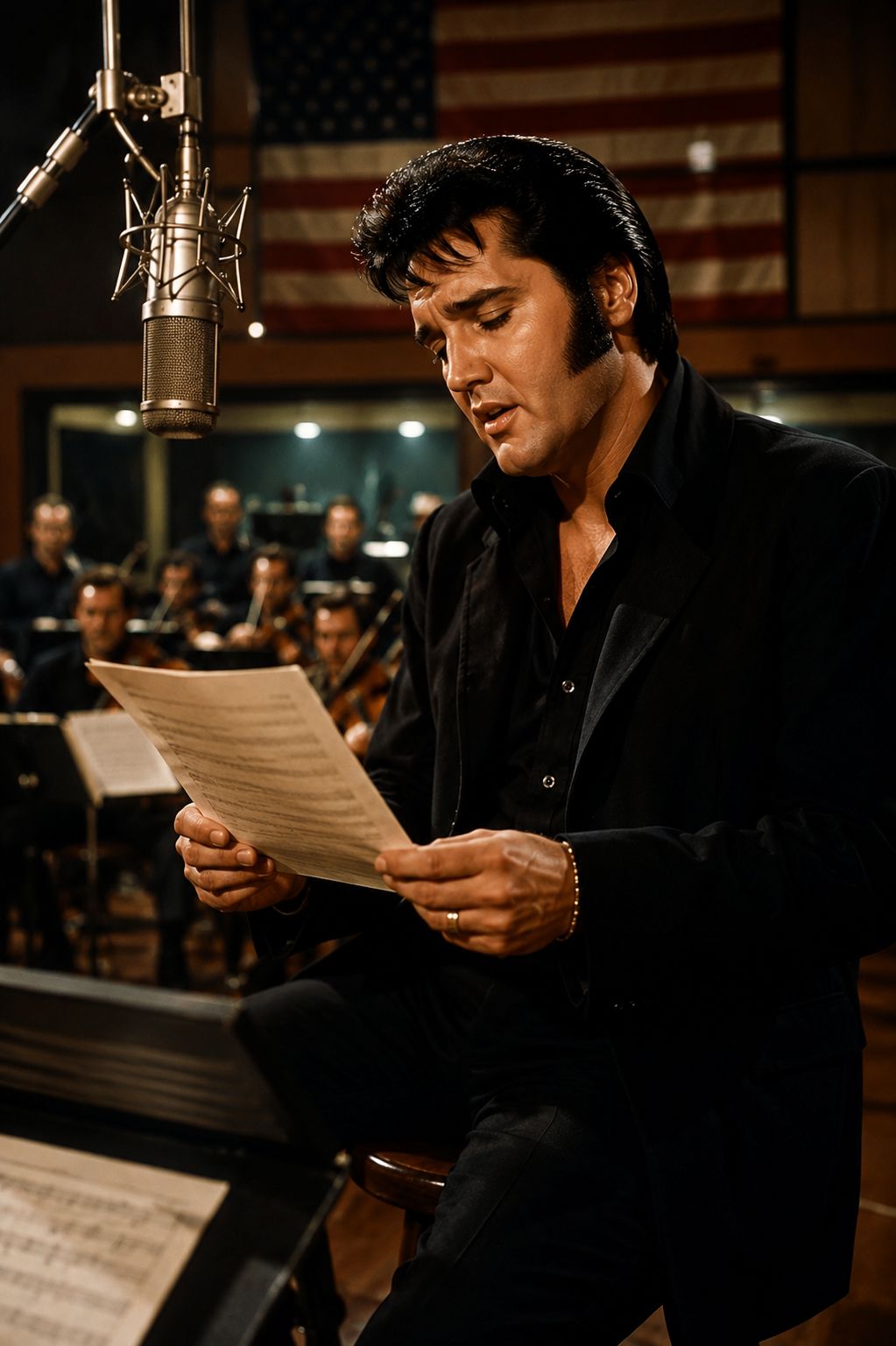
Unlike many polished studio sessions, the recording of “If I Can Dream” possessed an almost spiritual intensity.
Elvis wasn’t simply singing notes.
He was living every line.
Witnesses recalled the extraordinary atmosphere inside the studio.
There were very few jokes.
Very little conversation.
Everyone sensed they were participating in something larger than television entertainment.
As the orchestra swelled behind him, Elvis reached emotional heights that stunned even seasoned musicians.
His voice cracked—not from weakness, but from conviction.
Each phrase became more urgent than the last.
Every chorus sounded less like performance…
…and more like prayer.
The Final Performance That Left America Speechless
When viewers finally saw the completed performance, everything else seemed to disappear.
No elaborate choreography.
No flashy costumes.
No distractions.
Only Elvis.
Bathed in white light.
Standing almost motionless.
Delivering one of the most emotionally vulnerable performances of his career.
The camera lingered on his face.
Every expression revealed determination.
Compassion.
Hope.
As the orchestra grew louder, Elvis reached the unforgettable climax.
“If I can dream of a better land…”
It wasn’t merely a lyric anymore.
It became an invitation.
An invitation to believe that tomorrow could somehow be better than today.
Millions watching at home felt it instantly.
This wasn’t rock and roll.
This wasn’t gospel.
This wasn’t pop.
It was something that belonged to everyone.
The Voice That Had Matured
Earlier in his career, Elvis captivated audiences with youthful charisma.
His performances exploded with energy and rebellion.
But “If I Can Dream” showcased a different artist.
The playful young star had become a mature interpreter of human emotion.
His phrasing carried remarkable restraint.
His breathing communicated vulnerability.
His power emerged not from volume alone but from sincerity.
Every note sounded earned.
That emotional authenticity explains why the performance continues moving audiences decades later.
Technology changes.
Musical trends evolve.
But genuine feeling never becomes outdated.
More Than a Television Ending
The Comeback Special is remembered as one of the greatest career revivals in entertainment history.
Yet many historians argue its emotional climax arrived not during the famous leather-clad jam session…
…but during the final minutes of “If I Can Dream.”
That single performance redefined Elvis.
He wasn’t simply reclaiming commercial success.
He was reminding the world that music could heal.
That songs could unite.
That artists sometimes become voices for emotions ordinary people struggle to express themselves.
The special ended.
But its final message lingered.
Why the Song Still Resonates Today
More than half a century later, “If I Can Dream” remains astonishingly relevant.
Modern audiences continue facing division.
Conflict.
Uncertainty.
Many listeners hear the song today and feel as though it was written yesterday.
Its enduring power comes from avoiding partisan arguments.
Instead, it speaks directly to the human heart.
Everyone understands longing.
Everyone understands hope.
Everyone dreams of peace.
The song reminds us that compassion is timeless.
“We’re lost in a cloud with too much rain…”
Those words continue echoing across generations because every generation eventually faces its own storms.
Elvis Gave the Nation More Than Music
Many people remember Elvis Presley for the dazzling jumpsuits.
The chart-topping hits.
The unforgettable dance moves.
The magnetic charisma.
All of those memories deserve celebration.
But “If I Can Dream” reveals another side of the King.
A thoughtful artist.
A compassionate performer.
A man willing to stand before millions with nothing to hide except hope.
He didn’t pretend to possess all the answers.
He simply believed music could point people toward something brighter.
Sometimes that’s enough.
Sometimes that’s exactly what people need.
A Legacy Written in Hope
History often remembers the biggest concerts.
The highest-selling albums.
The loudest applause.
Yet some of music’s greatest achievements arrive quietly.
One singer.
One microphone.
One unforgettable song.
Before the curtain closed on the 1968 Comeback Broadcast, Elvis Presley delivered more than a finale.
He delivered a message that refused to fade.
A reminder that darkness does not last forever.
That dreams still matter.
That love remains stronger than fear.
More than fifty years later, the final image still inspires countless viewers.
Elvis, standing beneath glowing red letters spelling his name, singing not as a superstar but as a fellow human being reaching for a better tomorrow.
Perhaps that is why “If I Can Dream” continues to move listeners across generations.
Not because it belongs to the past.
But because every time the world feels fractured, its message becomes new again.
And every time Elvis sings those final soaring notes, he reminds us that hope is never naïve—it is necessary.
As long as people continue searching for light in difficult times, “If I Can Dream” will remain far more than the closing song of a television special.
It will endure as one of the most heartfelt anthems ever recorded—a timeless promise that even in our darkest moments, there is always another dream worth believing in.