Introduction
There are songs that entertain. There are songs that define generations. And then there are songs that rescue careers, restore broken confidence, and remind the world why legends are called legends.
In the summer of 1969, Elvis Presley stood at one of the most critical crossroads of his life. Once crowned the uncontested King of Rock and Roll, he had spent much of the decade trapped inside the glittering but creatively confining walls of Hollywood. Movie after movie, soundtrack after soundtrack, America watched as the revolutionary artist who had once shaken television screens became increasingly distant from the fearless performer who had changed popular music forever.
But Elvis wasn’t finished.
Not even close.
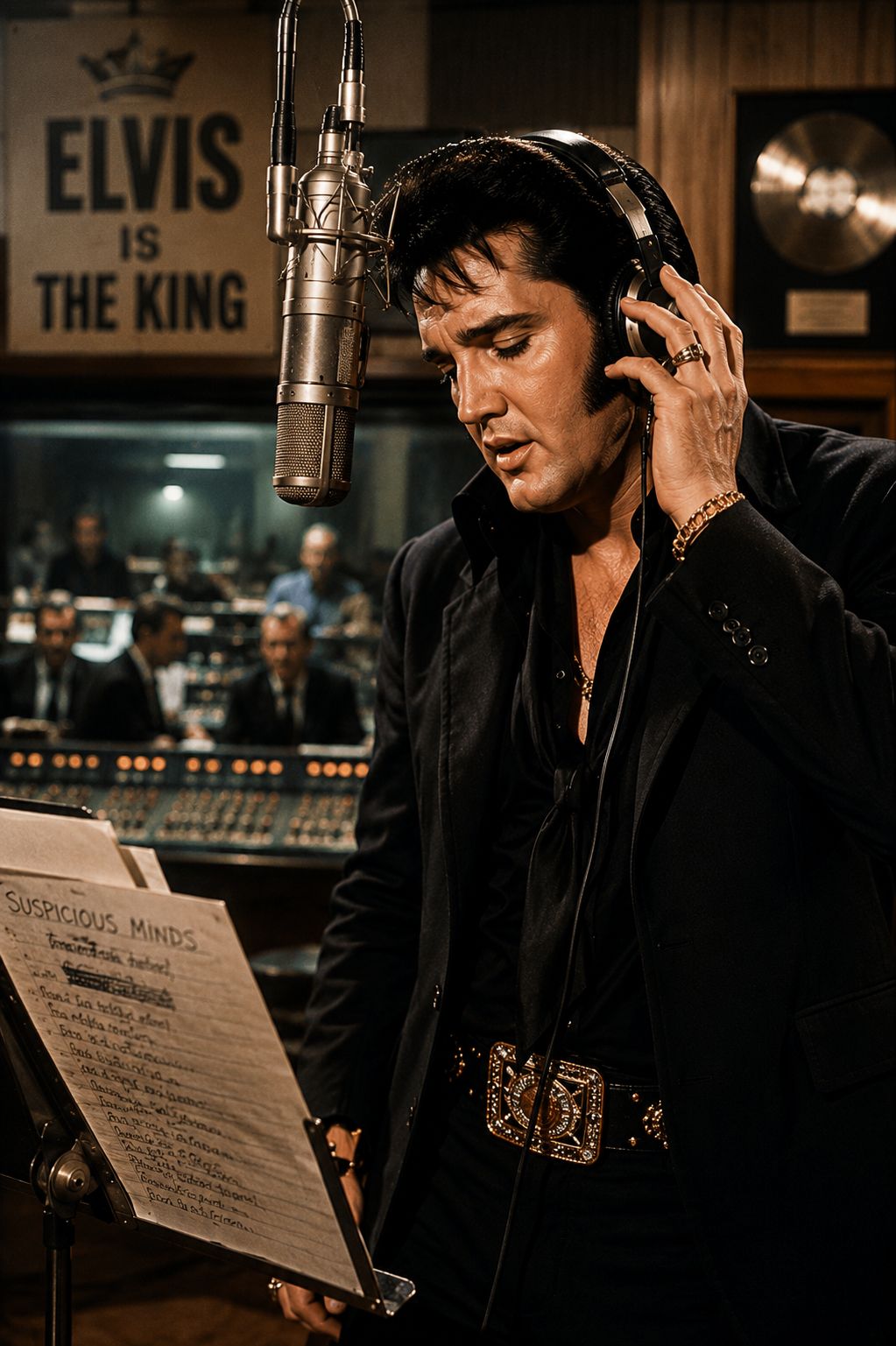
Long before his triumphant return to the concert stage in Las Vegas and months before audiences would once again rise to their feet chanting his name, Elvis stepped into American Sound Studio in Memphis and recorded a song that sounded less like another hit single—and more like a declaration of war.
That song was “Suspicious Minds.”
It wasn’t merely about jealousy.
It was about survival.
“We’re caught in a trap… I can’t walk out…”
Those opening words carried far greater weight than anyone listening on the radio could fully understand.
For Elvis, they reflected years of artistic frustration.
For millions of listeners, they became the soundtrack of relationships hanging by a thread.
And for history, they marked the precise moment the King reclaimed his crown.
The King Who Had Nearly Been Forgotten
By the late 1960s, music had changed dramatically.
The British Invasion had rewritten the rules.
Psychedelic rock dominated airwaves.
Soul music flourished.
Country evolved.
Young audiences embraced new heroes while Elvis, despite remaining famous, was increasingly viewed as yesterday’s superstar.
His films earned money but rarely respect.
The soundtracks often lacked the passion that had once electrified America.
Many critics quietly assumed his greatest days belonged to the 1950s.
Then something extraordinary happened.
The 1968 NBC Comeback Special reminded everyone what Elvis looked like when stripped of Hollywood costumes and placed in front of nothing but a microphone and an audience.
Suddenly the hunger returned.
Not only from fans.
From Elvis himself.
He wanted music that mattered again.
Returning Home to Memphis
Rather than continue recording in Nashville or Los Angeles, Elvis traveled back to Memphis.
There he joined legendary producer Chips Moman at American Sound Studio, where a remarkable group of musicians had already crafted hits for artists across multiple genres.
The atmosphere couldn’t have been more different from Hollywood.
There were no elaborate movie sets.
No scripted dialogue.
Only musicians chasing greatness.
The sessions became some of the most inspired recordings of Elvis’s entire career.
Night after night he rediscovered the emotional honesty that had made him unforgettable.
He wasn’t trying to imitate younger stars.
He wasn’t chasing trends.
He was simply becoming Elvis Presley again.
The Song Nobody Could Ignore
Written by Mark James, “Suspicious Minds” possessed everything Elvis needed.
A gripping melody.
A relentless groove.
Raw emotional conflict.
And lyrics that felt painfully human.
Unlike many pop songs of the era, this wasn’t a simple love story.
It explored the exhausting cycle of mistrust that destroys even the strongest relationships.
Every verse built tension.
Every chorus exploded with frustration.
Every repetition sounded like someone desperately trying to save something already slipping away.
“If an old friend I know drops by to say hello… would I still see suspicion in your eyes?”
Listeners didn’t just hear heartbreak.
They recognized themselves.
Recording with Fire
Those present during the Memphis sessions often described Elvis as completely engaged.
He challenged himself.
He experimented.
He laughed.
He pushed his voice harder than he had in years.
When “Suspicious Minds” came together, everyone inside the studio sensed they were witnessing something special.
The recording built slowly before erupting into one of the most exhilarating climaxes in popular music.
Instead of ending conventionally, the arrangement faded away…
Only to roar back even stronger.
That unforgettable false ending created emotional suspense unlike almost anything on radio at the time.
The record refused to let listeners go.
Much like the relationship inside the lyrics.
More Than a Love Song
Many fans interpreted “Suspicious Minds” as the story of two lovers trapped by jealousy.
But viewed through the lens of Elvis’s own career, the symbolism becomes impossible to ignore.
He had spent years battling expectations.
Battling critics.
Battling commercial pressures.
Battling his own uncertainty.
In many ways, the song mirrored an artist refusing to surrender.
Every vocal phrase sounded personal.
Every emotional crack in his voice revealed vulnerability.
Every soaring chorus became an act of defiance.
It was no longer enough for Elvis to survive.
He wanted to dominate again.
The Single That Changed Everything
Released in August 1969, “Suspicious Minds” climbed steadily up the charts.
Then history arrived.
The song reached No. 1 on the Billboard Hot 100.
It became Elvis Presley’s first chart-topping pop single in seven years.
That achievement wasn’t just another statistic.
It shattered a narrative.
For years, many believed Elvis had become a nostalgic figure—a legend remembered more for his past than his future.
“Suspicious Minds” proved exactly the opposite.
The King wasn’t making a comeback.
He was launching a new era.
Las Vegas Meets a Reborn Performer
Almost simultaneously, Elvis began his historic engagement at the International Hotel in Las Vegas.
Audiences expecting a faded movie star instead encountered something astonishing.
He looked stronger.
He sounded fearless.
His confidence radiated across every performance.
And when “Suspicious Minds” arrived in the setlist, it became one of the night’s defining moments.
The emotional intensity of the studio recording transformed into something even larger onstage.
His voice climbed higher.
The band played harder.
The audience erupted.
Night after night.
Show after show.
The song evolved into a battle cry.
It wasn’t merely being performed.
It was being lived.
“We’re caught in a trap…”
Thousands sang every word back to him.
Not because they pitied Elvis.
Because they believed him.
Why the Song Still Endures
More than half a century later, “Suspicious Minds” remains one of Elvis Presley’s defining masterpieces.
Its power lies in its honesty.
Every generation understands mistrust.
Every generation understands fighting for love.
Every generation understands refusing to surrender when everyone expects failure.
That universal truth allows the record to transcend its era.
Whether heard on vinyl, streamed through headphones, or performed on tribute stages around the world, the emotional impact remains remarkably fresh.
It doesn’t sound like a museum piece.
It sounds alive.
The Real Victory
People often describe 1969 as Elvis Presley’s comeback year.
But perhaps that word isn’t entirely accurate.
A comeback suggests someone returning from irrelevance.
Elvis was never irrelevant.
He had simply been waiting for the right moment—and the right song—to remind the world who he truly was.
“Suspicious Minds” became that moment.
It restored artistic credibility.
It reignited commercial success.
It reintroduced audiences to the fearless vocalist hidden beneath years of Hollywood glitter.
Most importantly, it reminded Elvis himself what greatness felt like.
The King didn’t reclaim his throne because audiences suddenly became nostalgic.
He reclaimed it because he delivered a performance so emotionally fearless that the world had no choice but to listen.
And decades later, every time that unmistakable groove begins and those unforgettable opening words fill the room, listeners aren’t simply hearing another classic hit.
They’re hearing an artist refuse defeat.
They’re hearing resilience become music.
They’re hearing one of the greatest performers in American history stand tall once again and declare—without ever saying the words—that legends are not remembered because they never fall.
They are remembered because they know exactly how to rise.
Video