Introduction
There are recording sessions.
There are legendary recordings.
And then there are moments so unexpected, so electric, that history almost forgets how extraordinary they truly were.
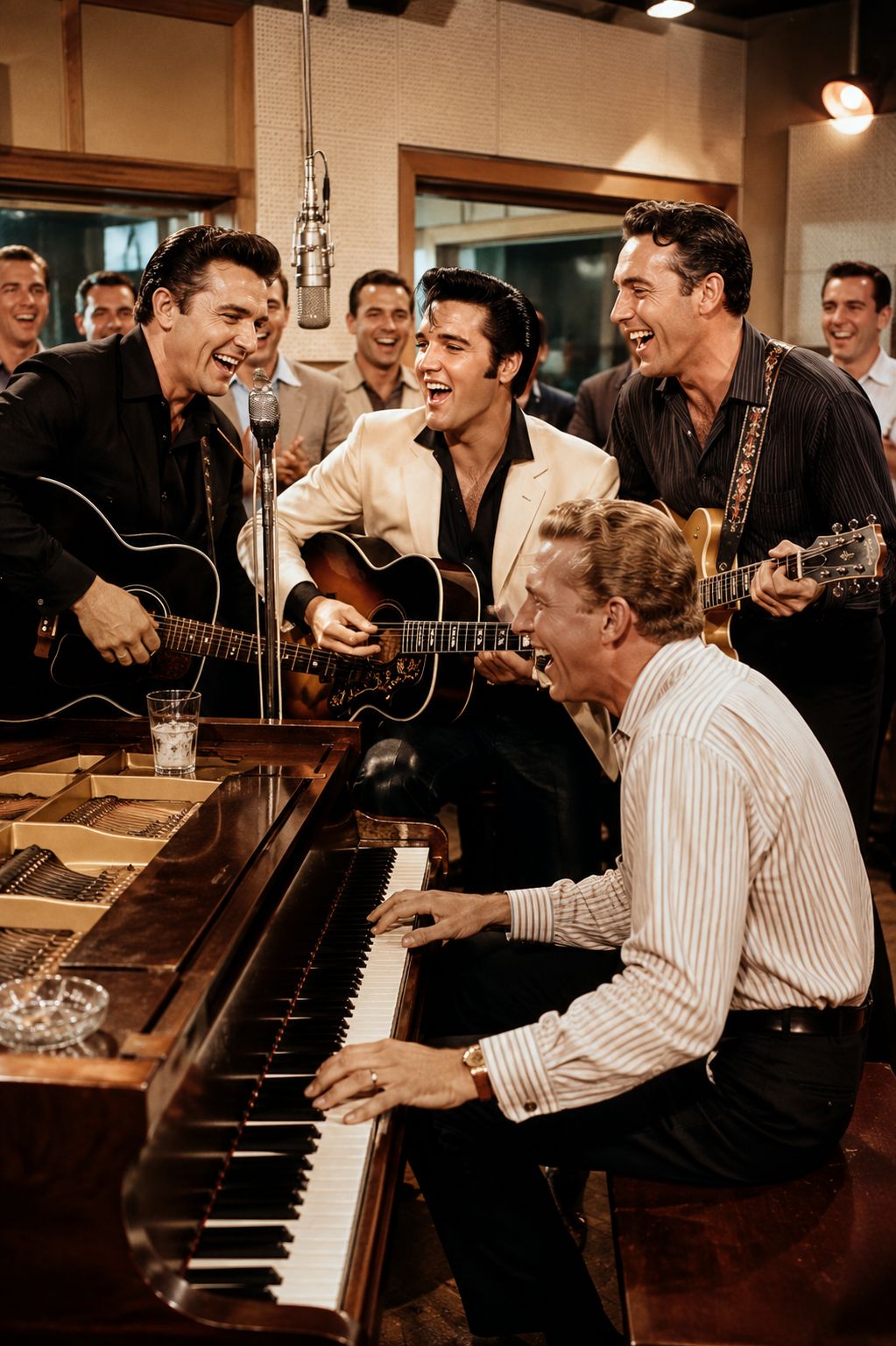
One afternoon in December 1956, inside the modest walls of Sun Studio in Memphis, Tennessee, something happened that no producer could have planned and no publicity campaign could have manufactured. Four young musicians—each destined to reshape American music—found themselves gathered around a piano, trading songs, laughing between verses, and feeding off one another’s energy.
Elvis Presley.
Johnny Cash.
Jerry Lee Lewis.
Carl Perkins.
Today, fans know this gathering as the “Million Dollar Quartet.” But those who were there described it less as a formal recording session and more as lightning trapped inside a room.
“Sometimes history doesn’t announce itself. Sometimes it simply starts playing.”
The atmosphere wasn’t stiff.
It wasn’t rehearsed.
It wasn’t about charts or record sales.
It was four friends—bound by the same musical roots—celebrating the sounds that had changed their lives.
And for everyone fortunate enough to witness it, the room seemed ready to explode.
Elvis Returns Home
By late 1956, Elvis Presley had become the biggest phenomenon in American entertainment.
His television appearances had stunned audiences.
His records were selling by the millions.
Teenagers screamed wherever he appeared.
Yet despite worldwide fame, Sun Studio still felt like home.
Producer Sam Phillips had discovered something unique in Elvis years earlier, giving a shy truck driver the opportunity to blend gospel, blues, country, and rhythm & blues into something completely new.
When Elvis dropped by the studio that afternoon, he wasn’t arriving as “The King.”
He was simply another musician eager to reconnect with old friends.
No one knew what would happen next.
Carl Perkins Was Already Recording
Carl Perkins had come to Sun Studio to work on new material.
His smash hit “Blue Suede Shoes” had become one of rockabilly’s defining songs.
Ironically, Elvis had also recorded the song, helping introduce it to an even wider audience.
There was never bitterness between them.
Only admiration.
Perkins represented the authentic country spirit mixed with blues grit.
His guitar spoke almost as clearly as his voice.
When Elvis walked into the studio, conversation quickly turned into music.
As musicians often do, they simply started playing.
Then Johnny Cash Walked In
Johnny Cash wasn’t yet the global icon history remembers today.
But his unmistakable baritone already carried enormous promise.
Hits like “I Walk the Line” had established him as one of Sun Records’ brightest stars.
Cash later admitted he mostly stood nearby during portions of the session.
Rather than dominating the room, he watched.
He listened.
He smiled.
Every now and then he’d step closer to the microphone, adding harmonies and joining the spontaneous performances.
There was no competition.
Only mutual respect.
Jerry Lee Lewis Added Pure Fire
Then there was Jerry Lee Lewis.
Still relatively unknown nationally, he had been hired to play piano during Carl Perkins’ recording session.
No one could have predicted that within months, he’d become one of rock and roll’s most explosive performers.
Even then, though, the signs were impossible to miss.
Lewis attacked the piano with astonishing energy.
Every chord seemed to leap from the keyboard.
Every gospel run carried enough electricity to shake the walls.
As the music intensified, his piano became the engine driving everyone forward.
“Some musicians accompany the song. Jerry Lee Lewis set the entire room on fire.”
The chemistry became irresistible.
Gospel Was Their Common Language
One of the most remarkable aspects of the gathering wasn’t the rock and roll.
It was the gospel.
Long before stadium crowds and screaming fans, all four men had grown up surrounded by church music.
Southern hymns…
Old spirituals…
Traditional gospel quartets…
Those songs connected them on a level deeper than commercial success.
During the session they drifted naturally into beloved hymns and sacred standards.
Their voices blended with surprising ease.
For a few unforgettable moments, superstardom disappeared.
What remained were four Southern boys singing the music that first taught them how to believe.
Many listeners still consider those gospel performances the emotional heart of the recordings.
There Were No Egos
Modern audiences sometimes assume that four future legends sharing one room must have created rivalry.
Instead, the recordings reveal something entirely different.
Laughter echoes between songs.
Friendly teasing fills the silence.
Musicians encourage one another.
Ideas bounce freely around the studio.
No one seems interested in proving they are the greatest.
They simply want the music to keep going.
That humility may be the session’s most enduring lesson.
Every artist present possessed enough talent to command a stage alone.
Yet together, they sounded even larger.
Sam Phillips Recognized Magic
Sun Records founder Sam Phillips immediately sensed that something extraordinary was unfolding.
Tape machines rolled.
Photographs were taken.
Someone wisely decided not to interrupt.
The performances were loose.
Sometimes unfinished.
Occasionally chaotic.
But they possessed something polished recordings often lose:
Authenticity.
Nothing was manufactured.
Nothing was edited for perfection.
Every laugh…
Every missed lyric…
Every spontaneous harmony…
Captured musicians living completely in the moment.
A Time Capsule of American Music
Listening today feels less like hearing a recording and more like opening a time capsule.
Country.
Rockabilly.
Gospel.
Blues.
Rhythm & blues.
Every style overlaps naturally.
The session reminds us that musical genres were never rigid boxes.
These artists borrowed freely from one another because they genuinely loved every influence.
That creative openness eventually transformed popular music forever.
Without those shared roots, countless future artists—from country stars to rock legends—might have sounded very different.
Why Fans Still Return to This Session
Nearly seventy years later, millions continue discovering the Million Dollar Quartet recordings.
Not because every performance is flawless.
But because every performance is real.
In an era increasingly shaped by studio perfection, pitch correction, and endless editing, these recordings feel refreshingly human.
You hear musicians searching.
Experimenting.
Laughing when something goes wrong.
Celebrating when something suddenly clicks.
It reminds us that greatness isn’t always carefully planned.
Sometimes it’s accidental.
Sometimes it’s spontaneous.
Sometimes it’s simply four gifted friends refusing to let the music stop.
The Room That Changed Music
Imagine standing quietly in the corner of Sun Studio that afternoon.
You would have heard Elvis Presley smiling through familiar gospel harmonies.
Johnny Cash’s deep voice settling effortlessly beneath the melody.
Carl Perkins weaving brilliant guitar lines around every chorus.
Jerry Lee Lewis attacking the piano with fearless enthusiasm.
No audience.
No bright stage lights.
No elaborate production.
Just music.
Pure, joyful, unforgettable music.
“Legends weren’t born that afternoon—they recognized one another.”
The world would eventually crown Elvis “The King.”
Johnny Cash would become “The Man in Black.”
Jerry Lee Lewis would forever be remembered as “The Killer.”
Carl Perkins would remain one of rockabilly’s greatest architects.
Each carved an unforgettable path.
But for one magical afternoon, titles didn’t matter.
Awards didn’t matter.
Fame didn’t matter.
Four extraordinary musicians gathered in the same studio, drawn together by shared roots and an unshakable love of American music.
The walls of Sun Studio could never contain the energy that filled that room.
And perhaps that’s why the story still resonates across generations.
Because every so often, history gives us a glimpse of greatness before anyone realizes they’re witnessing it.
The microphones captured songs.
The cameras captured smiles.
But neither could fully capture what everyone present felt.
When Johnny Cash, Jerry Lee Lewis, and Carl Perkins joined Elvis Presley in that studio…
The entire room truly erupted.
And American music has been echoing with that unforgettable moment ever since.
Video