Introduction
History often arrives with marching bands.
Sometimes it announces itself through newspaper headlines, motorcades, or world-changing speeches.
And sometimes…
It slips quietly through the back door of the White House.
On the morning of December 21, 1970, Washington, D.C., witnessed one of the strangest—and ultimately most unforgettable—meetings in American history. Without advance notice, without months of planning, and without the elaborate choreography normally surrounding presidential visits, Elvis Presley unexpectedly appeared at the White House hoping to meet President Richard Nixon.
No one inside the Executive Mansion could have predicted what would happen next.
No one imagined that a single photograph from that meeting would eventually become the most requested image in the history of the U.S. National Archives.
It remains one of the most fascinating intersections of music, politics, celebrity, and American culture ever captured on film.
“Some photographs freeze history. Others become history.”
By late 1970, Elvis Presley occupied a unique place in American life.
His triumphant 1968 television comeback had reminded audiences that the King still possessed extraordinary charisma.
His concerts were once again selling out across the country.
Yet behind the spotlight, Elvis had become increasingly fascinated by another subject entirely.
Law enforcement.
American patriotism.
Federal badges.
He collected police memorabilia with genuine enthusiasm and developed friendships with officers from numerous agencies. Friends recalled that Elvis viewed law enforcement not as a novelty but as a symbol of public service and national stability.
During this period, he became convinced that he could help America fight illegal drug abuse and anti-drug culture—not as a politician, but as someone whose influence reached millions of young people.
That conviction led to an extraordinary decision.
Rather than requesting a meeting through traditional channels weeks in advance, Elvis boarded a commercial flight to Washington.
He carried with him a handwritten letter addressed directly to President Nixon.
The note was sincere, unusual, and unmistakably Elvis.
He expressed his desire to serve his country in a unique capacity and requested a federal narcotics badge, believing it would help him contribute to the fight against drugs.
To many readers today, the request sounds almost surreal.
But to Elvis, it was deeply personal.
“Sometimes the most unexpected journeys begin with a handwritten letter and an impossible idea.”
White House staff initially had every reason to dismiss the request.
The President’s schedule was tightly managed.
Security protocols were uncompromising.
Unexpected celebrity visits were hardly routine.
Yet something about the proposal captured attention.
Perhaps it was Elvis’s immense cultural influence.
Perhaps it was simple curiosity.
Perhaps it was the realization that America rarely produced figures as universally recognized as Elvis Presley.
Against all expectations, arrangements were made.
Within hours, the King of Rock and Roll was walking through one of the most secure buildings in the world.
Imagine the scene.
Secret Service agents watching one of the world’s biggest entertainers stroll through the corridors of presidential power.
White House aides exchanging puzzled glances.
Officials wondering whether this astonishing meeting was actually happening.
It felt almost cinematic.
Except it was entirely real.
When Elvis entered the Oval Office, he met Richard Nixon with the same mixture of confidence and Southern courtesy that had characterized his career.
The contrast between the two men was impossible to ignore.
Nixon projected reserved political authority.
Elvis embodied cultural revolution.
One represented government.
The other represented popular music.
Yet their conversation unfolded with surprising warmth.
They discussed patriotism.
Drug abuse.
American youth.
Public responsibility.
Elvis explained that he believed celebrities could play a constructive role in encouraging respect for the law and the nation.
Whether every idea was practical mattered less than the sincerity with which he expressed it.
“History’s most memorable meetings are often those nobody would have thought to arrange.”
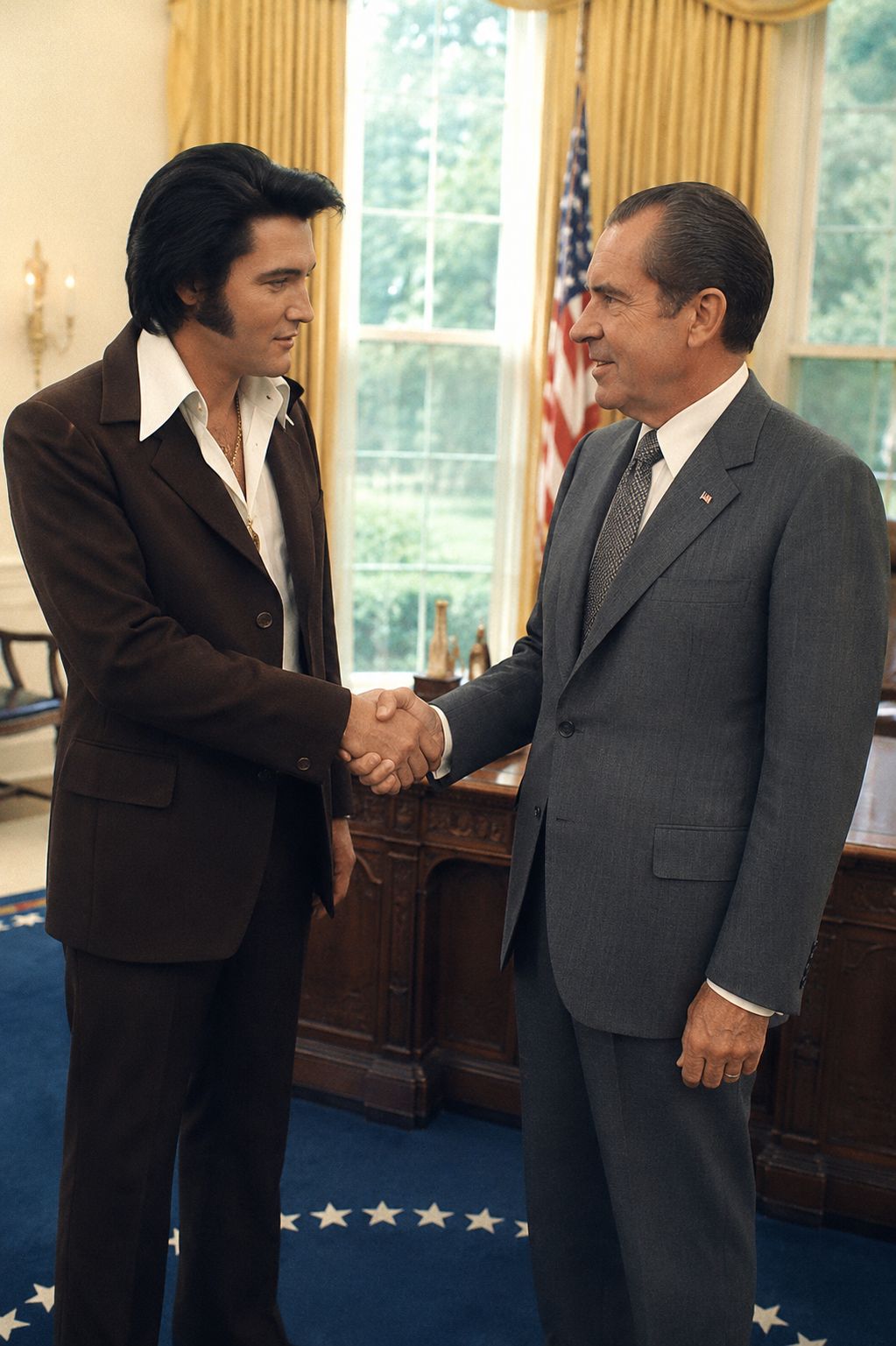
Then came the photograph.
Elvis, dressed in a striking purple velvet suit with an oversized belt buckle and signature style.
Nixon, impeccably formal in a dark business suit.
The two men standing side by side inside the Oval Office.
Neither smiling broadly.
Both appearing oddly comfortable despite the extraordinary circumstances.
No elaborate staging.
No theatrical lighting.
Just two icons from dramatically different worlds sharing a brief moment that would outlive them both.
At the time, few could have predicted the image’s future significance.
It appeared to be another official White House photograph.
Nothing more.
But decades passed.
Public fascination grew.
The image became endlessly reproduced in books, documentaries, exhibitions, magazines, and classrooms.
Eventually, archivists confirmed an astonishing fact.
It had become the most requested photograph held by the U.S. National Archives.
Why this image?
Why not a moon landing?
Why not a presidential inauguration?
Why not a wartime summit?
Perhaps because this single frame captures something uniquely American.
It brings together politics, celebrity, music, optimism, contradiction, and curiosity in one unforgettable composition.
It asks questions without answering them.
What were they really thinking?
How did this happen?
Could such a meeting occur today?
“Every generation discovers the photograph and asks the same question: ‘Is this real?'”
For Elvis fans, the meeting reveals another side of the performer.
Beyond the jumpsuits.
Beyond the screaming audiences.
Beyond the record-breaking concerts.
It shows a man deeply interested in his country and eager—however unconventional his methods—to contribute to something larger than entertainment.
Not every observer agreed with his approach.
Some viewed the meeting as eccentric.
Others considered it symbolic.
Many simply found it fascinating.
But almost everyone agreed on one point.
Only Elvis could have made such a meeting possible.
His combination of charisma, confidence, and unpredictability opened doors that seemed permanently closed.
Country music audiences, too, have long appreciated this chapter of Elvis’s life because it reflects values often celebrated within traditional country music: patriotism, respect for public service, and a belief that fame carries responsibility.
Though Elvis is forever associated with rock and roll, his roots remained firmly planted in Southern musical traditions.
Those roots shaped his worldview as much as they shaped his voice.
The meeting also reminds us how complex public figures truly are.
History sometimes reduces legends to a handful of familiar images.
The young rebel.
The movie star.
The Las Vegas performer.
But people are always more complicated than their reputations.
Elvis contained multitudes.
He loved gospel music.
He admired country storytelling.
He cherished family.
He enjoyed collecting unusual artifacts.
And yes, he sincerely wanted a federal badge.
That combination of seriousness and eccentricity made him unmistakably human.
“The greatest legends remain fascinating because they refuse to fit neatly into anyone’s expectations.”
More than half a century later, the Nixon-Elvis meeting continues inspiring documentaries, books, museum exhibits, and spirited conversations among music historians and political scholars alike.
It stands not merely as an entertaining anecdote but as a reminder that history is often shaped by individuals willing to do something completely unexpected.
No one scheduled this moment months in advance.
No publicist designed it.
No marketing team invented it.
It happened because one extraordinary man believed he had something important to say—and another agreed to listen.
That alone makes the encounter remarkable.
The photograph that emerged from that unlikely morning has become far more than an official portrait.
It is a cultural time capsule.
A snapshot of two powerful symbols of America standing together for just a few minutes before returning to vastly different worlds.
One would continue leading a nation.
The other would continue filling arenas with unforgettable music.
Yet for one extraordinary morning in December 1970, politics and popular culture crossed paths inside the Oval Office.
The cameras clicked.
History paused.
And an image was created that generations would continue requesting, studying, debating, and celebrating.
Sometimes the most extraordinary stories aren’t written in secret government files or hidden beneath layers of mystery.
Sometimes they’re hanging quietly in an archive—waiting for the next curious visitor to ask, “How in the world did that happen?”