Introduction
There are nights in country music that feel larger than history itself.
A single song.
A single stage.
A single moment when the world finally notices the soul that had been bleeding in silence for years.
For Willie Nelson, that night did not come easily.
It came after rejection.
After empty bars.
After radio executives said his voice sounded “too strange.”
After Nashville tried to polish him into something he was never meant to be.
And yet somehow, the skinny songwriter with the braided hair, the weathered face, and the battered guitar named Trigger would eventually become one of the most beloved outlaws in American music history.
But before the legends… before the sold-out arenas… before the standing ovations…
There was one unforgettable night when everything changed.
The Man Nashville Didn’t Understand
In the early years, Willie Nelson looked nothing like a future superstar.
He didn’t have the clean-cut image the music industry wanted. His voice was loose, conversational, almost behind the beat. He sang like a man telling secrets at 2 a.m. instead of performing for radio.
Executives didn’t know what to do with him.
But songwriters in Nashville knew the truth.
Because while Willie struggled to become a performer, he quietly wrote songs that would define country music forever.
“Crazy.”
“Night Life.”
“Funny How Time Slips Away.”
Those songs turned other artists into stars long before Willie ever became one himself.
Imagine writing classics for everyone else while sleeping in cheap apartments and wondering if your own career would ever happen.
That kind of heartbreak changes a man.
“Sometimes the people who change music the most are the ones the industry ignores first.”
Willie kept going anyway.
Night after night, he played tiny venues where conversations were louder than the applause. He drove endless highways with barely enough money for gas. The dream never completely died inside him — but there were moments when it came painfully close.
And then came Texas.
The Fire That Rebuilt Willie Nelson
By the early 1970s, Willie was exhausted with Nashville.
The rules.
The pressure.
The fake perfection.
Then disaster struck.
His house in Tennessee caught fire.
Most people would have seen ruin in those flames.
Willie Nelson saw freedom.
Legend says he ran into the burning home to rescue two things:
His guitar.
And a pound of marijuana.
That story became part of country music mythology because it perfectly captured who Willie was — fearless, unconventional, impossible to control.
After the fire, he left Nashville behind and returned to Texas.
That decision changed everything.
Texas crowds were different. They didn’t care about polished suits or perfect vocals. They wanted honesty. They wanted grit. They wanted music that felt alive.
For the first time in years, Willie stopped trying to fit into country music.
Instead, he let country music come to him.
His hair grew longer. His sound became freer. Rock fans, cowboys, hippies, and honky-tonk drifters suddenly found themselves standing in the same crowd singing the same songs.
Something revolutionary was happening.
The Outlaw movement was being born.
And Willie Nelson was standing at the center of it.
The Night the Crowd Finally Understood
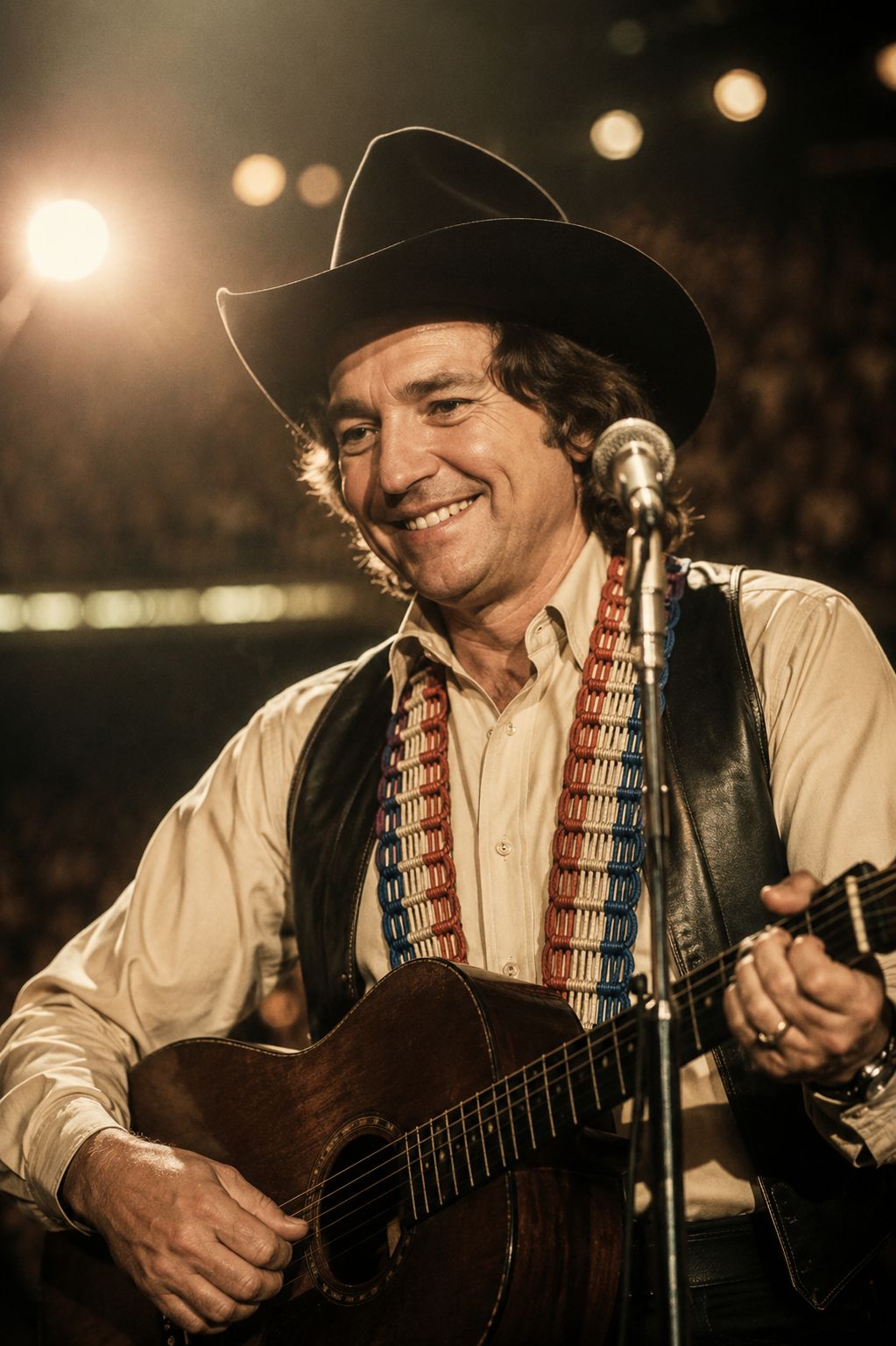
Then came the performance.
The kind of night people talk about decades later with tears in their eyes.
One stage.
One microphone.
One room packed with people unsure of what they were about to witness.
Willie walked out looking nothing like the polished stars dominating country radio.
No glitter.
No fake charm.
No rehearsed smile.
Just Willie.
And Trigger.
At first, the crowd watched carefully. Some were curious. Some skeptical.
Then he started singing.
Not loudly.
Not dramatically.
Honestly.
Every lyric sounded lived-in. Every word carried scars. Willie didn’t perform songs — he survived them in front of people.
And suddenly, something shifted inside the room.
The audience stopped talking.
People leaned closer.
By the middle of the set, strangers were crying into beer glasses while singing along to songs that felt like old memories.
That was the magic of Willie Nelson.
He could make a room of thousands feel like a lonely midnight conversation between friends.
“You were never just listening to Willie Nelson. You were listening to your own life through his voice.”
When he played Blue Eyes Crying in the Rain, the atmosphere changed completely.
That song became the emotional earthquake that finally shattered every doubt surrounding his career.
The audience erupted.
Not polite applause.
Not industry applause.
Real applause.
The kind earned through pain.
The kind that tells an artist: You finally made it.
That night, Willie Nelson stopped being a respected songwriter hiding in the shadows.
He became a star.
Why America Fell in Love With Him
What made Willie different wasn’t perfection.
It was truth.
He sang about loneliness without pretending to have answers. He sang about heartbreak without sounding theatrical. He made sadness feel human instead of glamorous.
In a world obsessed with image, Willie Nelson felt real.
That authenticity connected generations.
Truck drivers.
Farmers.
Vietnam veterans.
College kids.
Lonely people sitting awake after midnight.
They all saw themselves in him.
Because Willie never acted larger than life.
He acted like life itself.
And somehow, that became larger than any image Nashville could manufacture.
The Rise of an Outlaw Legend
After that breakthrough, everything accelerated.
Hit records.
Massive tours.
National fame.
But Willie never abandoned the spirit that made him special.
He stayed unpredictable.
One night he was performing with country legends.
The next, he was singing beside rock stars.
He crossed genres before the industry understood how powerful that could be.
And through it all, Trigger remained by his side — worn, scarred, and legendary, just like the man holding it.
Fans didn’t merely admire Willie Nelson.
They trusted him.
That is rarer than fame.
The Deeper Reason That Night Still Matters
The story of Willie Nelson becoming a star is not really about celebrity.
It is about survival.
About what happens when someone refuses to become what the world demands.
Most artists eventually surrender to the machine.
Willie didn’t.
He waited until the world was finally ready for the truth.
And when that truth arrived on stage that unforgettable night, audiences recognized something they had been starving for:
Authenticity.
“The greatest country music isn’t polished. It’s wounded, honest, and alive.”
That is why Willie Nelson’s rise still feels emotional decades later.
Because deep down, everyone understands the feeling of being overlooked.
Of being told you’re too different.
Too strange.
Too late.
Willie Nelson turned that pain into music.
And one magical night, the world finally listened.
The Legacy of That Night
Today, Willie Nelson is more than a country singer.
He is an American symbol.
A rebel.
A poet.
A survivor.
His songs became soundtracks for broken hearts and open highways alike. Younger generations continue discovering his music because honesty never ages.
And perhaps that is the most beautiful part of the story.
The night Willie Nelson became a star was not the night he changed who he was.
It was the night the world finally accepted him exactly as he had always been.