Introduction
There are legends.
There are superstars.
And then there was Elvis.
For a moment in history that felt almost unreal, one man from a tiny house in Tupelo became the center of the world’s heartbeat. His voice blasted through radios in diners, bars, and lonely bedrooms. His face appeared on magazine covers across continents. His movements shocked parents, electrified teenagers, and transformed music forever.
These were the years Elvis Presley did not simply dominate entertainment.
He ruled the world.
In the beginning, nobody expected it.
Elvis was just a shy Southern boy with slicked-back hair, carrying dreams bigger than his circumstances. He drove trucks. He listened to gospel music in church. He absorbed blues from Black musicians whose sounds were often ignored by mainstream America. Somewhere between gospel, rhythm and blues, and country music, Elvis created something the world had never truly heard before.
And when the world finally heard it…
Nothing was ever the same again.
His breakthrough at Sun Records felt almost accidental. But once songs like “That’s All Right” hit the airwaves, listeners reacted with confusion, excitement, and obsession all at once. People asked the same question over and over:
“Who is this kid?”
By the mid-1950s, that question turned into a cultural earthquake.
Teenagers screamed at concerts so loudly that audiences could barely hear the music. Girls cried uncontrollably. Young men copied his hair, clothes, and swagger. Older generations were horrified by the way he moved his hips on television.
But controversy only made Elvis bigger.
Every appearance became an event.
Every song became a sensation.
Every camera wanted him.
When Elvis appeared on The Ed Sullivan Show, America stopped what it was doing. Families gathered around black-and-white television sets, unsure whether they were witnessing genius or rebellion.
More than 60 million people tuned in.
At the time, it was one of the largest television audiences in American history.
And Elvis delivered exactly what the world feared and loved: charisma that could not be controlled.
“Elvis wasn’t just singing songs,” one critic later wrote.
“He was announcing the arrival of a new America.”
That statement was true.
Before Elvis, young people mostly followed the culture created by adults. After Elvis, youth culture became its own force. Music changed. Fashion changed. Celebrity changed.
Even masculinity changed.
Elvis could be dangerous and gentle in the same breath. He could snarl through a rock song and then break hearts with a tender ballad moments later. Men wanted his confidence. Women wanted his attention. And the music industry wanted another Elvis — though nobody ever truly found one.
Then came the explosion.
The late 1950s turned Elvis Presley into the most famous entertainer on Earth.
He recorded hit after hit:
- Heartbreak Hotel
- Hound Dog
- Jailhouse Rock
- Love Me Tender
- Don’t Be Cruel
These were not just songs anymore.
They were global events.
In countries thousands of miles from United States, fans lined up to buy his records. Soldiers carried Elvis records overseas. Teenagers memorized every lyric. His voice crossed oceans before the internet even existed.
Imagine that level of fame.
No social media.
No YouTube.
No TikTok.
Yet Elvis was everywhere.
Hollywood soon came calling.
Elvis entered movies at the exact moment America was becoming obsessed with youth-driven entertainment. Films like Jailhouse Rock and Blue Hawaii turned him into a box office machine.
To fans, he was no longer just a singer.
He became fantasy itself.
The handsome rebel.
The romantic hero.
The unstoppable icon.
Studios realized something extraordinary: people would watch Elvis do almost anything. Sing on a beach. Ride motorcycles. Fall in love. Fight bad guys. Smile into the camera for ninety minutes.
And audiences kept buying tickets.
The money became unimaginable.
The fame became overwhelming.
But beneath the screaming crowds and flashing cameras, something complicated was happening inside Elvis Presley himself.
The pressure of ruling the world came at a cost.
By the 1960s, Elvis was trapped between two identities: the revolutionary artist who changed music forever, and the commercial superstar expected to endlessly reproduce the same image.
His films became repetitive. Critics began questioning whether the King of Rock ’n’ Roll had lost his edge.
For a moment, it seemed possible that the world might move on without him.
But Elvis Presley was never ordinary.
And legends do not disappear quietly.
Then came 1968.
The comeback.
The moment that reminded the world exactly who Elvis Presley truly was.
Dressed in black leather during the legendary Elvis 1968 Comeback Special, Elvis looked reborn. There was no Hollywood polish hiding him anymore. No beach-movie distractions. Just raw talent, sweat, passion, and hunger.
He sang like a man reclaiming his soul.
And audiences felt it instantly.
“It was like watching a sleeping giant wake up.”
That special changed everything.
Suddenly, Elvis was dangerous again. Alive again. Relevant again.
Younger artists admired him. Older fans returned. Critics who once dismissed him were forced to admit the truth:
Nobody could command a stage like Elvis Presley.
Nobody.
The 1970s brought another era of dominance.
Las Vegas became Elvis territory.
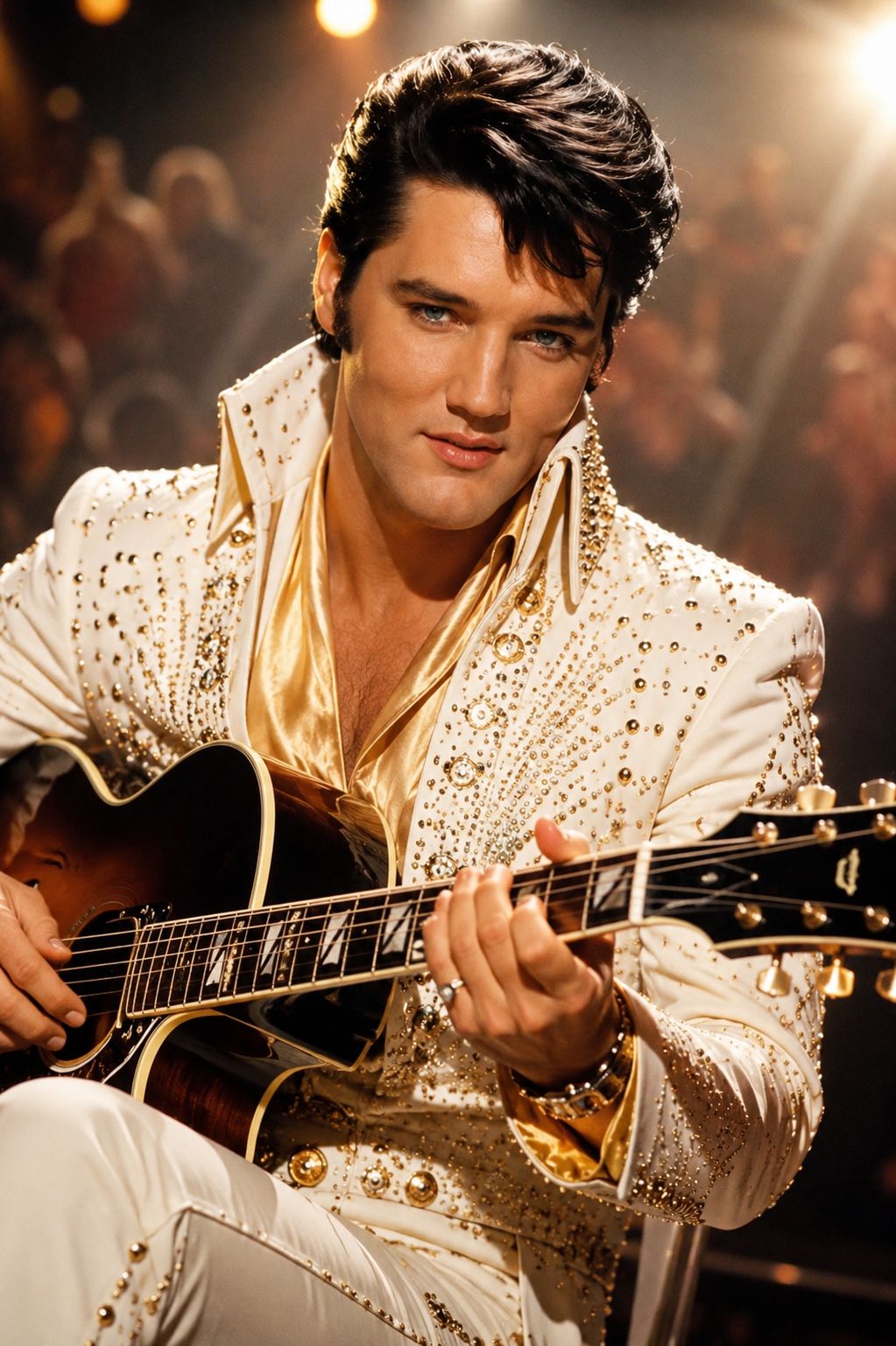
Night after night, crowds packed hotels just to witness him walk on stage in glittering jumpsuits. The performances became almost mythological. Fans described them like religious experiences.
He wasn’t merely performing songs anymore.
He was performing memory, nostalgia, and American identity itself.
Every dramatic gesture felt larger than life.
Every note carried years of triumph and pain.
And somehow, even as his health declined, the power remained undeniable.
When Elvis sang “Suspicious Minds” or “Can’t Help Falling in Love,” audiences still believed they were in the presence of something sacred.
Because they were.
Part of what made Elvis so powerful was that he represented contradiction.
He was humble yet worshipped.
Lonely yet surrounded by millions.
Confident yet deeply insecure.
A king who often seemed imprisoned by his own crown.
That humanity made people love him even more.
Fans did not just admire Elvis Presley.
They felt emotionally connected to him.
He was the dream of escape. The symbol of reinvention. Proof that a poor boy from Mississippi could become immortal.
And for years, he truly seemed immortal.
When Elvis died in 1977, the shock felt global.
People cried openly in streets. Radio stations played his songs nonstop. Fans gathered outside Graceland holding candles and flowers.
It did not feel like the death of a celebrity.
It felt like the end of an era.
Because in many ways, it was.
“Before Elvis, there was nothing,” John Lennon once famously said.
That quote may sound dramatic.
But history suggests it was closer to truth than exaggeration.
Elvis Presley changed music.
He changed fame.
He changed culture.
And during those extraordinary years, he became more than human in the eyes of the world.
He became the King.
Not because somebody handed him a crown.
But because millions of people, across generations and continents, decided no one else deserved it more.
And decades later, the world is still listening.