Introduction
There are celebrities… and then there was Elvis Presley.
By the late 1950s and deep into the 1960s, Elvis wasn’t just famous — he was a cultural earthquake. Crowds screamed before he even stepped onto the stage. Girls fainted at the sight of him. Reporters chased him like he was royalty. America watched him with fascination, fear, obsession, and envy all at once.
This was not normal fame.
This was hysteria.
And inside Elvis Presley’s wildest fame era was a lonely young man from Mississippi who could barely comprehend what the world had turned him into.
The story often begins with the music — the shaking hips, the Southern swagger, the dangerous smile. But Elvis’s rise exploded so fast that even the entertainment industry struggled to contain it.
One moment he was driving trucks and recording songs at Sun Records.
The next?
He was the most recognizable face on Earth.
“He looked like rebellion, sounded like freedom, and moved like nobody America had ever seen.”
Parents feared him.
Teenagers worshipped him.
Television executives argued over how much of his body they were allowed to show on screen because his dancing was considered too provocative for national audiences. Churches criticized him. Newspapers mocked him. Yet every criticism only made the hysteria grow stronger.
Elvis didn’t just enter pop culture.
He detonated it.
At the peak of his fame, America behaved as if Elvis were a myth instead of a man.
Women cried uncontrollably during concerts. Some had to be carried out by security. Police struggled to control crowds outside hotels. Thousands gathered just to catch a glimpse of him stepping out of a car for three seconds.
It was chaos everywhere he went.
And the terrifying part?
Elvis was still in his early twenties.
Imagine becoming the most desired man alive before fully understanding yourself.
That pressure changed him forever.
The money arrived faster than anyone could believe.
Hit records.
Sold-out shows.
Hollywood contracts.
Merchandise.
Magazine covers.
Movies.
Millions upon millions poured in while Colonel Tom Parker, the mysterious manager who controlled Elvis’s empire, carefully built the Presley machine into a global phenomenon.
Graceland became more than a mansion.
It became a kingdom.
Fans waited outside its gates hoping for a wave, a smile, any sign that Elvis was home. Reporters documented his every move. The world became obsessed with what he wore, what he ate, who he dated, and where he traveled.
But behind the luxury was exhaustion.
Because fame at Elvis’s level demanded something brutal:
He could never truly disappear again.
Inside the wildest years of Elvis fame, there were nights that looked magical from the outside.
Private jets.
Limousines.
Hollywood parties.
Beautiful women.
Flashbulbs exploding everywhere.
Yet those closest to Elvis often described something very different behind closed doors.
A man who laughed loudly to hide stress.
A man terrified of disappointing fans.
A man who sometimes stayed awake all night because silence made him uncomfortable.
“The world saw a king. Elvis often felt like a prisoner.”
That contradiction defined his life.
He was adored by millions yet increasingly isolated from reality.
Who could he trust?
Who actually loved him?
Who wanted Elvis Presley the person… and who only wanted the icon?
Fame forced those questions into every relationship he had.
Then came Hollywood.
Studios quickly realized Elvis wasn’t just a singer — he was a goldmine. During the 1960s, he starred in film after film, often playing charming rebels surrounded by beaches, fast cars, and romance.
Audiences loved them financially.
Critics hated them artistically.
And somewhere deep inside, Elvis began feeling trapped.
The dangerous, revolutionary rock-and-roll artist who once shocked America was slowly being packaged into safe entertainment.
Formula movies.
Formula songs.
Formula success.
The machine kept printing money, but creatively, something inside Elvis was fading.
People around him noticed it.
He noticed it too.
Then came one of the greatest comeback moments in music history.
In 1968, Elvis appeared in the legendary black leather special for NBC — raw, electric, alive again.
The world watched a different Elvis emerge.
Not the polished movie star.
Not the manufactured idol.
This was the hungry performer from the beginning.
Sweating.
Smiling.
Attacking songs with fire in his eyes.
For many fans, it felt like Elvis had finally broken free from the prison of his own fame.
“That night, Elvis didn’t just return. He reminded the world who invented the storm.”
The special reignited his career and proved something important:
The magic had never left him.
It had only been buried beneath the machinery of celebrity.
But fame at that level always comes with a cost.
As the years continued, Elvis’s schedule became relentless. Endless performances in Las Vegas turned him into a living attraction. Audiences still worshipped him, but the pressure intensified with age.
He had to remain Elvis Presley every single night.
No bad moods.
No weakness.
No ordinary humanity.
Just the legend.
And legends eventually become trapped by expectations.
The loneliness deepened.
Health struggles emerged.
Prescription medications became increasingly common in his life, partly driven by exhaustion, anxiety, and the crushing demands surrounding him.
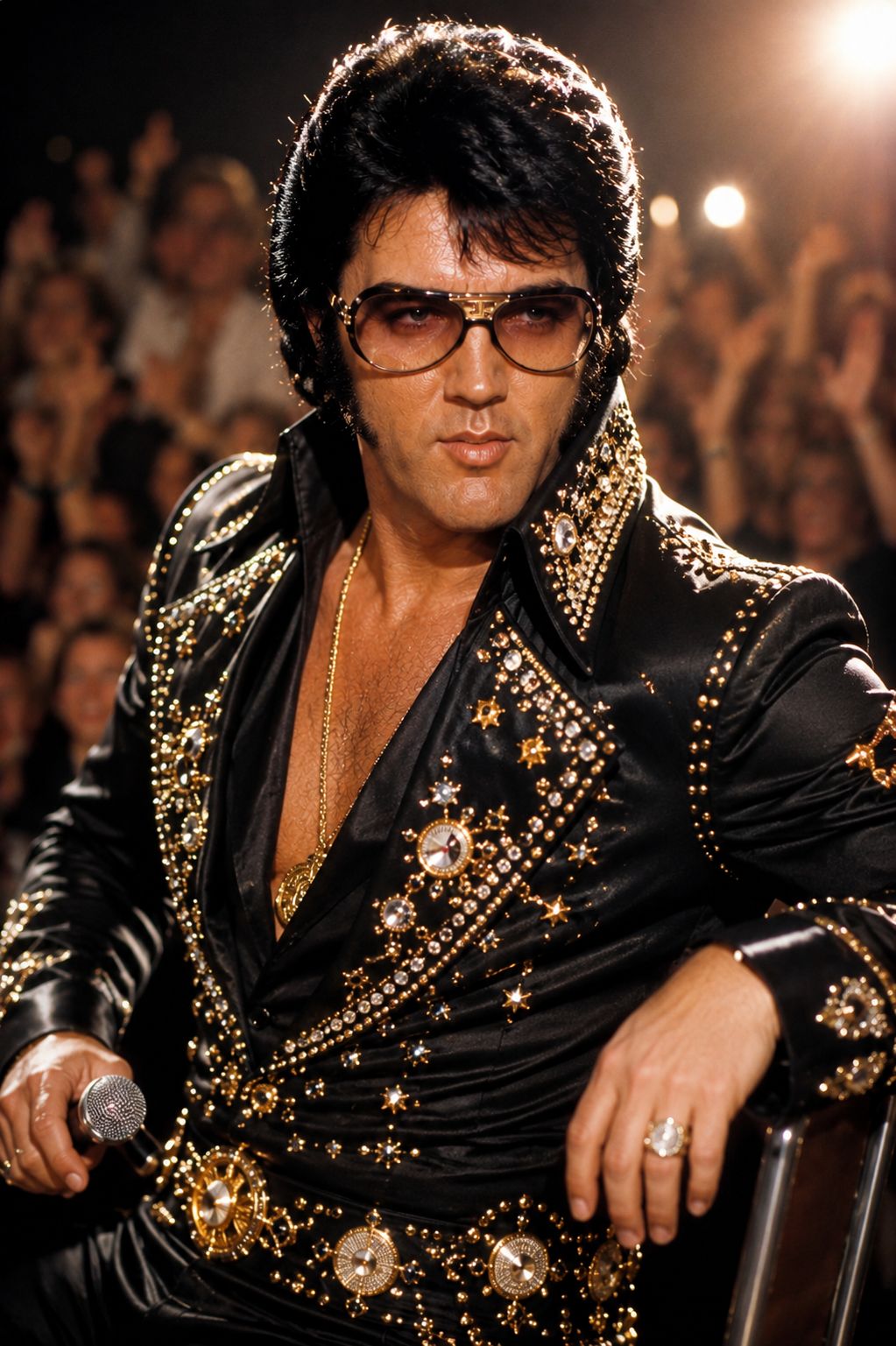
People saw the rhinestone jumpsuits.
They saw sold-out arenas.
But many never saw the emotional toll underneath it all.
What makes Elvis Presley’s wildest fame era so fascinating is that it revealed both the beauty and danger of superstardom before the modern celebrity machine fully existed.
Today, stars live under social media pressure.
Elvis endured global obsession without any roadmap at all.
No one had experienced fame like this before him.
Not at this scale.
Not with this intensity.
He became the blueprint for modern celebrity culture — the screaming fans, the media frenzy, the parasocial devotion, the impossible expectations.
Every superstar that came afterward inherited pieces of Elvis’s world.
From Michael Jackson to Prince to Garth Brooks, echoes of Elvis can still be seen in how audiences idolize performers.
Because Elvis taught the world what mass obsession looked like.
And yet, despite all the chaos, people still connected deeply to him.
Why?
Because beneath the fame, Elvis always seemed emotionally human.
He looked vulnerable.
Lonely.
Hopeful.
Broken.
Charismatic.
Real.
Fans didn’t just admire Elvis Presley.
They felt him.
That emotional connection is why his legacy refuses to die decades later.
Even now, new generations discover him and immediately understand the magnetism.
Not because he was perfect.
But because he carried both greatness and sadness at the same time.
In the end, Elvis Presley’s wildest fame era wasn’t only about screaming crowds or record-breaking success.
It was about what happens when one man becomes larger than culture itself.
He was worshipped, consumed, imitated, commercialized, and mythologized while still trying to navigate his own humanity.
And maybe that’s the tragedy hidden inside the legend.
The world wanted Elvis Presley forever.
But very few people stopped to ask what that kind of fame was doing to Elvis Aaron Presley the man.
“He gave the world everything he had — his voice, his energy, his soul. And the world never stopped asking for more.”
That’s why the story still resonates today.
Because inside Elvis Presley’s wildest fame era was not just the rise of a superstar…
It was the birth of modern fame itself.
Video