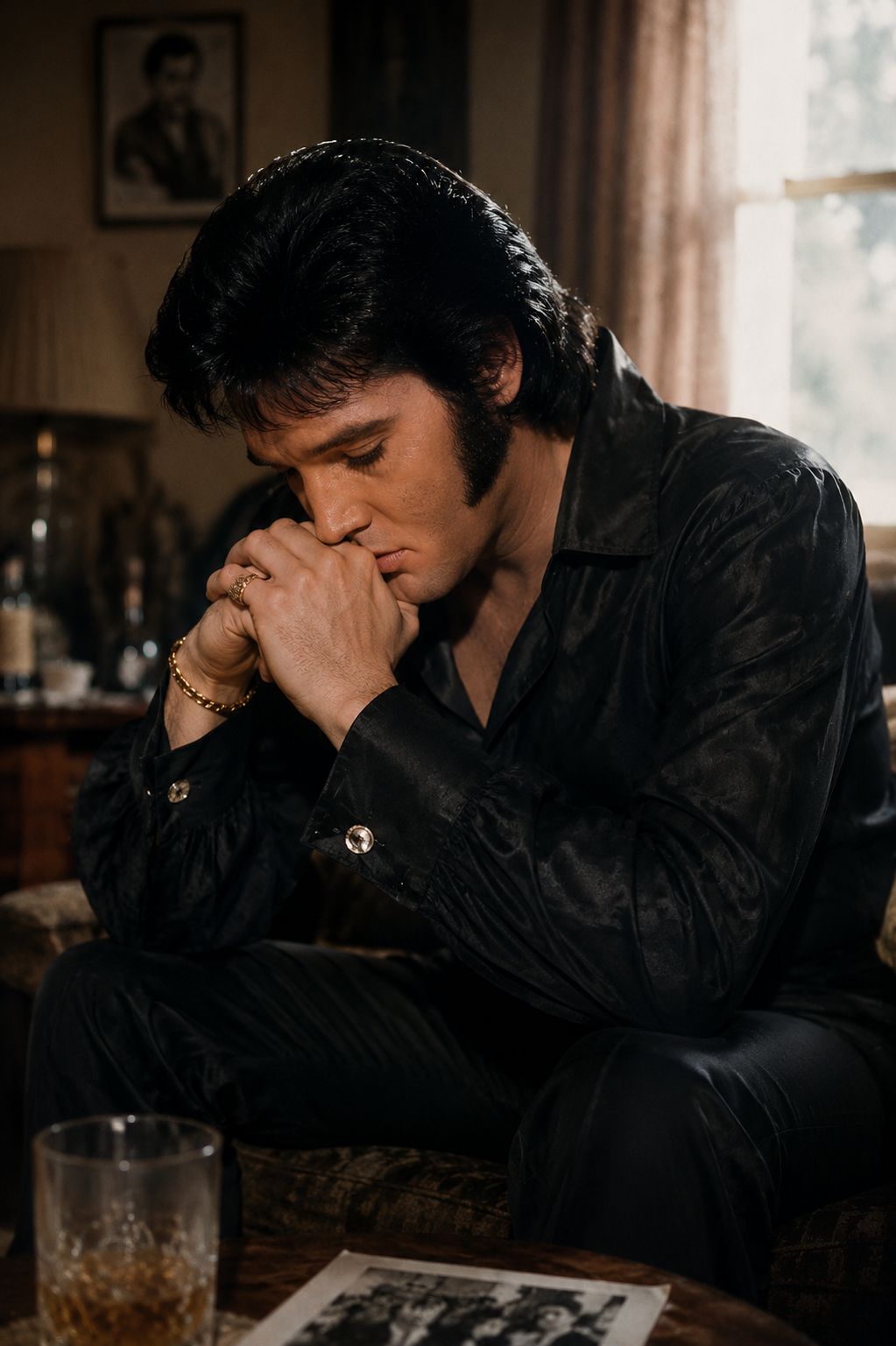
When the King Couldn’t Escape Himself: Elvis Presley’s Silent Battle Behind Closed Doors
To the world, Elvis Presley was untouchable.
He was the king of rhinestone glory, sold-out arenas, screaming fans, and shaking hips that changed music forever. Every smile looked effortless. Every performance looked larger than life. Cameras captured the legend. Headlines celebrated the icon.
But behind the gates of Graceland… behind the flashing cameras and gold records… there was another Elvis the public rarely saw.
A lonely man.
A frightened man.
A man silently losing a battle no amount of fame could heal.
And perhaps the saddest part of all was this:
The more the world worshipped Elvis Presley, the more isolated he became.
The Boy Who Never Escaped Poverty
Before he became “The King,” Elvis was simply a poor boy from Tupelo who grew up knowing struggle better than comfort.
His family had little money. His childhood was filled with uncertainty, instability, and emotional dependence on the people closest to him — especially his mother, Gladys Presley.
That bond would define Elvis for the rest of his life.
People who knew him early often described Elvis as deeply sensitive. He absorbed emotions intensely. Criticism wounded him. Rejection haunted him. Even at the height of his fame, there was still a fragile Southern boy underneath the dazzling jumpsuits.
And when fame exploded in the 1950s, Elvis was emotionally unprepared for what came next.
Because fame didn’t just change his life.
It trapped it.
“He could fill stadiums with people… yet still feel completely alone.”
Fame Became a Prison
The world saw screaming crowds and endless success.
But Elvis saw something different.
He saw pressure.
Every move he made became a headline. Every relationship became gossip. Every pound gained became public conversation. Millions adored him, but very few truly knew him.
As his fame grew, his personal freedom disappeared.
He couldn’t walk into stores normally. He couldn’t enjoy simple friendships without suspicion. Even trust became difficult. People wanted something from Elvis constantly — money, access, fame, opportunities.
Eventually, Graceland became less of a mansion…
…and more of a hiding place.


Those closest to him described long nights awake until dawn, watching television endlessly, unable to sleep, surrounded by people yet emotionally distant from nearly everyone.
The king of rock and roll had become a prisoner of his own legend.
The Death That Broke Him
When Elvis lost his mother in 1958, something inside him reportedly shattered forever.
Gladys Presley wasn’t just family to Elvis. She was his emotional anchor.
Her death devastated him so deeply that witnesses said he collapsed in grief at her funeral.
And although Elvis continued performing, filming movies, and building an empire afterward, many believe he was never emotionally whole again.
He spent years trying to fill a wound that never truly healed.
Relationships became unstable. Emotional dependency intensified. The need for comfort — any comfort — grew stronger over time.
And slowly, the cracks behind the smile became harder to hide.
“The world still saw a king. But privately, Elvis was carrying grief he never learned how to release.”
Hollywood Nearly Destroyed His Spirit
During the 1960s, Elvis became trapped in a machine that prioritized profit over passion.
Movie after movie.
Song after song.
Formula after formula.
While fans still adored him, Elvis himself reportedly became deeply frustrated with the shallow Hollywood system surrounding him. Many of the films lacked artistic meaning. The scripts felt repetitive. The music often lacked the fire that once made him revolutionary.
He wanted to be taken seriously.
Instead, he increasingly felt controlled.
Colonel Tom Parker, Elvis’s longtime manager, kept the machine moving relentlessly. Financial success mattered. Public image mattered.
But Elvis’s emotional exhaustion often came second.
Behind closed doors, frustration turned into sadness. Sadness turned into numbness.
And numbness became dangerous.
The Pills, the Sleepless Nights, and the Silence
One of the darkest chapters of Elvis Presley’s life was his growing dependence on prescription medication.
At first, the pills were practical.
Something to sleep.
Something to wake up.
Something for anxiety.
Something for exhaustion.
But over time, the dependency spiraled.
The touring schedule was brutal. The expectations were impossible. Elvis’s body and mind were under constant strain. Prescription drugs became an escape from emotional pain, insomnia, loneliness, and physical fatigue.
And because he was Elvis Presley, very few people truly stopped him.
Many around him depended financially on his success. Others feared confronting him. Some simply didn’t understand how serious the situation had become.
Meanwhile, the public still expected magic every night.


Onstage, Elvis could still electrify crowds.
Offstage, the battle intensified quietly.
“Some of the loudest applause in history could not drown out the silence Elvis felt inside.”
His Marriage Couldn’t Survive the Storm
Elvis’s relationship with Priscilla Presley remains one of the most discussed love stories in music history.
At first, their relationship seemed like a fairytale.
But life with Elvis was far from ordinary.
The fame. The isolation. The emotional instability. The endless touring. The pressures surrounding Graceland. It all created distance between them.
Priscilla later spoke openly about how difficult life became behind the scenes. Elvis could be loving and generous, but also emotionally restless and deeply complicated.
Eventually, their marriage collapsed under the weight of a life neither of them could fully control.
Even after their divorce, however, there remained affection between them.
Because beneath everything else, Elvis was still a man desperately searching for peace.
And perhaps he never truly found it.
The Final Years Were Painfully Human
By the mid-1970s, Elvis’s decline had become increasingly visible.
Weight fluctuations.
Exhaustion.
Health issues.
Erratic performances.
But what many people missed was the emotional suffering beneath the physical changes.
Elvis wasn’t just battling health problems.
He was battling emptiness.
Years of pressure, grief, dependency, and emotional isolation had taken a devastating toll.
And still… he kept performing.
Night after night.
City after city.
Giving fans pieces of himself even while he was falling apart internally.
There is something heartbreaking about watching late-era Elvis footage today.
You can still see flashes of brilliance.
Still hear the power in his voice.
Still feel the charisma.
But you can also see the exhaustion in his eyes.
As if part of him knew the fight was slipping away.
“The tragedy of Elvis Presley wasn’t that he lost fame. It was that fame slowly consumed the man underneath it.”
Why Elvis’s Story Still Hurts Generations Later
The reason Elvis Presley’s story continues to affect people decades after his death is because it feels painfully relatable beneath the celebrity.
His battle wasn’t only about stardom.
It was about loneliness.
About emotional wounds left untreated.
About trying to carry impossible expectations.
About becoming trapped inside an identity the world demanded from you.
Millions know what it feels like to smile publicly while suffering privately.
That’s why Elvis remains more than a music icon.
He became a symbol of the hidden emotional cost of fame.
And perhaps that is why people still gather at Graceland every year — not only to celebrate the legend, but to mourn the man.
Because somewhere beneath the glittering suits and roaring applause was a deeply human soul quietly crying out for peace.
And in the end…
The world heard the music.
But very few heard the pain.