Introduction
There are moments in music history when a single artist stops following the road and starts driving through the fence.
For country music, that moment belonged to Willie Nelson.
Long before the outlaw movement became a marketing term and decades before “authenticity” became a buzzword, Willie Nelson was searching for something deeper than Nashville polish. He wasn’t trying to rebel for the sake of rebellion. He was trying to hear the truth.
And the truth, as it turned out, was hiding beneath the studio gloss.
The raw, unedited sound that Willie Nelson embraced during the early 1970s didn’t just transform his own career—it gave birth to an entirely new musical universe known today as Cosmic Country.
Nashville’s Golden Cage
By the late 1960s, Willie Nelson was already respected as one of country music’s greatest songwriters.
He had written classics for other artists. His talent was unquestioned.
But there was a problem.
The Nashville production system was designed for perfection.
String sections were carefully arranged. Background vocals were polished. Sessions followed strict formulas. Producers often had the final say. The result was professional, radio-friendly, and commercially successful.
Yet Willie felt trapped.
The songs sounded clean.
Too clean.
The imperfections that made music human were being scrubbed away.
Years later, many musicians would describe this era as a time when country music often prioritized precision over personality. Willie Nelson wanted the opposite.
He wanted personality over perfection.
“The mistakes were part of the feeling.”
That philosophy would become the foundation of Cosmic Country.
The Return to Texas
Everything changed when Willie left Nashville and returned to Texas.
The move wasn’t merely geographic.
It was spiritual.
Austin in the early 1970s was becoming a cultural crossroads. Long-haired hippies and traditional country fans were beginning to share the same dance floors. Folk musicians mixed with honky-tonk veterans. Rock influences blended with country traditions.
Most executives saw confusion.
Willie Nelson saw possibility.
Instead of trying to fit into a category, he began creating music that ignored categories altogether.
The sound was looser.
The musicians played together instead of being assembled like machine parts.
Songs breathed.
Tempos drifted naturally.
Instruments interacted organically.
And most importantly, Willie stopped worrying about whether every note was technically perfect.
He started caring whether it felt real.
The Birth of an Unfiltered Sound
Listen carefully to Willie Nelson’s landmark recordings from the era.
What you hear isn’t studio perfection.
You hear people.
You hear fingers moving across guitar strings.
You hear slight timing variations.
You hear vocal cracks and emotional imperfections.
You hear life.
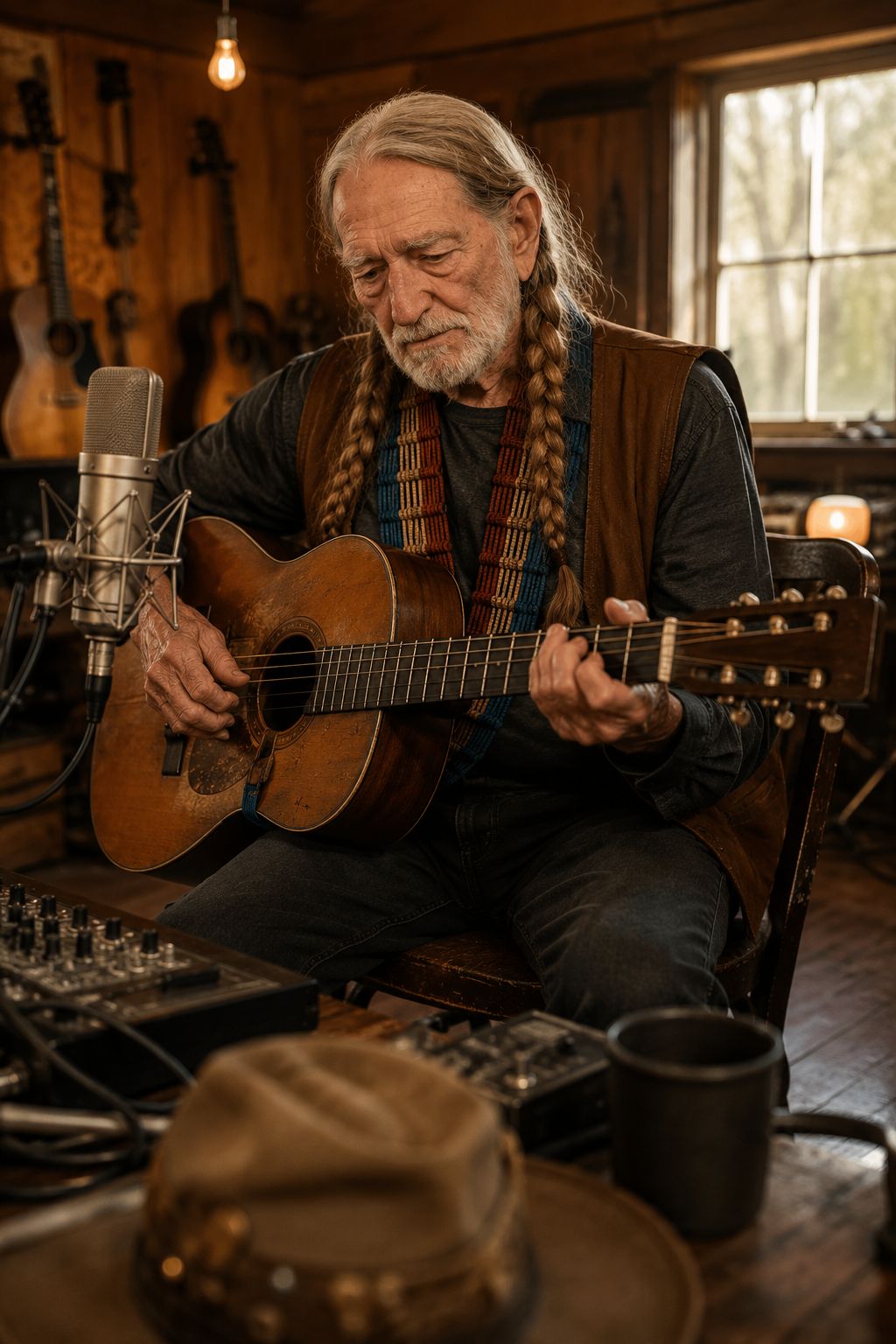
At the center of it all was Willie’s beloved guitar, Trigger.
Trigger wasn’t pristine.
It wasn’t shiny.
It wasn’t flawless.
In fact, it became increasingly worn over the years.
But that wear told a story.
Every scratch represented a performance.
Every scar represented a journey.
The guitar sounded like its owner: weathered, honest, and impossible to imitate.
When Willie played Trigger, he wasn’t chasing technical brilliance.
He was chasing emotional truth.
That distinction changed everything.
Why Cosmic Country Felt Different
The term “Cosmic Country” often confuses people.
Some assume it referred to psychedelic effects.
Others think it was simply country music played by hippies.
The reality was far more profound.
Cosmic Country was about freedom.
Freedom from genre expectations.
Freedom from commercial formulas.
Freedom from the belief that music had to fit into neat boxes.
Willie Nelson became one of the movement’s most visible pioneers because he understood something many artists missed:
Music is emotional communication before it is technical performance.
The raw recordings emerging from Texas carried an energy that polished Nashville productions often couldn’t capture.
Listeners weren’t hearing a manufactured product.
They were hearing a conversation.
“The songs felt like they were happening in real time.”
That feeling became addictive.
Fans could sense the difference immediately.
The Revolutionary Power of Imperfection
Modern music production often encourages artists to remove flaws.
Pitch correction.
Timing correction.
Editing.
Layer upon layer of adjustments.
Willie Nelson instinctively moved in the opposite direction.
He understood that imperfections create intimacy.
Think about the most memorable conversations you’ve ever had.
They weren’t perfect.
People paused.
They stumbled.
Their voices cracked with emotion.
That’s what made them meaningful.
Willie’s recordings captured those human moments.
His voice sometimes drifted behind the beat.
His guitar phrasing ignored conventional rules.
His delivery felt conversational rather than calculated.
Traditional industry executives sometimes viewed these qualities as weaknesses.
Audiences viewed them as honesty.
And honesty wins.
Every time.
The Album That Changed Everything
When Red Headed Stranger arrived in 1975, many industry insiders were stunned.
The album was sparse.
Minimalist.
Almost shockingly simple compared to mainstream country productions of the era.
Some executives reportedly feared it sounded unfinished.
Willie Nelson heard something else.
He heard space.
He heard emotion.
He heard truth.
The album trusted listeners to lean in rather than overwhelming them with production.
Instead of hiding vulnerability, it showcased vulnerability.
The result was one of the most influential country albums ever recorded.
It proved that rawness could be commercially successful.
It proved that authenticity could outperform formulas.
And it permanently altered the direction of country music.
“What some people heard as empty space, Willie heard as freedom.”
The Human Voice Behind the Legend
Perhaps the most overlooked aspect of Willie’s raw sound was his singing.
Technically, he never sounded like a conventional Nashville vocalist.
His phrasing was unusual.
His timing was unpredictable.
His delivery often borrowed from jazz traditions rather than standard country patterns.
But those very qualities made him unforgettable.
Willie sang as if he were telling a story directly to one person.
Not a crowd.
Not a radio audience.
One person.
That intimacy created an emotional connection that transcended genre boundaries.
Fans didn’t simply listen to Willie Nelson.
They believed him.
And belief is the most powerful force in music.
The Legacy That Still Echoes Today
The influence of Willie Nelson’s raw, unedited approach can be heard across generations.
Artists in Americana.
Independent country musicians.
Singer-songwriters.
Even modern alternative and folk performers.
Many of them are still following the path Willie helped clear decades ago.
The idea that a recording can be emotionally powerful without being technically perfect now feels obvious.
But it wasn’t obvious in the early 1970s.
Someone had to prove it.
Someone had to risk failure.
Someone had to trust that authenticity would resonate more deeply than polish.
Willie Nelson became that someone.
The Sound That Couldn’t Be Manufactured
The greatest irony of Cosmic Country is that countless people have tried to recreate it.
Many have copied the style.
Few have captured the spirit.
Because Cosmic Country was never really about instruments, hairstyles, or recording techniques.
It was about courage.
The courage to sound like yourself.
The courage to leave imperfections untouched.
The courage to trust emotion over convention.
That’s what Willie Nelson discovered.
The raw unedited sound that helped birth Cosmic Country wasn’t merely a production choice.
It was a philosophy.
A declaration.
A refusal to let authenticity be edited out of existence.
And decades later, as listeners continue searching for music that feels genuine, the lesson remains unchanged.
Sometimes the most powerful sound in the world isn’t the polished one.
It’s the imperfect one.
The one that still sounds human.
The one that Willie Nelson heard before anyone else.
And the one that changed country music forever.
Video