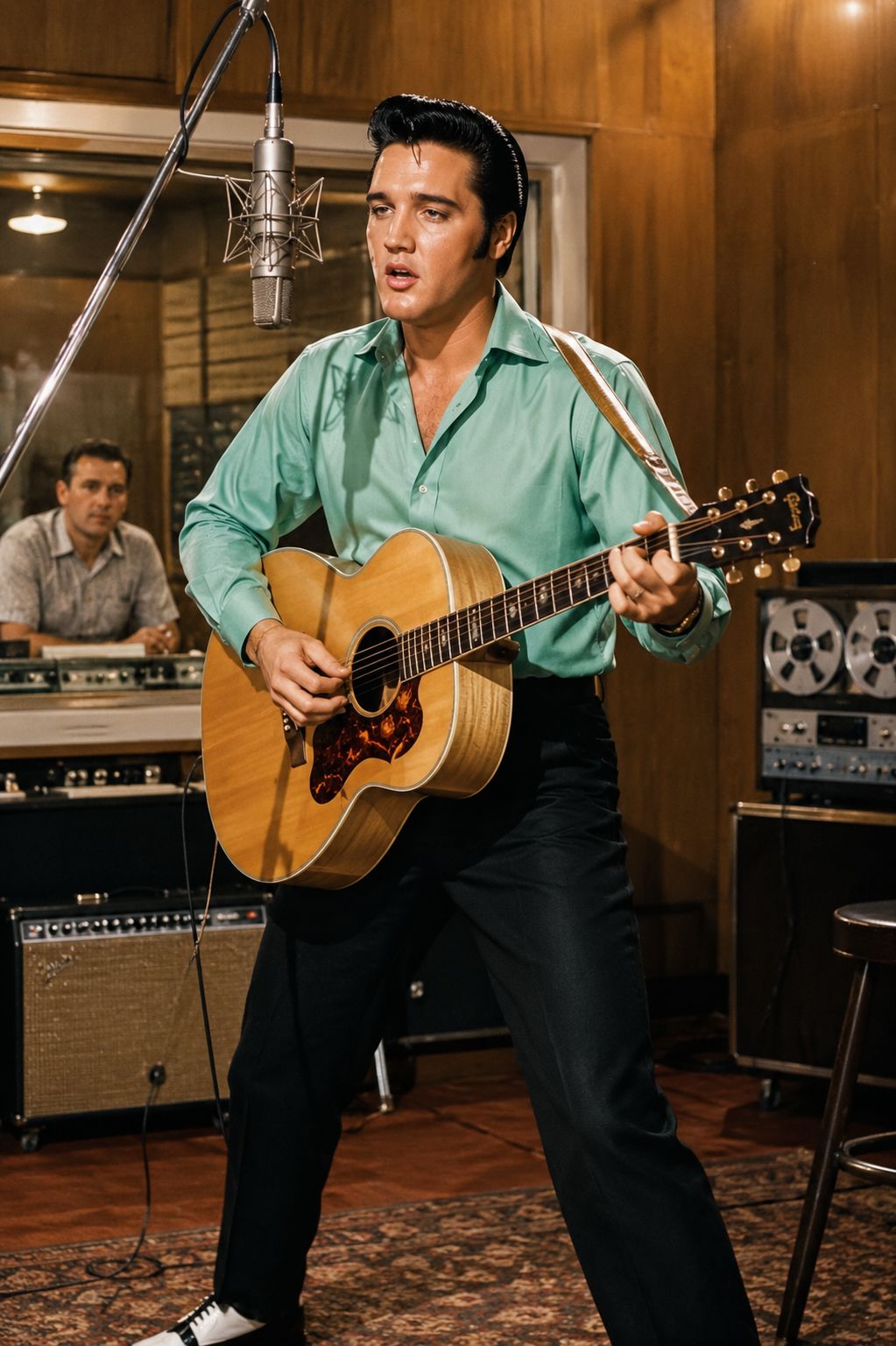
There are sounds in music history that feel bigger than notes. Bigger than lyrics. Bigger even than the artists who created them.
For Elvis Presley, one of those sounds was not a guitar riff, a vocal run, or a drumbeat.
It was an echo.
A quick, bouncing, almost ghostly repetition that seemed to chase his voice through the speakers like a shadow refusing to let go.
Today we call it slap-back echo. To modern ears, it may sound simple. But in the mid-1950s, it helped create one of the most electrifying sounds the world had ever heard.
This is the story of how a tiny studio effect became one of the most important ingredients in Elvis Presley’s legend.
The Sound That Didn’t Exist on the Radio
In 1954, America was changing.
The polished pop singers dominating the airwaves were delivering smooth, carefully controlled performances. Record labels preferred clean productions. Everything was designed to sound refined.
Then a young truck driver from Memphis walked into Sun Studio.
Elvis Presley possessed something producers struggled to define.
His voice carried gospel passion, country storytelling, rhythm-and-blues grit, and raw youthful energy all at once.
Yet even that remarkable voice needed a sonic identity.
The missing piece would arrive through experimentation.
Not through a carefully planned strategy.
Not through corporate market research.
But through pure curiosity.
Inside Sun Studio, producer and founder Sam Phillips was obsessed with making records sound different from anything else on the radio.
He understood a simple truth:
“If it sounds like everybody else, nobody remembers it.”
Phillips wasn’t searching for perfection.
He was searching for excitement.
And excitement often comes from accidents.
The Birth of a Sonic Ghost
The story of slap-back echo begins with tape machines.
Unlike today’s digital recording tools, engineers in the 1950s worked with magnetic tape. By routing sound from one machine to another and introducing a slight delay, they could create a quick echo.
Not a long cavernous reverb.
Not a dramatic cinematic effect.
Just a sharp repeat occurring fractions of a second after the original sound.
The result was magical.
When Elvis sang a line, the echo answered him.
When he shouted, the room seemed to shout back.
When he whispered, a ghostly version of his voice lingered behind him.
Suddenly recordings felt larger than life.
The sound wasn’t merely heard.
It was felt.
Listeners couldn’t always identify what made Elvis records different.
But they knew they sounded alive.
“That’s All Right” and a Revolution
When Elvis recorded the song That’s All Right, few could have predicted the impact it would have.
The performance itself was explosive.
His vocals danced between country and rhythm-and-blues traditions. His phrasing broke rules. His energy felt dangerous.
Then came the slap-back echo.
The effect wrapped around the performance like lightning around a thunderstorm.
Every vocal line gained movement.
Every pause gained tension.
Every emotional moment became larger.
Listeners weren’t hearing a polished studio creation.
They felt like they were standing inside the room.
That illusion changed everything.
The echo didn’t hide Elvis.
It amplified the excitement already exploding from him.
Many artists had strong voices.
Many singers had charisma.
But Elvis suddenly possessed a sound nobody else could replicate.
Why the Echo Worked So Perfectly
The genius of slap-back echo wasn’t simply technical.
It was psychological.
Human beings naturally respond to space.
An echo suggests distance, movement, and dimension.
When Elvis records used slap-back echo, they created the illusion that something enormous was happening.
The listener’s brain interpreted the sound as bigger than the speaker producing it.
That’s why early Presley recordings felt almost cinematic despite being created with extremely limited equipment.
His voice seemed to leap out of radios.
Teenagers felt it instantly.
Parents often found it unsettling.
The records sounded rebellious because they refused to sit still.
Even the echo itself seemed restless.
The Secret Weapon of Rockabilly
As Elvis rose to fame, slap-back echo became inseparable from the emerging rockabilly movement.
Artists throughout the South began chasing the same energy.
Studios attempted to recreate the magic.
Producers studied the recordings.
Engineers experimented endlessly.
Yet many discovered a frustrating reality.
The equipment mattered.
But the performer mattered more.
Elvis wasn’t successful because of slap-back echo.
Slap-back echo was successful because it enhanced Elvis.
Without his explosive vocal delivery, the effect could sound gimmicky.
With Elvis, it became transformative.
The combination was perfect.
Like gasoline meeting fire.
The Human Side of the Sound
What often gets overlooked is how emotional those recordings remain.
Listen closely to Elvis’s early work.
Behind the technical innovation is vulnerability.
A young man is singing with everything he has.
He isn’t calculating his legacy.
He isn’t thinking about history books.
He’s simply trying to communicate emotion.
The echo preserves that feeling.
It captures urgency.
It captures longing.
It captures youthful confidence mixed with uncertainty.
The effect almost functions as a second character in the performance.
A companion.
A reflection.
A memory arriving milliseconds after reality.
Every slap-back echo on an Elvis record feels like yesterday chasing today.
That’s why the sound still resonates decades later.
Technology ages.
Emotion doesn’t.
The Influence That Never Ended
The impact of Elvis’s slap-back echo extended far beyond the 1950s.
Generations of artists adopted the technique.
Rockabilly musicians embraced it.
Country artists borrowed it.
Rock performers made it part of their sonic vocabulary.
Even modern digital recordings frequently recreate the effect.
Producers now have software capable of generating thousands of echoes instantly.
Ironically, many still try to imitate the simple tape delay that helped define Elvis.
Because authenticity remains difficult to manufacture.
The original recordings possessed imperfections.
Tiny fluctuations.
Human unpredictability.
Those flaws became strengths.
The echo felt alive because the people creating it were alive.
The Echo Behind the Legend
When people discuss Elvis Presley, they often focus on the obvious landmarks.
The jumpsuits.
The television appearances.
The screaming audiences.
The record sales.
The cultural revolution.
All of those things matter.
But legends are often built upon details invisible to casual observers.
A guitar tone.
A microphone choice.
A recording trick.
A split-second delay.
The slap-back echo belongs in that category.
It wasn’t merely a studio effect.
It became part of Elvis’s identity.
Part of his mythology.
Part of the sonic fingerprint that distinguished him from everyone else.
Without it, the records might still have been great.
With it, they became unforgettable.
The Final Echo
More than seventy years after those early Memphis sessions, the sound continues to reverberate through music history.
New listeners discover Elvis every year.
Many cannot explain why the recordings feel so immediate.
Why they sound energetic even compared to modern productions.
Why they seem to jump from the speakers with such urgency.
The answer is partly Elvis himself.
His voice.
His courage.
His charisma.
But hidden behind those famous performances is a quick bouncing shadow.
A split-second companion following every phrase.
A technical innovation transformed into emotional art.
A sound that helped launch rock and roll.
And perhaps that’s the greatest lesson of the slap-back echo chronicles.
Sometimes history isn’t changed by the loudest sound in the room.
Sometimes it’s changed by the sound that arrives a fraction of a second later.
The sound that refuses to disappear.
The sound still chasing Elvis Presley across generations.
The sound we are still hearing today.
Video