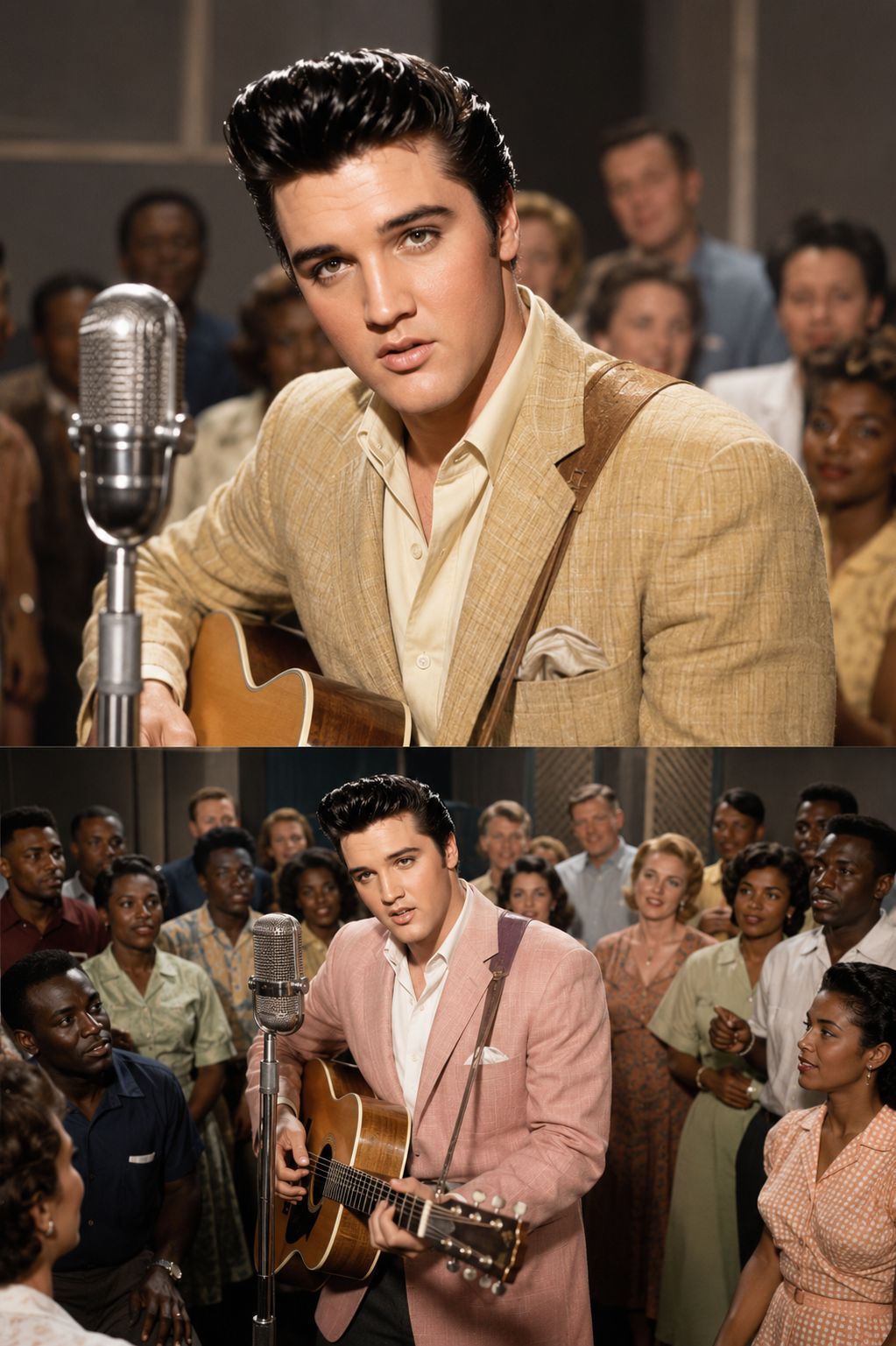
Introduction
There are moments in music history that feel larger than songs. Moments when a voice crackles through a speaker and quietly begins changing a culture. For millions of Americans in the mid-1950s, one such moment arrived through a humble radio broadcast featuring a young truck driver from Memphis named Elvis Presley.
Today, it may be difficult to understand just how revolutionary Elvis sounded when he first hit the airwaves. Modern listeners hear the familiar voice of a global icon. But in 1954, listeners across the American South heard something entirely different: a sound that seemed to blur racial boundaries in a region where those boundaries were fiercely enforced.
That first radical radio debut did more than introduce a future superstar. It challenged assumptions, confused audiences, and shocked a segregated society that wasn’t prepared for what it was hearing.
A South Divided by More Than Geography
The South of the early 1950s was governed not only by laws but by unwritten social codes. Segregation shaped schools, restaurants, buses, theaters, and even the music industry.
Radio stations generally divided music into categories that mirrored racial divisions. White audiences were expected to listen to country music, while Black audiences often tuned into rhythm and blues stations. The industry carefully labeled records according to race and market demographics.
Then along came Elvis Presley.
Raised in Tupelo, Mississippi, and later Memphis, Tennessee, Elvis grew up absorbing sounds from every direction. He listened to country singers, gospel quartets, blues musicians, and rhythm-and-blues performers. Unlike many artists of the era, he didn’t view these styles as separate worlds.
He simply loved music.
That love would soon create a cultural earthquake.
The Night Everything Changed
In July 1954, Elvis entered the legendary studios of Sun Records under the guidance of Sam Phillips. The recording session had produced little excitement until late in the evening.
During a break, Elvis began fooling around with an upbeat version of “That’s All Right,” originally recorded by blues artist Arthur Crudup.
Something clicked.
The energy in the room transformed instantly.
Guitarist Scotty Moore and bassist Bill Black jumped in. What emerged was neither traditional country nor conventional rhythm and blues.
It was something new.
Sam Phillips knew he had captured lightning.
But no one could predict what would happen once the recording reached radio listeners.
The Broadcast That Left Listeners Guessing
When Memphis DJ Dewey Phillips premiered “That’s All Right” on his popular radio program, phones began ringing almost immediately.
Listeners wanted answers.
Who was this singer?
Where had he come from?
And perhaps most revealingly:
Was he Black or white?
“People genuinely couldn’t tell.”
The question itself revealed how unusual the recording sounded.
White singers generally didn’t perform with the vocal phrasing, rhythmic intensity, and emotional delivery associated with Black rhythm-and-blues artists. Yet Elvis’s voice carried precisely those influences.
Across living rooms, diners, and automobiles, listeners debated the mystery.
Some were convinced the singer had to be African American.
Others insisted he was white.
The confusion spread rapidly.
In a segregated society where music was often categorized by race before talent, Elvis had unintentionally shattered expectations.
A Dangerous Kind of Innovation
The significance of that radio debut wasn’t merely musical.
It was cultural.
The South’s social structure depended heavily on maintaining distinctions between Black and white experiences. Music was one of the many spaces where those distinctions were enforced.
Elvis’s recording challenged those assumptions.
He wasn’t mocking Black music.
He wasn’t imitating it as a novelty.
He was embracing influences he genuinely loved and combining them with country traditions he had grown up hearing.
The result created discomfort for some listeners.
“The music sounded familiar, yet completely foreign.”
Conservative audiences struggled to classify it.
Industry executives didn’t know how to market it.
Radio programmers weren’t sure which stations should play it.
That uncertainty revealed something profound: Elvis had slipped through the barriers that the music business had carefully constructed.
The Shockwaves Through Southern Radio
As “That’s All Right” spread beyond Memphis, reactions became increasingly intense.
Teenagers loved it.
Many adults were horrified.
The song represented a generation beginning to challenge old assumptions. Young listeners cared less about rigid categories and more about excitement, energy, and authenticity.
Elvis delivered all three.
His records soon became fixtures on jukeboxes throughout the South.
Crowds gathered whenever his songs played.
Young fans felt they were hearing the future.
Older critics often felt they were hearing the collapse of tradition.
Both sides recognized one thing:
Something significant was happening.
More Than a Singer
What made Elvis particularly threatening to cultural gatekeepers wasn’t simply his sound.
It was his accessibility.
He wasn’t an established star from New York or Hollywood.
He wasn’t backed by a major corporation.
He looked like an ordinary Southern kid.
That relatability made his success harder to dismiss.
Listeners could imagine someone like Elvis living down the street.
And if someone like Elvis could blend musical traditions that society insisted should remain separate, what else might be possible?
Those questions lingered beneath the surface of every radio broadcast.
The Youth Revolution Begins
Many historians focus on Elvis’s television appearances, his chart success, or his later films.
But the real revolution arguably began with radio.
Before the national headlines.
Before the screaming crowds.
Before the gold records.
There was simply a voice coming through a speaker.
A voice that sounded unlike anything listeners expected.
Radio allowed the music to arrive without visual context. Audiences heard the sound before they saw the performer.
That sequence mattered.
If listeners had first encountered Elvis visually, some might have immediately categorized him as a white Southern singer.
Instead, they heard the music first.
And the music challenged their assumptions before their eyes could reinforce them.
It was a subtle but powerful disruption.
The Legacy of That First Broadcast
Looking back, it’s easy to underestimate the significance of Elvis’s radio debut.
After all, history remembers him as the King of Rock and Roll. His eventual success feels inevitable.
But nothing about that first broadcast was guaranteed.
The record could have disappeared.
The audience could have rejected it.
The experiment could have failed.
Instead, it ignited one of the most influential careers in music history.
More importantly, it revealed the power of music to cross boundaries that society considered immovable.
“A song lasting only a few minutes exposed the fragility of divisions that had existed for generations.”
That doesn’t mean Elvis single-handedly transformed the South. Cultural change is never that simple.
Yet his emergence demonstrated that art often moves ahead of politics, laws, and institutions.
Music can open doors long before society is ready to walk through them.
Why the Story Still Matters
More than seventy years later, the story of Elvis’s radical radio debut continues to resonate because it reminds us that innovation often begins with confusion.
The most transformative artists rarely fit neatly into existing categories.
They challenge assumptions.
They blur boundaries.
They force audiences to reconsider what they think they know.
When Elvis Presley’s voice first emerged from Southern radio speakers, listeners weren’t merely hearing a new singer.
They were hearing the sound of cultural walls beginning to crack.
The shock, controversy, and fascination that followed were proof that something extraordinary had happened.
A young man from Memphis had unknowingly launched a revolution—not with a speech, a protest, or a political movement, but with a song.
And for a segregated South accustomed to clear divisions, that may have been the most radical thing of all.
Video