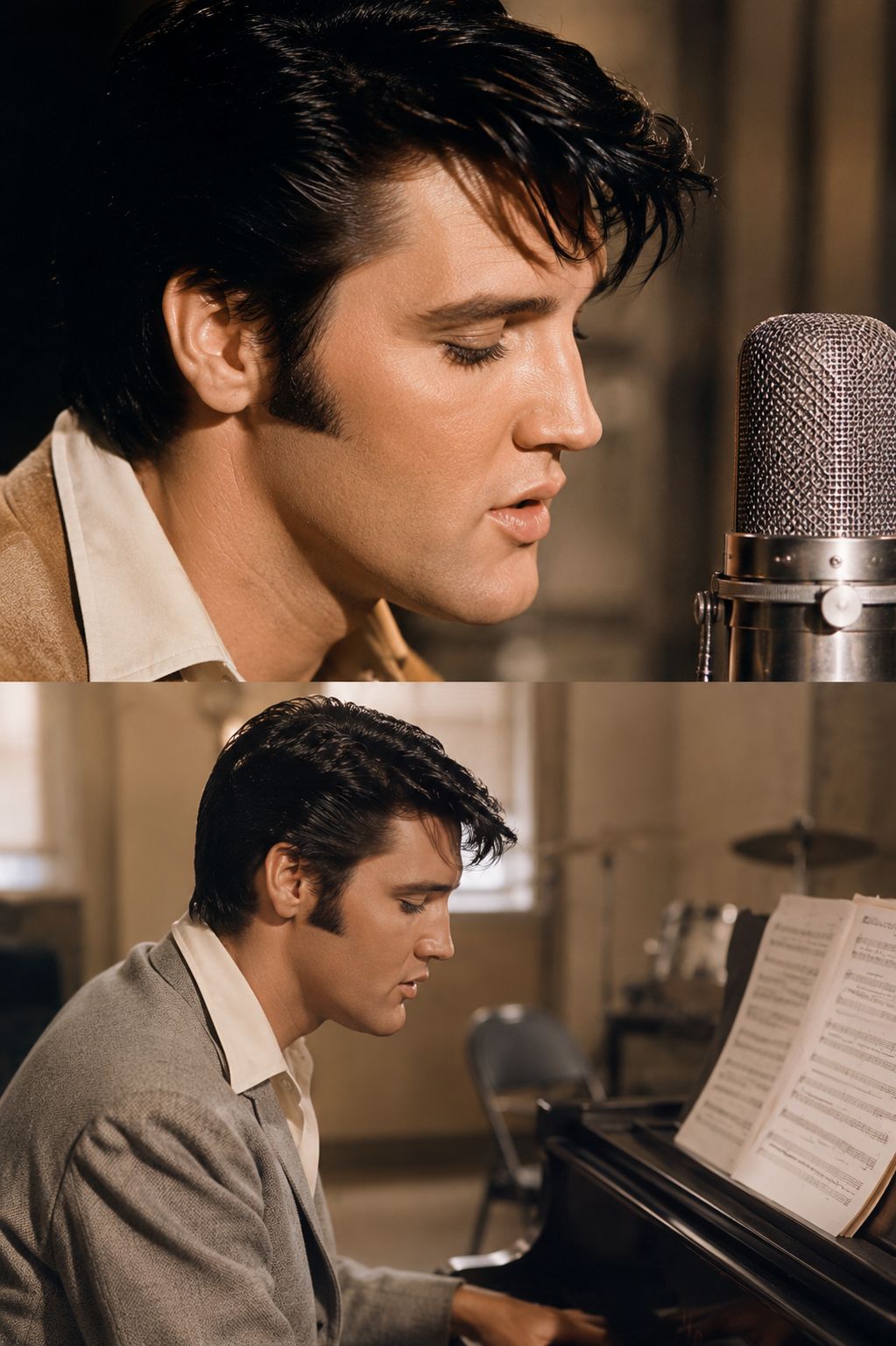
Introduction
Long before the dazzling jumpsuits, the sold-out arenas, and the global phenomenon known simply as Elvis, there was a narrow stretch of pavement in Memphis that witnessed something extraordinary. Union Avenue wasn’t just another street in America’s musical landscape—it was the proving ground where a young truck driver named Elvis Presley quietly forged the sound that would change popular music forever.
Today, millions know the legend. Far fewer know the rehearsal secrets hidden behind the walls of the famous recording rooms on Union Avenue, where Elvis spent countless hours refining his craft. Those sessions weren’t glamorous. They weren’t attended by screaming fans. There were no television cameras, no gold records hanging on the walls.
There was only ambition.
And an almost obsessive desire to become unforgettable.
The Room Where Everything Changed
In the early 1950s, Memphis was overflowing with musical energy. Blues drifted from Beale Street. Gospel echoed from churches. Country music poured from radios across the South.
At the center of this collision of sounds stood the legendary Sun Studio on Union Avenue.
When Elvis first stepped inside, nobody expected history to unfold.
He wasn’t a polished performer. He wasn’t a trained vocalist. In fact, many industry veterans would have dismissed him as just another hopeful singer carrying impossible dreams.
But there was something different.
Studio personnel quickly noticed that Elvis approached rehearsal unlike anyone else.
While many singers wanted to rush into recording, Elvis wanted to experiment.
He wanted to search.
He wanted to discover.
“He never seemed satisfied with the obvious version of a song.”
That restless curiosity became the foundation of his greatness.
Rehearsals That Lasted Far Beyond Midnight
Stories from those early sessions reveal a performer who often treated rehearsals as laboratories rather than practice sessions.
Elvis would run through songs repeatedly, altering tempos, changing vocal inflections, and experimenting with phrasing.
One take might sound deeply country.
The next would lean toward rhythm and blues.
Then suddenly he’d inject gospel harmonies he remembered from church services during his childhood.
Witnesses often described the process as chaotic.
Yet hidden inside that chaos was genius.
While others were trying to fit into existing musical categories, Elvis was unknowingly creating a new one.
Union Avenue became his workshop.
Every rehearsal represented another step toward the revolutionary sound that would soon explode across America.
The Secret Weapon Nobody Saw Coming
Many people assume Elvis’s greatest strength was his voice.
Others point to his charisma.
Some credit his appearance.
But musicians who observed those rehearsal sessions often highlighted something else entirely: his listening ability.
Elvis listened constantly.
He listened to records.
He listened to fellow musicians.
He listened to mistakes.
Most importantly, he listened to possibilities.
During rehearsals, he would absorb ideas from everyone in the room.
A guitarist’s accidental riff.
A drummer’s unexpected rhythm.
A casual suggestion from an engineer.
Nothing escaped his attention.
That openness transformed rehearsals into collaborative adventures rather than rigid performances.
“Elvis could hear something special before anyone else recognized it.”
This ability allowed him to blend influences in ways that seemed impossible at the time.
The Moment That Revealed His Work Ethic
Popular culture often portrays Elvis as someone naturally gifted from the beginning.
The reality was far more inspiring.
Behind the effortless performances stood relentless preparation.
Musicians recalled rehearsals where Elvis refused to leave until a song felt right.
Not technically correct.
Not commercially safe.
Right.
That distinction mattered.
He wasn’t chasing perfection.
He was chasing emotion.
If a performance failed to generate feeling, he considered it unfinished.
Hours could disappear while searching for a single vocal phrase capable of delivering the emotional impact he imagined.
This obsession became one of the defining characteristics of his career.
It started on Union Avenue.
When Confidence Was Still Fragile
One of the most fascinating rehearsal secrets involves Elvis’s vulnerability.
History remembers him as a fearless superstar.
The young Elvis was something entirely different.
He frequently questioned himself.
He worried about whether audiences would accept his unusual style.
He wondered if blending country, blues, and gospel would alienate listeners.
Those insecurities surfaced during rehearsals.
Yet instead of allowing fear to stop him, he used uncertainty as fuel.
Every rehearsal became an opportunity to test ideas.
To fail safely.
To improve.
To grow.
There is something deeply human about that image.
The future King of Rock and Roll wasn’t born believing he would conquer the world.
He became Elvis by repeatedly confronting doubt and moving forward anyway.
The Magic of Spontaneity
Perhaps the most remarkable Union Avenue secret was Elvis’s relationship with spontaneity.
Many legendary recordings emerged from moments that were never planned.
Rehearsals often drifted into informal jam sessions.
Musicians would loosen up.
Pressure would disappear.
Then something unexpected would happen.
A rhythm would click.
A melody would ignite.
An entirely new energy would fill the room.
Elvis thrived in those moments.
He possessed an extraordinary ability to recognize lightning while it was still forming.
Instead of stopping spontaneous breakthroughs, he encouraged them.
The result was music that felt alive.
Not manufactured.
Not calculated.
Alive.
That authenticity would become one of the defining qualities of every stage of his career.
“The best moments were often the ones nobody intended.”
Building the Performer Behind the Legend
Union Avenue wasn’t merely shaping Elvis the singer.
It was creating Elvis the performer.
During rehearsals, he experimented with movement as much as music.
Even in informal settings, he responded physically to rhythm.
A foot tap.
A shoulder movement.
A sudden burst of energy.
What later shocked television audiences had roots in these private sessions.
The physical connection between Elvis and music wasn’t choreography.
It was instinct.
The rehearsals allowed him to understand how sound and movement could work together to create emotional impact.
Without realizing it, he was developing a performance style that would redefine live entertainment.
Why These Secrets Still Matter Today
Modern artists have access to technology Elvis could never have imagined.
Digital editing.
Pitch correction.
Artificial intelligence.
Endless production tools.
Yet the lessons from Union Avenue remain timeless.
Elvis succeeded because he embraced experimentation.
He welcomed collaboration.
He accepted failure as part of growth.
Most importantly, he never stopped searching for emotional truth inside a song.
That mindset remains far more valuable than any technological advantage.
The rehearsal rooms on Union Avenue remind us that greatness rarely appears fully formed.
It develops quietly.
Patiently.
One imperfect rehearsal at a time.
The Echoes That Never Faded
Walk down Union Avenue today and it’s easy to focus on the mythology.
The records.
The photographs.
The global fame.
But the true story lives in the unseen moments.
The repeated takes.
The nervous uncertainty.
The late-night experiments.
The determination to discover something new.
Those rehearsal secrets reveal a version of Elvis Presley that feels surprisingly relatable.
Not the icon.
Not the king.
Just a young artist chasing possibility.
And perhaps that’s what makes the story so powerful.
Before Elvis Presley became one of the most influential entertainers in history, he was simply a dreamer standing inside a small room on Union Avenue, searching for a sound nobody had heard before.
The world would eventually hear it.
And music would never be the same.
“Legends are not created under spotlights. They are built in rehearsal rooms where nobody is watching.”
The greatest secret of Union Avenue may not be how Elvis found his voice.
It may be how he found himself.