Introduction
There are concerts that entertain. There are concerts that make headlines. And then there are the rare moments in music history when a stage becomes something larger than a stage—a gathering place for a nation searching for hope.
For country music fans, few events fit that description more powerfully than the benefit concert movement spearheaded by Willie Nelson during one of the darkest periods rural America had faced in generations.
What began as a desperate response to an agricultural crisis evolved into a cultural phenomenon that forever changed the relationship between country music and social activism. It was more than a show. More than a fundraiser.
For countless families across America’s heartland, it felt like salvation.
A Crisis Sweeping Across the Plains
The 1980s were brutal for American farmers.
Across the Midwest and Great Plains, family farms that had survived wars, droughts, and economic downturns suddenly found themselves facing crushing debt. Land values collapsed. Interest rates soared. Foreclosures spread from county to county like an unstoppable storm.
For many farm families, generations of work seemed destined to disappear.
The crisis wasn’t just financial—it was emotional.
Entire communities were unraveling. Small-town businesses suffered. Schools struggled. Families who had worked the same soil for decades faced the possibility of losing everything.
While politicians debated solutions, many Americans living in urban centers barely understood the scale of the disaster unfolding across rural landscapes.
Then Willie Nelson saw what was happening.
And he refused to look away.
The Artist Who Couldn’t Stay Silent
By the mid-1980s, Willie Nelson was already a legend.
With his braided hair, weathered voice, and unmistakable guitar named Trigger, he had become one of country music’s most recognizable figures. Yet what separated Willie from many stars wasn’t simply his music.
It was his empathy.
Friends often described him as someone who naturally gravitated toward ordinary people. Farmers, truck drivers, ranchers, factory workers—these weren’t demographics to him.
They were neighbors.
When stories of struggling farm families reached him, Nelson didn’t see statistics.
He saw faces.
He saw fathers wondering how they would make the next payment.
He saw mothers trying to shield children from fear.
He saw a way of life slipping away.
And he decided country music could do something about it.
“If the farmers go under, we’re all going under.”
That sentiment became the emotional foundation for a movement that would soon capture the attention of the entire nation.
The Birth of Something Historic
Few people could have predicted what would happen when Nelson joined forces with fellow music giants to organize a massive benefit concert for struggling farmers.
The concept sounded ambitious.
Gather some of the biggest names in music.
Put them on one stage.
Raise awareness.
Raise money.
Help save family farms.
Simple in theory.
Revolutionary in practice.
What emerged was far more powerful than anyone expected.
The event attracted not only country music fans but also Americans from every walk of life who suddenly realized the agricultural crisis wasn’t someone else’s problem.
It was a national problem.
And they wanted to help.
A Stage Unlike Any Other
As the concert day arrived, anticipation surged.
Thousands poured into the venue.
Millions more followed through television broadcasts and media coverage.
The atmosphere felt different from a traditional music festival.
There was excitement, certainly.
But there was also purpose.
People weren’t simply attending to hear songs.
They were showing up to stand beside struggling families.
The lineup read like a dream roster of American music.
Country legends shared space with rock icons.
Musicians who might never have appeared on the same bill suddenly found common ground.
The cause transcended genres.
Backstage, performers understood they were participating in something bigger than career promotion.
For one night, celebrity status became secondary.
The mission came first.
When Music Became a Lifeline
As Willie Nelson stepped before the crowd, something extraordinary happened.
The audience wasn’t just watching a performer.
They were witnessing leadership.
Nelson’s presence carried a quiet authenticity that audiences trusted. He didn’t deliver polished political speeches.
He spoke from the heart.
Every song seemed to carry additional weight.
Every lyric about hardship, perseverance, and resilience felt deeply connected to the reality facing rural America.
People sang along.
Some cried.
Others embraced complete strangers standing beside them.
The emotional energy became impossible to ignore.
“This isn’t just about music. It’s about keeping families on their land.”
That message resonated across the country.
For struggling farmers watching from living rooms and community centers, the concert offered something they desperately needed:
Visibility.
America was finally paying attention.
The Moment the Heartland Fought Back
What made the benefit concert truly monumental wasn’t merely the money raised.
It was the shift in national consciousness.
Before the event, many Americans viewed the farm crisis as distant news.
Afterward, it became personal.
Viewers heard real stories.
They saw real faces.
They understood that family farms represented more than agricultural production.
They represented heritage.
Tradition.
Community.
Identity.
The concert transformed abstract economic issues into human stories.
And human stories move people in ways statistics never can.
Suddenly newspapers were covering the crisis more intensely.
Public discussions expanded.
Additional fundraising efforts emerged.
Momentum began building.
The heartland had found a voice.
And Willie Nelson had handed it a microphone.
Why the Event Still Matters Today
Decades later, the legacy of that benefit concert remains remarkable.
Many modern charity events owe something to the blueprint established during those historic performances.
Artists learned they could leverage fame for meaningful social impact.
Audiences learned that buying a ticket could help change lives.
Communities learned that collective action could generate national attention.
Most importantly, farmers learned they weren’t alone.
The event demonstrated that music possesses a unique power.
Not the power to solve every problem overnight.
But the power to unite people around a shared purpose.
That kind of unity is rare.
And when it happens, history remembers.
Willie Nelson’s Defining Act of Service
Willie Nelson’s career contains countless memorable moments.
Hit records.
Hall of Fame honors.
Legendary performances.
Cultural influence spanning generations.
Yet many longtime fans argue that his greatest achievement wasn’t musical at all.
It was humanitarian.
At a time when struggling families felt forgotten, Nelson used his platform to ensure they would be heard.
He transformed concern into action.
Compassion into organization.
Music into movement.
That accomplishment cannot be measured by album sales or chart positions.
It can only be measured in lives touched.
In farms preserved.
In communities strengthened.
In hope restored.
The Night That Became a Symbol
Looking back today, the monumental benefit concert stands as more than an event in country music history.
It has become a symbol.
A reminder that artists can influence more than entertainment.
A reminder that ordinary people can unite around extraordinary causes.
A reminder that America is often strongest when it remembers its rural roots.
And at the center of that story stands Willie Nelson.
Not merely as a singer.
Not merely as a songwriter.
But as a guardian of the American heartland.
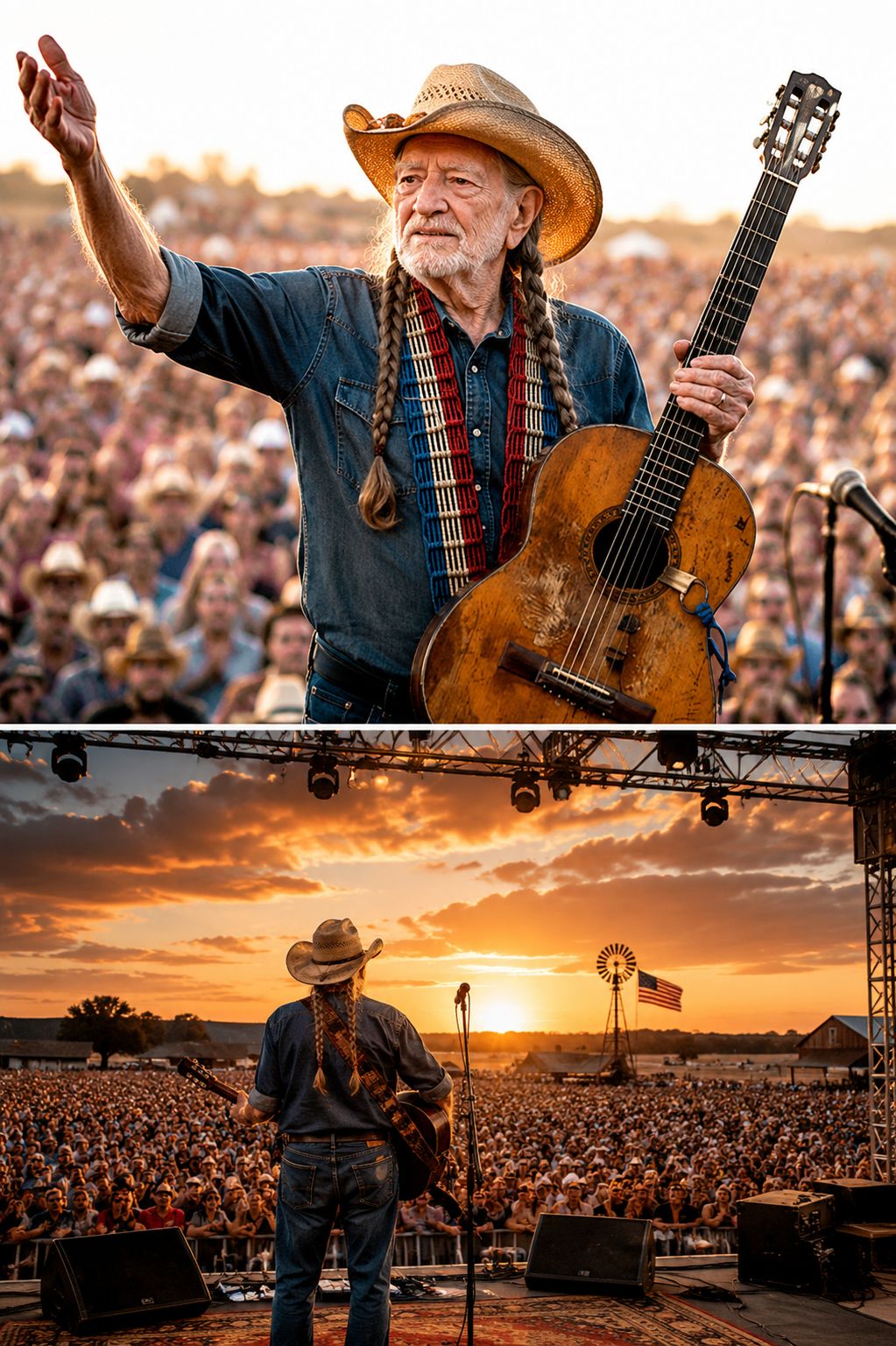
The image endures: a weathered musician holding his guitar beneath bright stage lights, surrounded by fellow artists and thousands of supporters, all focused on one mission.
For a few unforgettable hours, music became a lifeline.
And in the eyes of countless farm families, Willie Nelson didn’t just perform at a benefit concert.
He helped save a way of life.
That is why the moment remains legendary.
That is why the story continues to resonate.
And that is why, whenever discussions arise about the most meaningful events in country music history, the monumental benefit concert that rallied behind America’s farmers still stands as one of the genre’s finest hours—a night when compassion filled a stadium, crossed the nation, and reminded the heartland that it had not been forgotten.