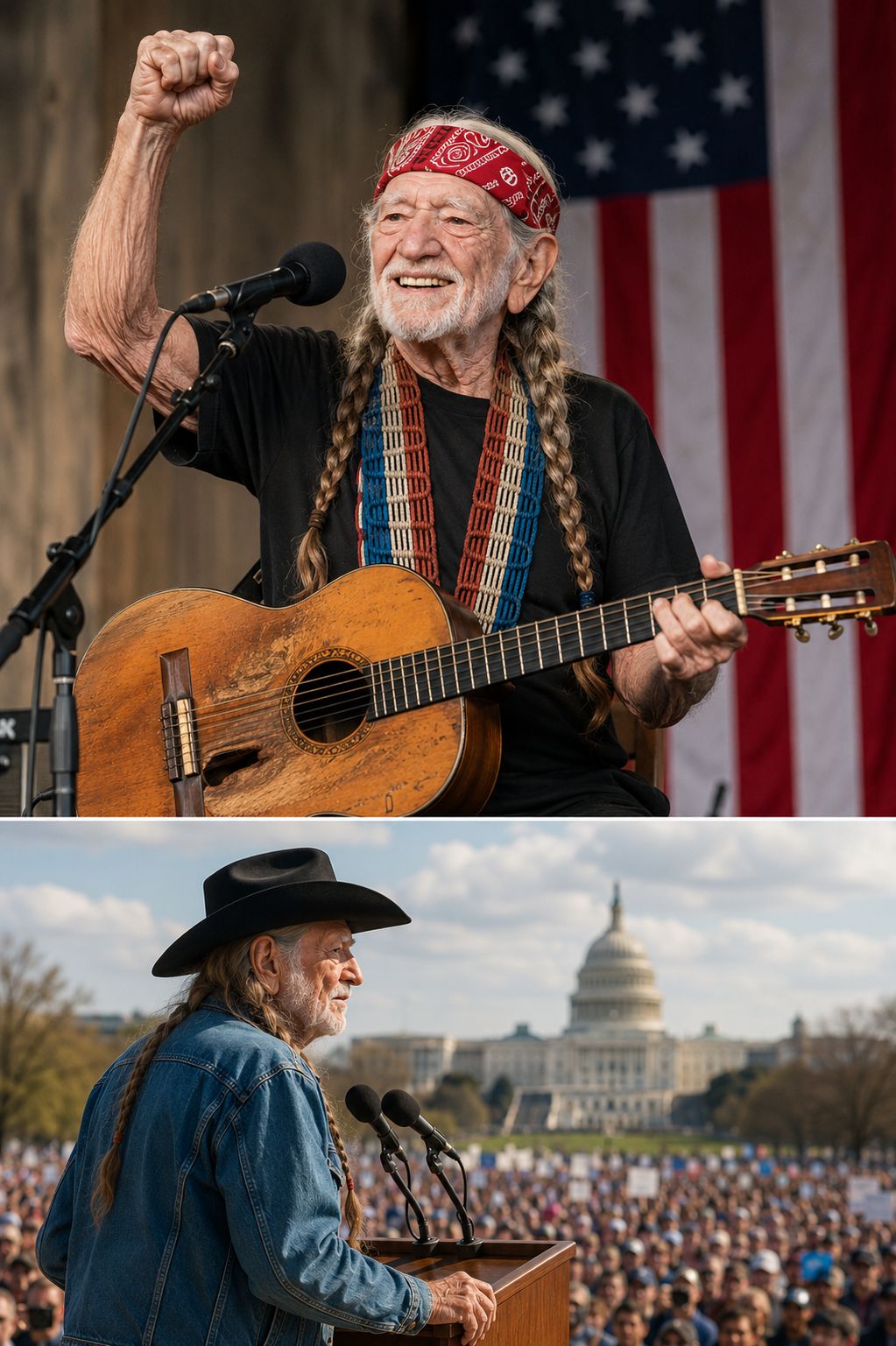
Introduction
For decades, country music has often been portrayed as a genre that avoids political controversy. Artists have traditionally been encouraged to stay focused on songs about love, heartbreak, family, faith, and rural life. Yet one towering figure consistently challenged that expectation. Through changing administrations, cultural upheavals, economic crises, and shifting public opinion, Willie Nelson never seemed interested in remaining silent.
The remarkable story is not that Willie Nelson occasionally voiced a political opinion. The truly extraordinary story is that he maintained a public political stance for more than forty consecutive years, refusing to abandon causes he believed in even when doing so risked alienating portions of his audience.
In an industry where careers can collapse after a single controversial statement, Nelson became something far rarer: a country music icon who accepted the consequences of speaking his mind.
The Outlaw Who Refused to Stay in His Lane
Long before social media transformed every celebrity opinion into a headline, Willie Nelson had already established himself as an independent thinker.
The same rebellious spirit that helped create the outlaw country movement also shaped his public life. Nelson never appeared interested in fitting neatly into any box that Nashville—or America—wanted to place him in.
He wore his hair long when many country traditionalists disliked it. He challenged industry expectations when executives told him what music he should make. And eventually, he brought that same stubborn independence into political and social issues.
What made Nelson unique was that he rarely approached politics as a partisan warrior. Instead, he framed many of his positions around deeply personal values: helping struggling families, supporting farmers, defending individual freedoms, and promoting compassion.
Those themes became a consistent thread running through his public life.
“Willie Nelson never sounded like a politician. He sounded like a neighbor who had made up his mind.”
That distinction mattered.
Fans who disagreed with him often still respected him because his positions appeared rooted in genuine conviction rather than political opportunism.
The Farm Crisis That Changed Everything
If there is one issue that defines Nelson’s political legacy more than any other, it is the American family farm.
During the 1980s, countless farmers faced financial devastation. Rising debt, falling land values, and economic hardship pushed many families toward foreclosure. Across rural America, communities that had survived for generations suddenly found themselves fighting for survival.
Nelson could have watched from the sidelines.
Instead, he acted.
In 1985, he helped launch Farm Aid alongside fellow musicians. What began as a benefit concert quickly evolved into a national movement aimed at supporting family farmers.
The decision transformed Nelson from a beloved entertainer into something else entirely: an activist willing to use his fame as a platform.
Many artists participate in charity events. Few dedicate decades of their lives to a cause.
Nelson did.
Year after year, Farm Aid continued.
Decade after decade, he remained involved.
Through changing political climates and media cycles, he refused to let the issue disappear.
“The headlines changed. The politicians changed. Willie Nelson stayed.”
That consistency became one of the defining features of his public image.
Taking Risks in a Divided America
Perhaps the most remarkable aspect of Nelson’s political journey was his willingness to speak openly during periods of intense national division.
Many entertainers carefully calculate every public statement.
Nelson rarely seemed interested in such calculations.
Whether discussing environmental issues, criminal justice reform, agricultural policy, or social concerns, he often accepted criticism as the price of honesty.
There were moments when fans threatened boycotts.
There were periods when commentators questioned whether his opinions would damage his popularity.
Yet the backlash never appeared to alter his fundamental approach.
He continued speaking.
He continued advocating.
He continued showing up.
For many observers, that consistency became more impressive than any individual position he held.
After all, maintaining a controversial opinion for a week requires courage.
Maintaining it for forty years requires something deeper.
It requires conviction.
Why Fans Kept Listening
The obvious question is simple:
Why did so many people continue supporting Willie Nelson even when they disagreed with him?
The answer may lie in the authenticity that has always defined his career.
Nelson never seemed interested in winning political arguments.
He seemed interested in expressing what he believed.
Audiences can often detect the difference.
Throughout his career, Nelson maintained friendships across ideological lines. He performed for diverse audiences. He collaborated with artists from different backgrounds and perspectives.
His message was rarely framed as “agree with me or leave.”
Instead, it often sounded more like:
“This is what I believe. You are free to believe something else.”
That approach allowed many fans to separate political disagreements from their appreciation of his music.
In an increasingly polarized society, that may have been one of Nelson’s greatest strengths.
He demonstrated that disagreement did not automatically require hostility.
The Personal Cost of Speaking Out
There is a tendency to romanticize public activism.
The reality is often far messier.
Every political statement carries consequences.
Every public position creates critics.
Every controversial cause generates backlash.
Nelson experienced all of it.
There were angry letters.
There were negative headlines.
There were disappointed fans.
There were accusations that he should “stick to music.”
Yet he consistently rejected the idea that artists should abandon citizenship once they become famous.
For Nelson, music and conscience appeared inseparable.
His songs reflected human experiences.
His activism reflected human concerns.
The two worlds naturally overlapped.
That philosophy shaped much of his public life.
An Unexpected Symbol of Independence
Ironically, Nelson eventually became admired by people across the political spectrum.
Some praised his specific positions.
Others simply respected his willingness to stand by them.
Even critics often acknowledged the consistency of his character.
In an era where public figures frequently shift positions according to changing trends, Nelson’s long-term commitment became part of his appeal.
People knew what he stood for.
They knew why he stood for it.
And they knew he was unlikely to abandon those beliefs because of temporary pressure.
That level of predictability is surprisingly rare.
“The world changed around Willie Nelson. Willie Nelson remained Willie Nelson.”
Perhaps that is why his political legacy continues to fascinate observers.
It is not merely a story about politics.
It is a story about authenticity.
The Legacy of Forty Years
Today, Willie Nelson occupies a unique place in American culture.
He is simultaneously a country music legend, an outlaw pioneer, a songwriter, a philanthropist, and a political advocate.
His forty-year public stance demonstrates something increasingly uncommon in modern public life: endurance.
Many causes rise and fall with the news cycle.
Many activists disappear once attention fades.
Many celebrities move on when controversy becomes inconvenient.
Nelson did not.
Whether one agrees with every position he has taken is almost beside the point.
The larger lesson lies in the persistence.
For more than four decades, he continued supporting the causes he considered important.
He continued helping farmers.
He continued speaking his mind.
He continued accepting criticism.
And he continued making music that connected with millions.
That combination may explain why Willie Nelson remains such a powerful figure.
Not because he avoided controversy.
Not because everyone agreed with him.
But because he proved that a person can remain true to both their art and their convictions over an entire lifetime.
In the end, the heavy political stance Willie Nelson maintained for forty straight years tells us something larger than politics itself.
It tells us about courage.
It tells us about consistency.
And perhaps most importantly, it tells us that authenticity—real authenticity—is not measured in headlines or applause.
It is measured in whether a person remains faithful to their beliefs long after the spotlight moves elsewhere.
Few artists have done that more visibly than Willie Nelson.
Video