Introduction
On the morning of August 16, 1977, America didn’t just lose a music icon. It lost a piece of its soul.
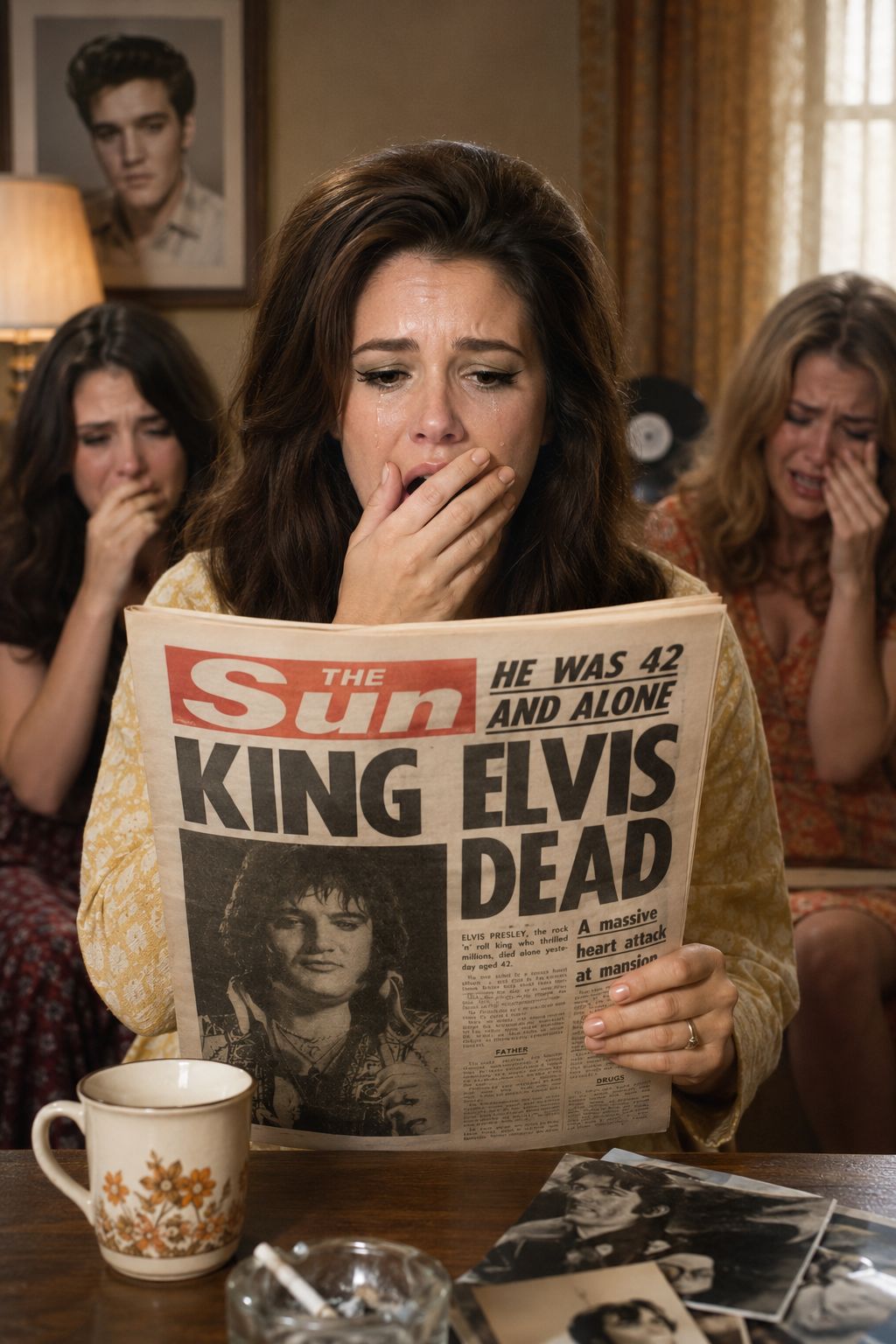
The news traveled fast — faster than anyone could emotionally process. Radios interrupted regular programming. Television anchors struggled to keep their composure. Fans stood frozen in grocery store aisles, diners, gas stations, and living rooms as the unbelievable words echoed across the country:
“Elvis Presley has died.”
For millions, it felt impossible. Elvis Presley was only 42 years old. He was larger than life. A man whose voice seemed eternal. A performer whose presence had reshaped American culture forever. How could someone so powerful simply… disappear?
Yet on that sweltering summer afternoon in Memphis, the King of Rock and Roll was gone.
And the world would never sound the same again.
The Day Time Stopped at Graceland
The gates outside Graceland quickly became a gathering place for heartbreak. Fans drove through the night from every corner of America. Some arrived crying before they even stepped out of their cars. Others brought flowers, candles, handwritten letters, and vinyl records worn from years of replaying his music.
Nobody wanted to believe it.
Inside Graceland, chaos and grief collided. Friends, family members, employees, and musicians moved through the mansion in stunned silence. Outside, reporters crowded the sidewalks while helicopters circled overhead. It was no longer just a private tragedy.
It was a global moment.
Because Elvis Presley was never merely a singer.
He was the soundtrack of an era.
Before Elvis, Music Had Rules
It’s difficult for younger generations to fully understand what Elvis represented in the 1950s. Before him, mainstream American music felt controlled, polished, predictable.
Then came a young truck driver from Mississippi with slicked-back hair, shaking hips, and a voice that blended gospel, blues, country, and raw emotion into something the world had never seen before.
He didn’t just sing songs.
He detonated tradition.
When Elvis stepped onto television screens for the first time, parents were horrified while teenagers became obsessed overnight. Churches condemned him. Critics mocked him. But audiences couldn’t look away.
“He made freedom sound dangerous.”
That was Elvis.
He gave working-class kids permission to dream bigger. He made poor Southern roots feel powerful instead of shameful. He brought Black musical influences into white American households during one of the most divided periods in U.S. history.
And through it all, he carried an aching vulnerability beneath the fame.
Because even at the height of his superstardom, Elvis often looked lonely.
The Fame That Slowly Consumed Him
By the 1970s, the dazzling young rebel who once electrified crowds had become increasingly isolated.
Yes, the jumpsuits were iconic. The concerts still sold out. Fans still screamed when he walked onto stage. But behind the spotlight, something darker was unfolding.
Elvis was exhausted.
The pressure of fame had become relentless. Years of nonstop touring, Hollywood expectations, prescription medication use, insomnia, failed relationships, and emotional isolation were taking a devastating toll.
Those closest to him noticed the changes.
The once-energetic performer sometimes appeared bloated, fatigued, emotionally distant. Yet whenever the curtain rose, he still somehow found a way to deliver moments of magic.
That contradiction made his decline even more heartbreaking.
He wasn’t simply fading away.
He was fighting to stay Elvis.
The Final Performances
In the months leading up to his death, fans noticed something haunting during his concerts.
There were moments when his voice sounded stronger than ever — deep, soulful, almost prophetic. Songs like Unchained Melody carried an emotional weight that now feels almost painful to revisit.
Looking back, many believe Elvis somehow knew he was nearing the end.
When he sat at the piano during those final performances, there was a sadness in his eyes that cameras couldn’t fully hide.
“He sang like a man trying to hold onto himself.”
And audiences felt it.
Even exhausted, even struggling physically, Elvis could still command an arena with one note. That was the tragedy of his final chapter: the talent never disappeared.
The man underneath the pressure simply couldn’t carry the burden anymore.
August 16, 1977
That Tuesday morning began like many others at Graceland.
But by the afternoon, emergency responders were rushing to the mansion. Rumors spread rapidly through Memphis radio stations before official confirmation arrived.
Then came the announcement that shattered millions of hearts.
Elvis Presley was dead.
The reaction was immediate and overwhelming.
Fans openly sobbed in public. Radio stations played Elvis songs nonstop for days. Record stores were flooded with grieving listeners desperate to reconnect with his voice. Newspapers across the world printed his face on front pages in giant black headlines.
Even hardened journalists became emotional covering the story.
Because Elvis wasn’t just famous.
He felt personal.
People had grown up with him. Fallen in love with him. Survived heartbreak with his music playing in the background. His voice had become stitched into family memories, road trips, weddings, military deployments, lonely nights, and American identity itself.
Losing Elvis felt like losing part of your own life.
The Funeral That Became History
More than 80,000 fans lined the streets of Memphis during Elvis’s funeral procession.
Think about that.
Tens of thousands stood in unbearable August heat simply for one final glimpse of the man who had changed music forever.
Some fainted from emotion. Others held signs reading:
“The King Lives Forever.”
And in many ways, he does.
Because few artists have ever achieved the mythical status Elvis reached after death. His music continued breaking records. New generations discovered him repeatedly. His image became immortal — the white jumpsuit, the curled lip, the unforgettable voice.
Even today, decades later, Graceland remains one of the most visited homes in America.
Not because fans are obsessed with celebrity.
But because they’re chasing a feeling.
A connection.
A memory of when music felt larger than life.
The Pain Behind the Legend
What makes Elvis Presley’s story endure isn’t just the fame.
It’s the humanity.
At his core, Elvis remained deeply insecure despite global adoration. Friends often described him as generous, spiritual, sensitive, and desperate to make people happy. He gave away cars, jewelry, money — sometimes impulsively — because he genuinely wanted others to feel joy.
Yet he struggled to find peace himself.
That contradiction is what makes his story timeless.
The boy who rose from poverty to unimaginable fame achieved nearly everything the world says should create happiness.
And still, he suffered.
There’s something profoundly tragic about that.
Why The World Still Can’t Let Go
Nearly fifty years later, Elvis Presley remains one of the most discussed figures in music history.
Why?
Because he represents more than entertainment.
He symbolizes the beauty and danger of fame itself.
The dream.
The pressure.
The loneliness behind applause.
Every generation rediscovers Elvis differently. Some see the revolutionary artist. Others see the tragic celebrity. Some admire the voice. Others mourn the man beneath the legend.
But almost everyone feels something when they hear him sing.
That emotional connection never disappeared.
And perhaps it never will.
The Day Music Lost Its King
August 16, 1977 wasn’t merely the day Elvis Presley died.
It was the day millions realized that even legends are fragile.
The King of Rock and Roll had seemed untouchable for so long that his death forced the world to confront something uncomfortable: fame cannot protect a person from pain.
Yet despite the tragedy, Elvis left behind something eternal.
A voice.
A revolution.
A legacy powerful enough to outlive generations.
And somewhere, late at night, when an old Elvis record begins spinning through dusty speakers, it still feels like he’s here.
Still singing.
Still breaking hearts.
Still reminding the world why nobody will ever truly replace the King.