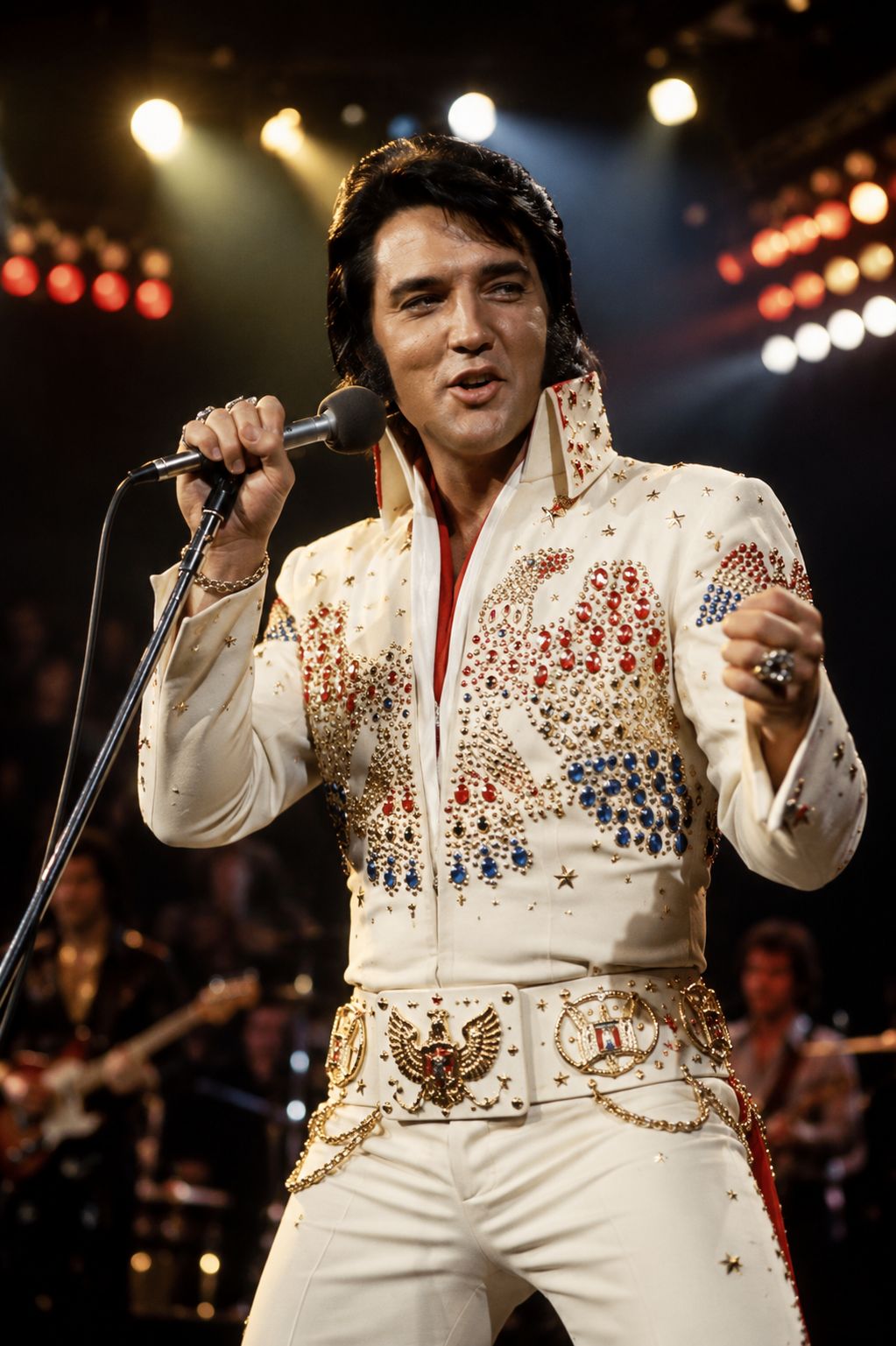
There are legends… and then there is Elvis.
The world remembers the glittering jumpsuits, the screaming crowds, the shaking hips that changed music forever. Fans remember the smile, the charisma, the voice that could make millions feel understood in a single note. But behind the gold records and sold-out arenas was a man who often seemed trapped inside the very empire he created.
And decades after his death, one haunting question still lingers:
Was Elvis Presley ever truly happy?
To understand the answer, you have to look beyond the mythology.
You have to look at the lonely man behind the crown.
The Boy Who Only Wanted Love
Before the fame, Elvis was simply a poor Southern kid from Tupelo. He grew up in a tiny home with almost nothing, deeply attached to his mother, Gladys Presley. Friends who knew him in those early years often described him as shy, polite, and desperate to belong.
Music became his escape.
When Elvis first walked into Sun Records in Memphis, nobody could have predicted that the nervous young truck driver would soon become the most famous entertainer on Earth.
But fame came at a cost Elvis was never emotionally prepared to pay.
“He had the world… but he was always searching for something he couldn’t name.”
That search would follow him for the rest of his life.
Fame Turned Him Into a Prisoner
By the late 1950s, Elvis wasn’t just a singer anymore.
He was a phenomenon.
Women screamed so loudly at concerts that audiences could barely hear him sing. Reporters followed his every move. Studios demanded movies. Colonel Tom Parker controlled nearly every aspect of his career.
To the public, Elvis looked untouchable.
But privately, cracks were already forming.
The endless touring, the pressure to stay perfect, and the suffocating isolation of celebrity began eating away at him. People close to Elvis often said he struggled to trust anyone completely. Everyone wanted something from him — money, fame, access, or influence.
Imagine being surrounded by thousands of people every day… yet feeling completely alone.
That was Elvis’s reality.
The Death That Changed Him Forever
If there was one moment that permanently altered Elvis emotionally, it was the death of his mother in 1958.
Gladys Presley wasn’t just his mother.
She was his emotional anchor.
When she died, Elvis reportedly collapsed in grief. Witnesses described him kissing her face repeatedly and refusing to let go of her body. Some historians believe he never emotionally recovered from that loss.
Afterward, something changed.
The joyful young rebel who electrified America slowly became more withdrawn, more anxious, and increasingly dependent on prescription medications to cope with stress and insomnia.
“From the day his mother died, part of Elvis died too.”
Fans saw the superstar.
Very few saw the heartbreak.
The Illusion of Graceland Happiness
To millions, Graceland looked like paradise.
Cars. Horses. Private jets. Endless parties.
But many who spent time inside Graceland later described an atmosphere filled with emotional extremes. Elvis could be generous and playful one moment, then deeply depressed the next.
He bought gifts for friends constantly — cars, jewelry, vacations. Some believe giving became his way of trying to create genuine connection.
But material things never filled the emptiness.
Late at night, Elvis would reportedly stay awake for hours watching television, talking about religion, life, death, and whether fame had ruined him.
He searched obsessively for meaning through spirituality, books, and philosophy.
Because deep down, he seemed terrified that all the success still wasn’t enough.
His Greatest Fear Was Being Forgotten
Ironically, one of the most famous men in history feared irrelevance.
By the 1970s, music was changing. Younger stars emerged. Critics mocked Elvis’s movies and performances. While his concerts still sold out, the pressure to remain “The King” became emotionally exhausting.
And perhaps that’s the cruelest part of fame:
Once the world crowns you, it refuses to let you be human again.
Elvis couldn’t simply age naturally.
He had to remain Elvis Presley forever.
That burden crushed him.
The Truth About His Marriage
The relationship between Elvis and Priscilla Presley remains one of the most discussed love stories in music history.
At first, Priscilla seemed to bring stability into Elvis’s chaotic world. Their wedding captivated the public, and for a brief moment, it looked like he might finally build the peaceful family life he always wanted.
Then reality intervened.
Elvis struggled with commitment, emotional vulnerability, and the nonstop pressures surrounding his career. Priscilla later admitted that living with Elvis often felt like living with someone emotionally unreachable.
Even when surrounded by love, Elvis seemed unable to fully receive it.
Their divorce in 1973 devastated him more than many realized.
Friends said he became increasingly isolated afterward.
On Stage Was the Only Time He Felt Alive
Despite everything, there was one place where Elvis still seemed genuinely happy:
The stage.
Especially during his legendary live comeback years.
When Elvis performed songs like “American Trilogy” or “How Great Thou Art,” audiences witnessed flashes of pure emotional release. For a few moments, the sadness disappeared. The insecurity vanished. The man transformed back into the electrifying force who changed music forever.
“When he sang, he escaped.”
That may be the closest Elvis ever came to peace.
Music wasn’t just entertainment for him.
It was survival.
The Final Years Were Heartbreaking
By the mid-1970s, Elvis’s health and emotional condition had visibly declined.
The relentless touring schedule, dependency on medications, poor sleep, loneliness, and pressure from those around him created a dangerous spiral.
Photos from his final years often show a man exhausted beyond words.
And yet fans still adored him.
That’s what makes Elvis’s story so tragic.
The world loved him endlessly.
But he often seemed unable to love himself with the same intensity.
Even in his final concerts, there were moments where the old magic returned — flashes of humor, warmth, vulnerability, and brilliance. But they were increasingly overshadowed by fatigue and sadness.
When Elvis died in 1977 at just 42 years old, the world mourned a superstar.
But those closest to him mourned something even sadder:
A sensitive man who spent his life trying to outrun loneliness.
So… Did Elvis Ever Truly Find Happiness?
Maybe the honest answer is:
Only in moments.
In music.
In love.
In laughter with friends late at night.
In the roar of the crowd.
In spiritual searching.
In giving to others.
But lasting happiness?
That may have remained just out of reach.
Elvis Presley achieved the kind of fame most people cannot even imagine. Yet his story remains one of the clearest reminders that success does not protect a person from pain, insecurity, grief, or emptiness.
And perhaps that’s why people still connect to him decades later.
Not because he was perfect.
But because beneath the legend was someone painfully human.
Someone searching for joy the same way the rest of us are.
“The King of Rock and Roll conquered the world… but never fully conquered the sadness inside himself.”
That truth still breaks hearts today.