Introduction
There are songs that become hits.
There are songs that become classics.
And then there are songs that quietly transcend music itself—transforming into sacred moments shared between an artist and generations of listeners. For Elvis Presley, no recording accomplished that miracle more completely than “Can’t Help Falling In Love.”
What began as a gentle ballad for a Hollywood film eventually became something far greater than anyone could have imagined. It evolved into the final heartbeat of Elvis’ concerts, the last melody audiences heard before the lights faded, and the emotional promise that lingered long after he disappeared backstage.
It wasn’t simply the end of a performance.
It became the farewell no one realized they were rehearsing.
“Wise men say only fools rush in… but I can’t help falling in love with you.”
Those words, first recorded in 1961, would eventually become the closing chapter of one of the greatest careers in American music.
A Song Born From Simplicity
When Elvis entered the studio to record “Can’t Help Falling In Love,” he wasn’t trying to create history.
The song was intended for the film Blue Hawaii, a lighthearted musical that showcased his enormous popularity during the early 1960s. Inspired in part by the French melody Plaisir d’Amour, the composition carried a timeless elegance unlike the rock-and-roll explosions that had first made Elvis famous.
Instead of swagger, there was tenderness.
Instead of rebellion, there was surrender.
His voice floated softly above the orchestra, never forcing emotion because genuine feeling required no exaggeration.
It sounded almost like a private confession.
Even then, listeners sensed something extraordinary. While Elvis had conquered stages with energy and charisma, this recording revealed another side of him—a man capable of astonishing vulnerability.
The King didn’t need to shout.
Sometimes all he needed was a whisper.
The Song That Grew Alongside Its Singer
Many performers eventually outgrow their biggest hits.
Elvis never outgrew this one.
Instead, “Can’t Help Falling In Love” matured with him.
When he returned triumphantly to live performance in Las Vegas at the end of the 1960s, audiences expected explosive versions of “Suspicious Minds,” “Burning Love,” and the classics that defined rock history.
But as each concert approached its conclusion, something remarkable happened.
The atmosphere changed.
The lights softened.
The cheering slowly quieted.
The orchestra introduced the familiar opening notes.
Suddenly thousands of people weren’t witnessing a superstar.
They were sharing an intimate goodbye with someone who had accompanied their lives for decades.
Children who had become adults…
Young couples now celebrating anniversaries…
Parents introducing Elvis to their own children…
Everyone heard something different inside those familiar lyrics.
Yet everyone felt the same emotion.
More Than A Closing Song
Many artists end concerts with their biggest hit.
Elvis ended his concerts with his heart.
Night after night, “Can’t Help Falling In Love” became less of a performance and more of a ritual.
Fans understood what the opening chords meant.
The evening was ending.
Soon Elvis would smile…
Offer a final wave…
Leave the stage while the orchestra continued playing.
There was no dramatic speech.
No elaborate farewell.
The song itself said everything words could not.
“Until next time.”
No one imagined how painfully those words would one day echo.
The Final Goodbye No One Saw Coming
During the final years of Elvis’ career, his concerts carried increasing emotional weight.
His health was becoming more fragile.
The physical demands of constant touring were immense.
Yet whenever the orchestra reached “Can’t Help Falling In Love,” something extraordinary still happened.
His voice softened.
His expression relaxed.
For a few minutes, the pressures surrounding him seemed to disappear.
Fans weren’t judging him.
They weren’t reading newspaper headlines.
They weren’t thinking about celebrity.
They were simply listening to the man whose music had shaped their memories.
Looking back today, those final performances possess an almost unbearable poignancy.
What audiences believed was another goodnight became history’s last embrace.
Every farewell now feels permanent.
Every wave carries greater meaning.
Every lyric feels prophetic.
A Promise Hidden Inside The Melody
Perhaps the reason the song has endured for more than six decades is because its message extends far beyond romance.
For countless Elvis fans, the lyrics gradually came to represent something else entirely.
A promise.
A bond.
A relationship between artist and audience that survived changing musical trends, changing generations, and even death itself.
The song quietly whispered:
“I’ll always be with you.”
That promise proved true.
Elvis never stopped accompanying weddings.
He never stopped appearing on family playlists.
He never stopped comforting lonely nights.
He never stopped introducing young listeners to music that predates their parents.
The man left.
The voice remained.
Every Generation Finds Its Own Elvis
One of the greatest achievements of “Can’t Help Falling In Love” is its astonishing ability to speak across generations.
Teenagers discovering Elvis through streaming platforms hear sincerity that feels refreshingly authentic.
Older listeners remember dancing to it decades earlier.
Grandparents recall watching him perform it on television.
Parents remember hearing it played at weddings.
Each generation inherits the song differently.
Yet every generation reaches the same conclusion.
Some songs never age.
Because genuine emotion never becomes outdated.
Why It Still Stops Audiences Today
Modern concerts often rely on spectacle.
Massive video screens.
Pyrotechnics.
Perfect choreography.
Elvis proved something simpler.
Sometimes one man…
Standing beneath a spotlight…
Singing honestly…
Can create a more unforgettable moment than every technological innovation combined.
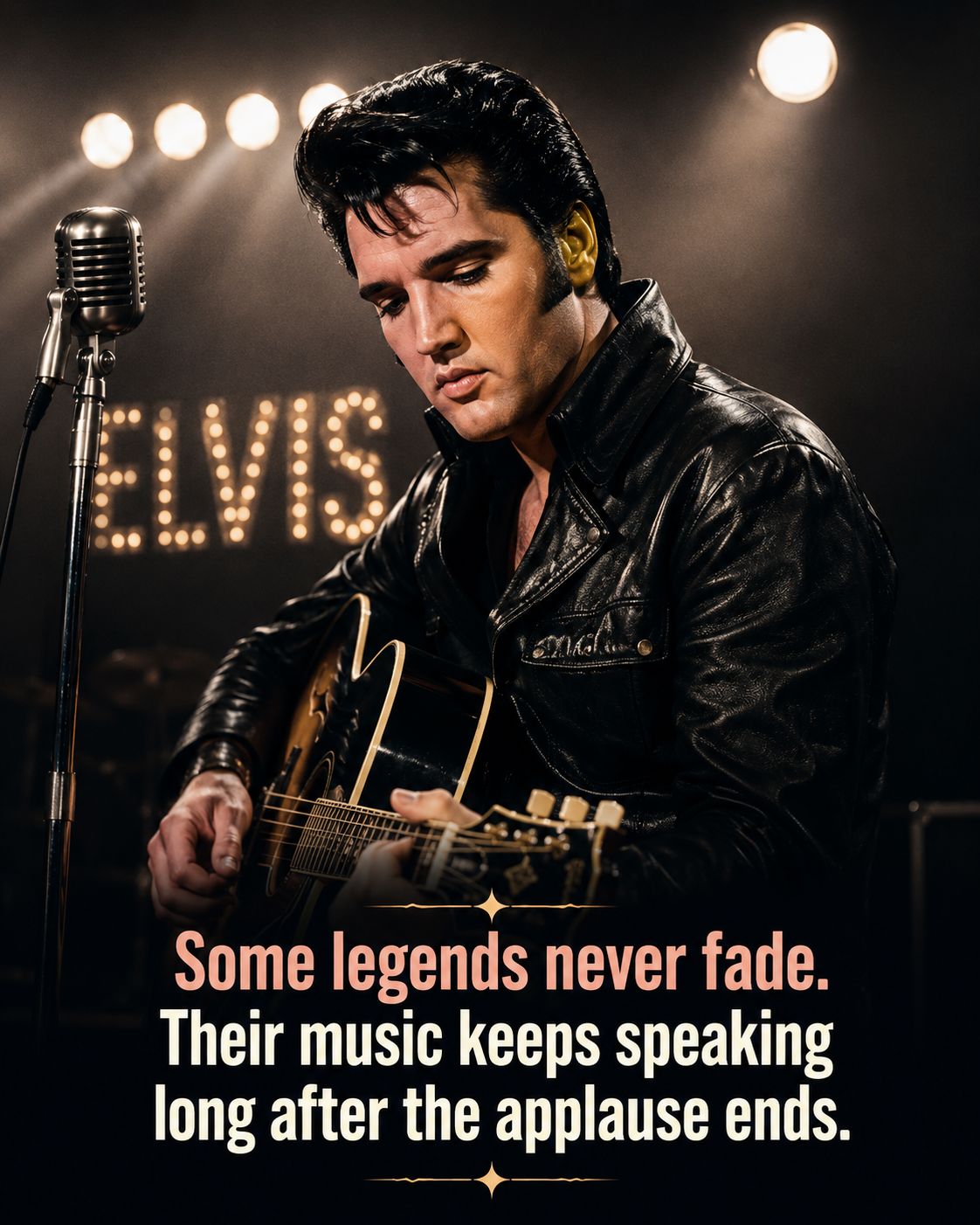
That is why tribute artists continue ending shows with “Can’t Help Falling In Love.”
It isn’t imitation.
It’s tradition.
The audience expects that final emotional release because Elvis established the blueprint decades ago.
Every closing performance acknowledges where that tradition began.
The Curtain Never Truly Fell
On August 16, 1977, the world lost Elvis Presley.
But strangely, “Can’t Help Falling In Love” prevented his farewell from ever feeling complete.
Every time someone presses play…
The curtain rises once again.
He smiles.
He sings.
He reaches the final chorus.
The orchestra swells.
For a few beautiful minutes, time stops.
The King is back.
That is the rare power of timeless music.
It refuses to accept endings.
An Eternal Promise
History remembers Elvis Presley as the revolutionary who transformed popular music forever.
Rock-and-roll pioneer.
Movie star.
Cultural icon.
Global phenomenon.
All of those titles are deserved.
Yet perhaps his greatest legacy is something quieter.
One unforgettable song that gently reminded millions of people they were loved in return.
Fans gave Elvis their loyalty across decades.
They defended him during criticism.
They celebrated every comeback.
They filled arenas until the very end.
And whether he consciously intended it or not, “Can’t Help Falling In Love” became his answer to that devotion.
It was never merely a closing number.
It became gratitude set to music.
The final notes signaled the end of each performance, but they also carried an unspoken assurance that the connection between Elvis and his audience would survive beyond applause, beyond fame, and beyond life itself.
That is why the song continues to move listeners today.
Not because it marks an ending.
But because it reminds us that some promises are too powerful to be silenced by time.
Every farewell Elvis ever sang eventually led to another generation discovering him.
Every final bow became another beginning.
And somewhere, every time those opening piano notes drift through the air, millions of hearts still respond exactly as they did decades ago—believing, if only for a moment, that the King is smiling from the stage one last time, offering the same timeless promise to the fans who never left his side.
Video