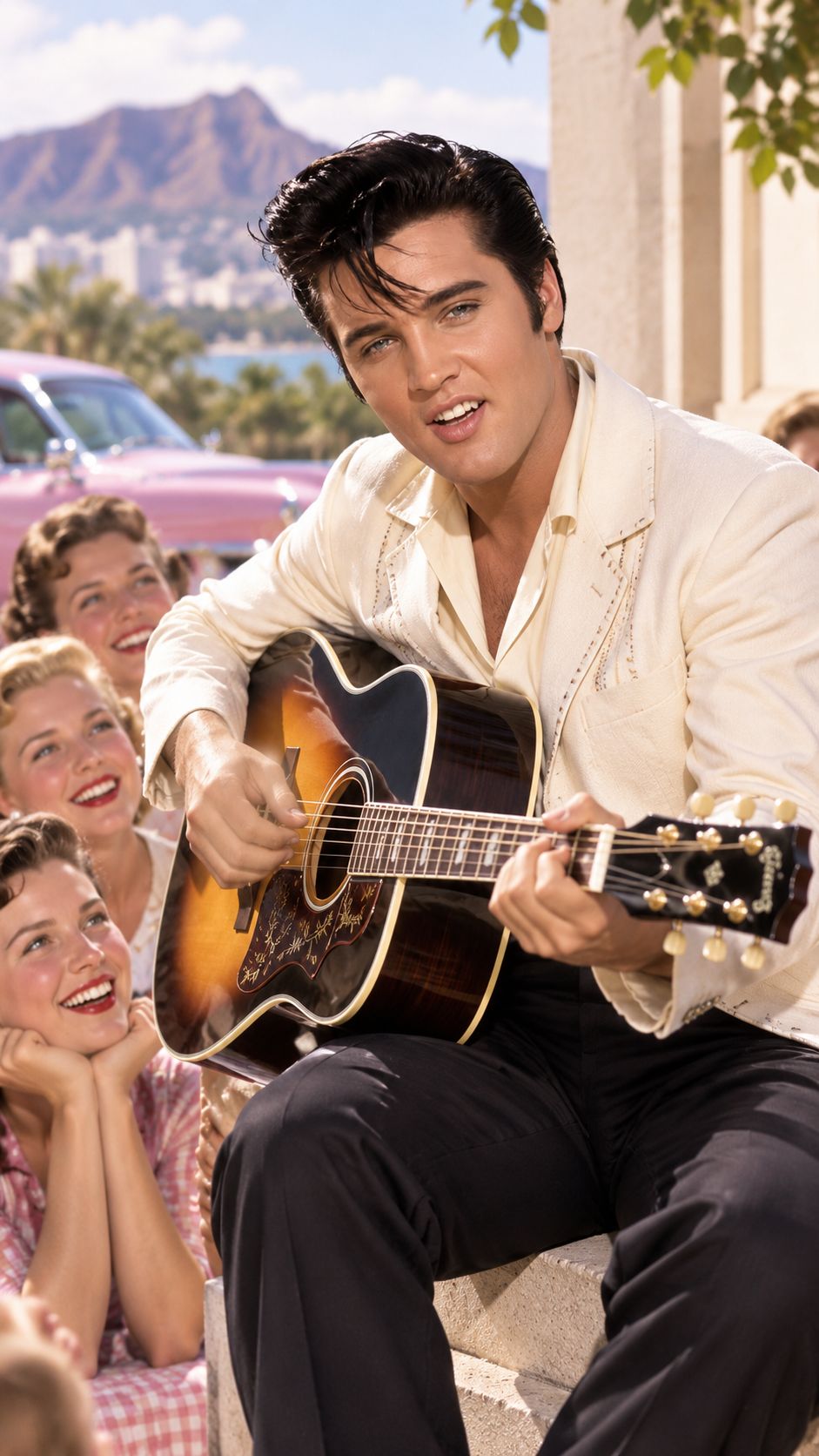
Introduction
There are singers with extraordinary voices.
There are performers with incredible stage presence.
There are artists who sell millions of records, fill arenas, dominate television, and become household names.
But every once in a while, someone appears who seems to possess something that cannot be measured.
Something that cannot be taught.
Something that other singers can imitate—but never truly reproduce.
That was Elvis Presley.
People have copied his hairstyle.
They have worn the jumpsuits.
They have imitated his movements.
They have recreated his songs.
They have tried to reproduce his voice.
Thousands of Elvis impersonators have spent decades studying the smallest details of his performances.
And yet, somehow, the real thing remains unmistakable.
Because Elvis Presley had something no other singer could completely replicate.
He had presence.
Not simply fame.
Not simply charisma.
Not simply a great voice.
Something deeper.
The moment Elvis walked onto a stage, the audience knew something was about to happen.
And that feeling is almost impossible to manufacture.
BEFORE THE LEGEND, THERE WAS A YOUNG MAN WITH A DIFFERENT SOUND
Elvis Aaron Presley came from Tupelo, Mississippi.
He didn’t enter the music business as an already-formed superstar.
He grew up around Southern musical traditions that would become central to his artistic identity.
Gospel.
Country.
Blues.
Rhythm and blues.
These influences didn’t exist in isolation.
They were part of the cultural environment surrounding him.
At Sun Records in Memphis, Elvis began developing a sound that brought together elements from several musical traditions.
That combination became one of the foundations of his early identity.
But something else happened when he performed.
People reacted.
They didn’t merely listen.
They watched.
And they talked.
THE VOICE WAS ONLY THE BEGINNING
It is tempting to explain Elvis’s success by pointing to his voice.
Certainly, his voice was distinctive.
He could move from a soft, almost intimate delivery to a powerful, dramatic performance.
He could sing rock and roll.
He could sing country.
He could sing gospel.
He could sing ballads.
His musical range allowed him to move between genres without completely losing his identity.
But there were plenty of talented singers.
There were plenty of powerful voices.
There were plenty of performers who could sing beautifully.
Elvis had something else.
He didn’t just deliver a song. He made the song feel like it belonged to him.
That is much harder to replicate.
THE FIRST TIME PEOPLE SAW HIM, THEY SAW SOMETHING UNEXPECTED
In the mid-1950s, television was becoming increasingly influential in American life.
Radio could give you a singer’s voice.
Television could give you the entire person.
And Elvis was extraordinarily suited to the visual medium.
His hair.
His clothes.
His posture.
His smile.
His eyes.
His movements.
Everything contributed to the performance.
When Elvis appeared on television, audiences didn’t know exactly what they were going to get.
That uncertainty became part of his appeal.
His 1956 appearance on The Milton Berle Show, particularly his performance of “Hound Dog,” became a major cultural moment.
His movements generated controversy.
Critics attacked him.
Young audiences embraced him.
Parents worried about his influence.
Suddenly, everyone had an opinion.
Elvis didn’t need everyone to love him. He had already achieved something almost as powerful: he had made everyone notice him.
YOU COULD COPY THE MOVEMENT — BUT NOT THE FEELING
This is where the Elvis phenomenon becomes fascinating.
His famous movements were imitated almost immediately.
People could watch what he did and try to reproduce it.
But copying a movement isn’t the same as possessing the instinct behind it.
Elvis wasn’t simply moving because someone told him to.
The movement was connected to the rhythm.
To the lyric.
To his confidence.
To the audience.
To the moment.
That’s why imitation often feels like imitation.
The mechanics are there.
The emotion isn’t.
A person can recreate the famous gestures perfectly and still fail to create the electricity of the original.
Because Elvis wasn’t performing a sequence of movements.
He was reacting.
HIS GREAT SECRET WAS CONNECTION
Watch Elvis closely and you’ll notice that he rarely seemed completely detached from his audience.
He responded to them.
Their screams affected him.
Their energy fed his performance.
He smiled.
He paused.
He moved.
He waited.
He played with anticipation.
That created a feedback loop.
The audience reacted to Elvis.
Elvis reacted to the audience.
The energy grew.
And suddenly the performance became something larger than the song itself.
Elvis didn’t simply perform in front of an audience. He made the audience feel like they were inside the performance.
That is extremely difficult to reproduce.
HE COULD MAKE A SIMPLE SONG FEEL PERSONAL
Another part of Elvis’s uniqueness was his ability to interpret material.
He didn’t necessarily need to write every song himself.
His greatest gift was often interpretation.
Give Elvis a song and he could reshape its emotional identity through phrasing, tone, rhythm, and performance.
He could make a familiar lyric feel personal.
That is why his recordings often don’t sound like simple covers.
They sound like Elvis songs.
He took ownership of the emotional world.
And when an artist can do that, the audience stops thinking about where the song came from.
They think about the performer.
GOSPEL REVEALED ANOTHER SIDE OF HIM
One of the easiest ways to understand Elvis’s musical depth is to listen to his gospel performances.
Gospel music was enormously important to him.
It wasn’t simply another genre he recorded.
It was part of his musical upbringing.
When Elvis sang gospel, the flashy image could disappear.
The young rebel.
The movie star.
The celebrity.
The King.
For a moment, the focus became the voice.
The emotion.
The harmony.
The spiritual intensity.
And that revealed something important.
The charisma wasn’t an empty shell.
There was a serious musician underneath it.
THE ’68 COMEBACK SHOWED THE WORLD WHAT WAS STILL INSIDE HIM
By the late 1960s, Elvis’s public image had changed dramatically.
Hollywood had occupied much of his career.
The musical landscape had evolved.
A new generation of performers had arrived.
Then came the television special now known as the ’68 Comeback Special.
Elvis appeared in black leather.
He played with musicians in a more intimate setting.
He sang with urgency.
He looked focused.
For many viewers, it felt like rediscovering the Elvis they remembered.
But there was something more mature about him.
The comeback wasn’t simply about returning to the past. It was about proving that the artist was still there beneath the mythology.
That was one of the most important moments of his career.
THEN CAME THE STAGE ELVIS
The 1970s brought another transformation.
Elvis became associated with spectacular live performances.
Large orchestras.
Huge stages.
Elaborate costumes.
The famous jumpsuits.
Powerful arrangements.
A voice that had matured considerably.
He had become a spectacle.
But even inside all that extravagance, there were moments when the old Elvis appeared.
A gesture.
A smile.
A particular vocal phrase.
A sudden burst of energy.
Those moments reminded audiences that the person underneath the costume hadn’t disappeared.
He had simply evolved.
THE KING COULDN’T BE REDUCED TO ONE ERA
That’s another reason his legacy is so difficult to replicate.
There isn’t just one Elvis.
There is the young Elvis of the 1950s.
The Hollywood Elvis of the 1960s.
The comeback Elvis of 1968.
The concert Elvis of the 1970s.
Each version is different.
Yet all of them are recognizably him.
That ability to evolve while retaining identity is extraordinarily rare.
Many artists become associated with one particular sound.
Elvis became associated with himself.
HIS LEGACY ALSO BELONGS TO A MUCH BIGGER MUSICAL HISTORY
It’s important not to turn Elvis into a myth detached from the musicians who influenced him.
Rock and roll did not begin with Elvis.
Its development was deeply connected to Black American musical traditions, including blues, gospel, and rhythm and blues.
Artists such as Sister Rosetta Tharpe, Arthur “Big Boy” Crudup, Big Mama Thornton, Little Richard, Chuck Berry, and countless others played essential roles in the history that preceded and surrounded Elvis.
Elvis absorbed these influences and became one of the most successful white performers to bring a version of that musical fusion to a huge mainstream audience.
His legacy therefore exists inside a larger and complicated American musical story.
Recognizing those roots doesn’t make Elvis less significant.
It makes the story more complete.
WHY OTHER SINGERS COULDN’T BECOME ELVIS
Because Elvis wasn’t one talent.
He was a combination of talents that happened to appear in one person at one extraordinary moment.
The voice.
The face.
The physicality.
The timing.
The musical instincts.
The Southern background.
The confidence.
The vulnerability.
The ability to communicate with an audience.
The ability to reinvent himself.
And the ability to make all of those things feel natural.
You can teach singing.
You can teach stagecraft.
You can teach choreography.
You can study recordings.
You can copy clothing.
But you can’t simply manufacture the exact combination.
You can reproduce the sound of Elvis Presley. You cannot reproduce the moment when Elvis Presley entered the room.
That’s the difference.
PEOPLE DIDN’T JUST SEE A STAR — THEY SAW THEMSELVES
Perhaps Elvis’s deepest connection with his audience came from the fact that he represented possibility.
To young people in the 1950s, he didn’t look like the older generation.
He represented something new.
Freedom.
Individuality.
Confidence.
Excitement.
And even controversy.
He was not simply telling teenagers how to behave.
He was showing them another way to exist.
That made him more than an entertainer.
He became a symbol of generational change.
THE STRANGE POWER OF A VOICE YOU RECOGNIZE IN ONE SECOND
Think about the greatest singers in history.
Often, you can recognize them within a few notes.
But Elvis could sometimes be identified almost instantly.
The phrasing.
The tone.
The little vocal inflections.
The way he approached a lyric.
The emotional weight behind the delivery.
These details created an identity.
And identity is what survives.
Even decades after his death, someone can hear an Elvis recording and immediately know who it is.
That’s not simply technical ability.
That’s artistic fingerprint.
HIS BIGGEST GIFT MAY HAVE BEEN MAKING PEOPLE FEEL SOMETHING
Ultimately, that’s what great performers do.
They make people feel.
Elvis could make an audience excited.
He could make them laugh.
He could make them scream.
He could make them nostalgic.
He could make them emotional.
He could make a room feel intimate even when thousands of people were present.
That emotional communication was the part nobody could truly duplicate.
People tried to imitate Elvis’s voice. They tried to imitate his clothes. They tried to imitate his movements. But what they could never completely imitate was the feeling of being Elvis.
And that feeling was the foundation of the legend.
THE MAN BEHIND THE MYTH
Elvis Presley was not perfect.
His story included extraordinary success and serious personal difficulties.
His career contained brilliant artistic moments alongside periods of compromise.
His legacy is complicated.
But complexity doesn’t erase greatness.
In fact, it often makes the story more human.
The man behind the legend wasn’t a superhero.
He was a performer who happened to possess an extraordinary combination of gifts.
And for a brief period in American history, those gifts collided with the perfect cultural moment.
THAT’S WHY ELVIS STILL FEELS DIFFERENT
More than four decades after his death, people still imitate Elvis.
They perform his songs.
They dress like him.
They study his recordings.
They recreate his concerts.
They analyze his movements.
They try to capture the voice.
Some become extraordinarily convincing.
And yet there is always a gap.
Because Elvis Presley wasn’t just a collection of recognizable traits.
He was the chemistry between those traits.
The confidence.
The vulnerability.
The timing.
The audience.
The music.
The moment.
All of it existed simultaneously.
And that’s something you can’t reproduce on command.
THE THING NO ONE COULD COPY
Maybe the simplest explanation is also the most powerful.
Elvis didn’t have just one extraordinary quality.
He had an unrepeatable combination of qualities.
He could walk onto a stage and make thousands of people believe something important was about to happen.
He could turn a microphone into a prop.
A song into a story.
A movement into a headline.
A performance into a memory.
And eventually, a career into mythology.
The world has produced countless great singers since Elvis Presley. But there was only one Elvis.
That’s why the impersonators can look remarkably similar.
That’s why singers can reproduce the notes.
That’s why musicians can recreate the arrangements.
And that’s why, after all these years, you can hear the opening seconds of an Elvis recording and immediately know:
Nobody else sounds quite like this.
Nobody else moves quite like this.
Nobody else carries quite this combination of danger, tenderness, confidence, vulnerability, and charisma.
The clothes can be copied.
The hairstyle can be copied.
The songs can be copied.
Even the voice can be studied.
But the presence?
That belonged to Elvis.
And perhaps that’s the greatest mystery of all.
Some artists leave behind songs.
Some leave behind records.
Some leave behind awards.
Elvis Presley left behind something much harder to define.
A feeling.
And no matter how many people try to recreate it, the original remains unmistakable.