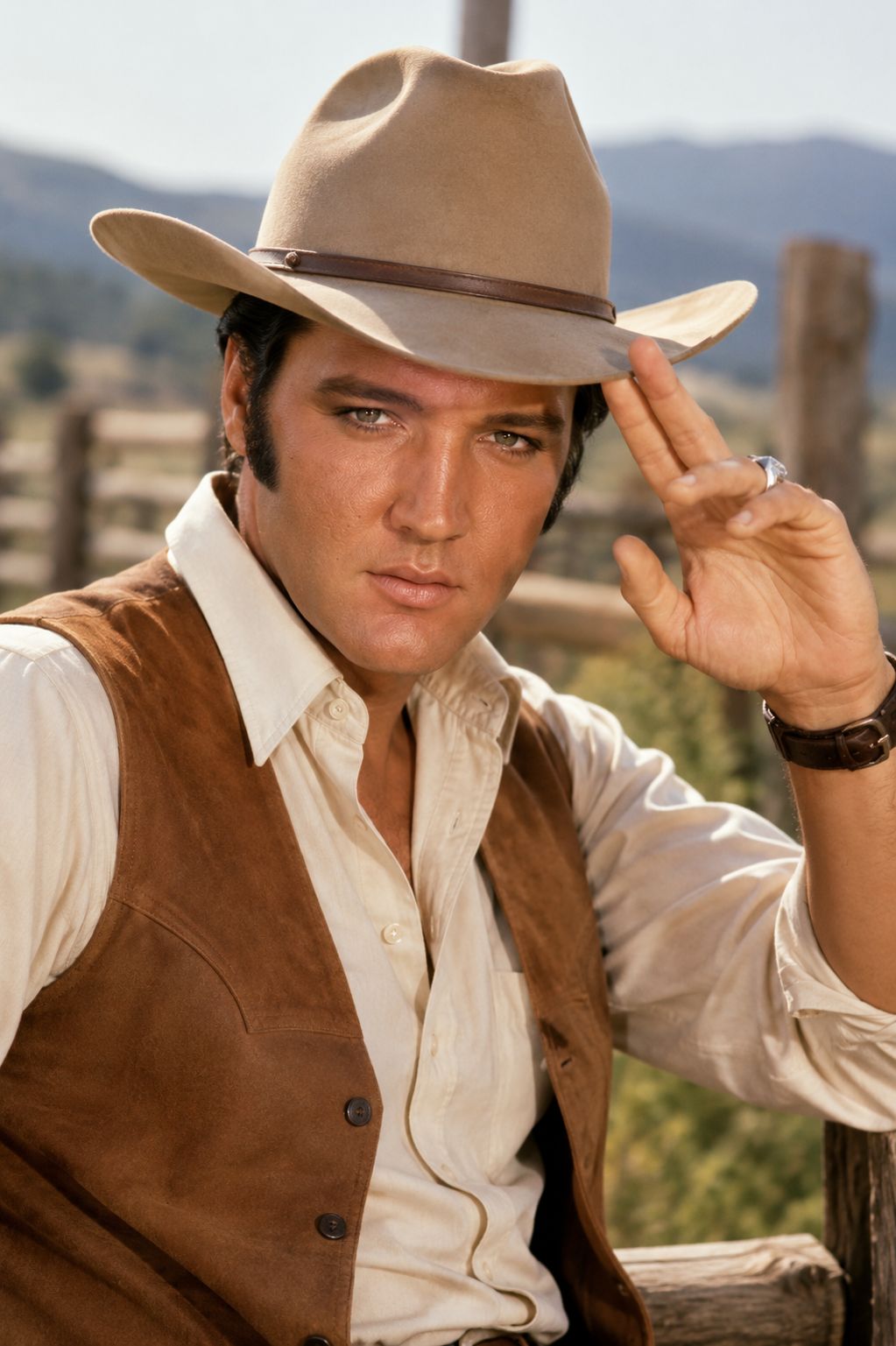
Introduction
There are legends… and then there is Elvis.
More than four decades after his death, the world still speaks his name with the same awe reserved for mythological figures. New generations wear his image on T-shirts. Old fans still cry when hearing the opening lines of “Can’t Help Falling in Love.” His home, Graceland, remains a pilgrimage site where people arrive not simply to remember a singer — but to feel close to something eternal.
Because Elvis Presley did not just become famous.
He became immortal.
The Boy Who Came From Nothing
Before the rhinestone jumpsuits, before the screaming crowds, before the world called him “The King,” Elvis was just a shy boy born in a tiny house in Tupelo during the Great Depression.
His family had almost nothing.
They struggled to survive. They moved often. Sometimes there was barely enough food on the table. Yet from the beginning, music surrounded him like destiny waiting patiently in the shadows. Gospel hymns from church, blues from nearby neighborhoods, country songs from the radio — Elvis absorbed them all.
What made him different wasn’t merely his voice.
It was his loneliness.
There was always a sadness in Elvis Presley that audiences could feel even before he became famous. It lived in the way he sang love songs, the way he looked into crowds, the way he smiled while somehow appearing heartbreakingly distant.
That emotional vulnerability became his secret weapon.
Millions of people saw themselves in him.
“He didn’t sing songs. He felt them.”
And audiences felt them too.
The Moment America Changed Forever
In 1954, Elvis walked into Sun Records in Memphis and unknowingly changed music history forever.
Nobody could fully explain what happened when he recorded “That’s All Right.”
It sounded dangerous.
It sounded rebellious.
It sounded alive.
At a time when America was rigid and conservative, Elvis blended Black rhythm and blues with white country music in a way mainstream audiences had never seen before. His voice crossed boundaries society itself was afraid to cross.
Then came the television appearances.
The movements.
The energy.
The shaking hips that scandalized parents and electrified teenagers.
Suddenly, Elvis Presley was no longer just a singer.
He was a cultural explosion.
Young people didn’t merely admire him — they worshipped him. Girls screamed so loudly at concerts that his voice could barely be heard. Men copied his hairstyle, his clothes, his swagger.
America had seen stars before.
But never anything like this.
“When Elvis appeared, the old world began to disappear.”
He represented freedom at a time when people desperately wanted to break free.
And once the world saw him, there was no going back.
Elvis Was Never Just a Performer
Many artists entertain.
Very few become emotional symbols.
Elvis carried something deeper than celebrity. Fans looked at him and saw dreams they wanted for themselves: escape, passion, rebellion, tenderness, heartbreak.
He could sing with explosive confidence one moment and devastating vulnerability the next.
That duality made him timeless.
In songs like “Jailhouse Rock,” he was electric and untouchable. In ballads like “Love Me Tender,” he sounded fragile enough to break your heart.
People didn’t just listen to Elvis.
They attached memories to him.
First dances.
Road trips.
Military deployments.
Broken marriages.
Family Christmases.
Funerals.
Entire lifetimes became connected to his voice.
And that is one of the rarest forms of immortality a human being can achieve.
Fame Began Destroying Him
But immortality often comes with tragedy.
As Elvis became bigger, the pressure around him became unbearable. Hollywood wanted him constantly filming movies. Fans demanded perfection. His management controlled nearly every aspect of his career.
The world saw the glamorous version of Elvis.
Very few saw the exhausted man behind the curtain.
There were moments when he felt trapped inside his own legend.
He longed to be taken seriously as an artist. He wanted meaningful music. He wanted peace. Yet the machine surrounding Elvis Presley never stopped moving.
Over time, loneliness consumed him.
Prescription pills entered his life.
The isolation deepened.
And perhaps the saddest part of Elvis’s story is this: the man who made millions feel alive often struggled privately to feel alive himself.
“The bigger Elvis became, the more impossible it was for him to escape Elvis Presley.”
That contradiction transformed him from superstar into tragic icon.
And history has always remembered tragic icons forever.
The 1968 Comeback Changed Everything
By the late 1960s, critics believed Elvis was fading away.
Rock music had evolved. New artists dominated the culture. Many assumed “The King” belonged to another era.
Then came the Elvis ’68 Comeback Special.
And suddenly, the world remembered exactly who he was.
Dressed in black leather, armed with nothing but charisma and raw talent, Elvis delivered one of the greatest comebacks in music history. He looked dangerous again. Hungry again. Human again.
The performances felt stripped of illusion.
No giant movie sets.
No distractions.
Just Elvis, a microphone, and pure emotion.
It reminded audiences that beneath the fame and spectacle was one of the greatest vocal performers America had ever produced.
For many fans, that special became more powerful than even his early success.
Because they weren’t just watching a star.
They were watching a man fight to reclaim himself.
Why Death Made Him Eternal
When Elvis Presley died in 1977 at only 42 years old, the world reacted as if a piece of itself had vanished.
Crowds gathered outside Graceland in shock and disbelief. Newspapers across the globe treated his death like the fall of royalty.
And in many ways, it was.
Death froze Elvis in time.
He never became an old man slowly fading from public memory. He remained permanently suspended between youth and tragedy — beautiful, gifted, wounded, unforgettable.
That matters more than people realize.
History often immortalizes those who leave too soon because they remain emotionally unfinished in the minds of fans.
People continue imagining who Elvis could have become.
What songs he still could have sung.
What pain he still carried.
What redemption he still might have found.
That mystery keeps him alive.
The World Keeps Rebuilding Elvis
Today, Elvis Presley exists far beyond music.
He is an icon reproduced endlessly through films, documentaries, impersonators, merchandise, TikTok edits, tribute concerts, and memories passed from grandparents to grandchildren.
Every generation discovers him differently.
Some fall in love with the voice.
Others with the style.
Others with the tragedy.
But almost everyone feels something.
That emotional connection is why Elvis remains untouchable decades later. Many singers have sold records. Many celebrities have dominated headlines.
Very few become symbols larger than time itself.
“Elvis Presley stopped being a man long ago. He became a feeling.”
And feelings do not die.
The Real Reason Elvis Became Immortal
Immortality is not about perfection.
Elvis Presley became immortal because he was gloriously human.
He was talented yet insecure.
Loved yet lonely.
Worshipped yet deeply vulnerable.
People saw both the king and the broken man underneath the crown.
And somehow, that made them love him even more.
The voice still echoes.
The image still captivates.
The legend still grows.
Somewhere tonight, a teenager will discover Elvis Presley for the first time and feel chills hearing him sing. Somewhere else, an elderly fan will quietly remember dancing to his music decades ago.
That is immortality.
Not simply being remembered…
…but continuing to live inside the emotions of people who never truly let you go.