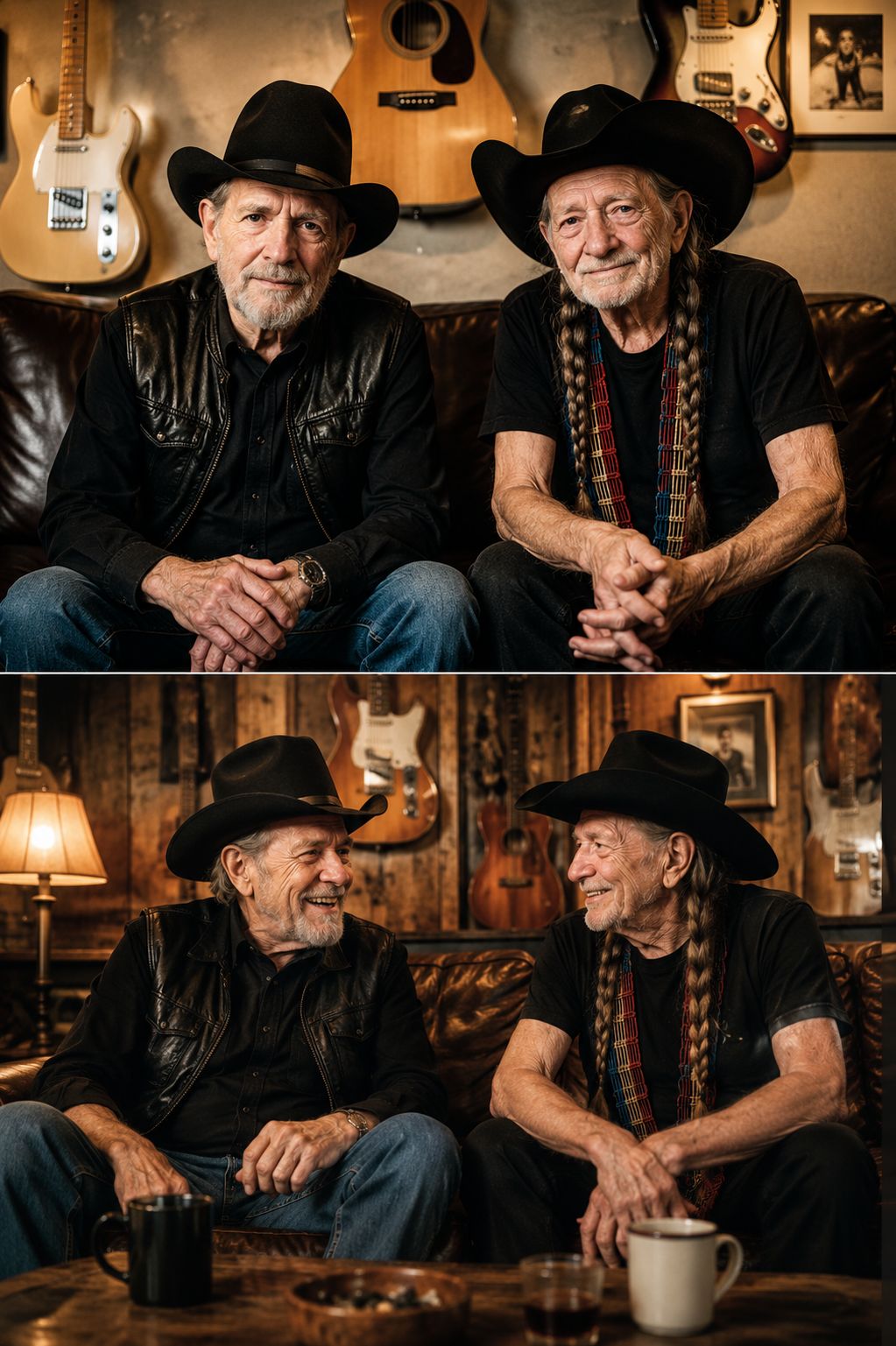
Introduction
Country music has always been a genre built on stories. Some singers tell those stories with crystal-clear precision. Others deliver them like a weathered letter discovered in an old drawer. Few artists embodied those two approaches more beautifully than Merle Haggard and Willie Nelson.
Their voices were never identical. In fact, they were strikingly different. Yet that contrast became one of the greatest gifts country music ever received.
When listeners hear Merle Haggard and Willie Nelson, they are hearing two entirely different roads that somehow lead to the same destination: truth.
One voice sounded like the hard-earned wisdom of a man who had survived life’s storms and emerged with dignity intact. The other sounded like a wandering poet who had learned to embrace every twist and turn along the journey.
Together, they created a contrast so powerful that it helped define an era of American music.
Two Voices, Two Worlds
Merle Haggard’s voice carried remarkable clarity.
Even during his later years, there was a precision to his singing that made every lyric feel intentional. His phrasing was disciplined. His tone was rich and commanding. Whether he was singing about heartbreak, working-class struggles, or memories of a changing America, Haggard delivered songs with the confidence of a master storyteller.
Listeners often felt as though Merle wasn’t merely performing a song.
He was presenting evidence.
Every line sounded lived-in.
Every emotion sounded earned.
Meanwhile, Willie Nelson approached singing from an entirely different angle.
His voice floated.
It bent.
It drifted behind the beat and then somehow landed exactly where it needed to be.
Willie sang as though he was having a conversation with the listener rather than delivering a performance.
His unique phrasing often ignored conventional timing, creating a style that countless artists have tried—and failed—to imitate.
“Merle sang like a man explaining life. Willie sang like a man wondering about it.”
That distinction became one of the most fascinating contrasts in country music history.
The Sound of Experience vs. The Sound of Reflection
Merle Haggard’s voice often felt grounded in reality.
Songs like “Mama Tried,” “Working Man Blues,” and “The Way I Am” carried the weight of personal experience. There was strength in his delivery. Even vulnerability came wrapped in determination.
When Merle sang about pain, listeners believed he had already survived it.
When he sang about regret, listeners felt he had learned from it.
His voice represented resilience.
Willie Nelson’s voice represented reflection.
In songs such as “Blue Eyes Crying in the Rain,” “Angel Flying Too Close to the Ground,” and “Always on My Mind,” Willie sounded less concerned with conclusions and more interested in emotions themselves.
He lingered on words.
He stretched moments.
He gave silence almost as much importance as the lyrics.
“Where Merle built the house, Willie wandered through the rooms.”
This difference created an extraordinary balance whenever fans compared their catalogs.
One artist delivered certainty.
The other delivered possibility.
Why Their Voices Felt So Human
Part of what made both singers legendary was their refusal to chase perfection.
Modern music often rewards flawless vocals.
Merle and Willie offered something far more valuable.
Character.
Neither voice could be mistaken for anyone else’s.
You could identify both men within seconds of hearing a single phrase.
That uniqueness became their superpower.
Haggard’s voice contained grit without sacrificing beauty. There was authority in his tone, but never arrogance.
Willie’s voice contained fragility without weakness. There was vulnerability in every note, yet listeners sensed tremendous strength beneath the surface.
The imperfections became assets.
The rough edges became signatures.
And the humanity became unforgettable.
When Outlaws Became Icons
During the rise of the Outlaw Country movement in the 1970s, both men helped reshape Nashville’s expectations.
They challenged the polished production styles dominating mainstream country music.
Yet even within that shared rebellion, they remained wonderfully different.
Merle represented the rugged California honky-tonk tradition.
Willie represented the free-spirited Texas renegade.
Merle’s vocals often felt like railroad tracks stretching across the American West—straight, purposeful, and unwavering.
Willie’s vocals felt like the open sky above those tracks—unpredictable, expansive, and impossible to contain.
Together, they proved there was no single way to be authentic.
That lesson still resonates today.
The Emotional Power of Contrast
One reason audiences remain captivated by both artists decades later is because they satisfy different emotional needs.
There are moments in life when listeners crave Merle Haggard.
Moments when they need conviction.
Moments when they need someone to tell them they can endure hardship.
Moments when strength matters most.
Then there are moments when listeners need Willie Nelson.
Moments of reflection.
Moments of uncertainty.
Moments when life refuses to provide easy answers.
Willie never rushed those feelings.
He welcomed them.
The contrast between the two artists mirrors the contrast within all of us.
We all experience confidence and doubt.
Certainty and curiosity.
Strength and tenderness.
Merle and Willie gave musical voices to both sides of the human experience.
A Friendship Rooted in Respect
What makes the story even more remarkable is the mutual admiration these two legends shared.
Neither artist needed to imitate the other.
Neither competed for artistic territory.
Instead, they respected their differences.
That respect allowed both men to flourish.
Fans never had to choose between them.
Country music was large enough to hold both voices.
And the genre became richer because of it.
“The greatest artists do not erase their differences. They transform those differences into something beautiful.”
Merle Haggard and Willie Nelson embodied that truth.
The Legacy That Still Echoes
Today, countless singers continue to draw inspiration from both men.
Some chase Merle’s disciplined storytelling.
Others study Willie’s unconventional phrasing.
Very few can capture either.
Because their greatness was never simply technical.
It was emotional.
Their voices carried entire lifetimes within them.
Listeners could hear heartbreak, redemption, humor, loneliness, resilience, and hope in every performance.
Merle Haggard sounded like a man standing firmly on the ground, looking straight ahead.
Willie Nelson sounded like a man gazing toward the horizon, wondering what might lie beyond it.
Neither approach was better.
That was the magic.
The beauty came from the contrast.
In a genre built on authenticity, these two icons showed that truth can wear many faces and speak in many voices.
One voice was steady as a railroad line.
The other drifted like a Texas breeze.
One delivered certainty.
The other delivered mystery.
And together, Merle Haggard and Willie Nelson created one of the most beautiful vocal contrasts country music will ever know.
Long after trends fade and generations change, their voices continue to remind listeners that music is not about perfection.
It is about connection.
And few artists have connected with the human heart more deeply than Merle Haggard and Willie Nelson.