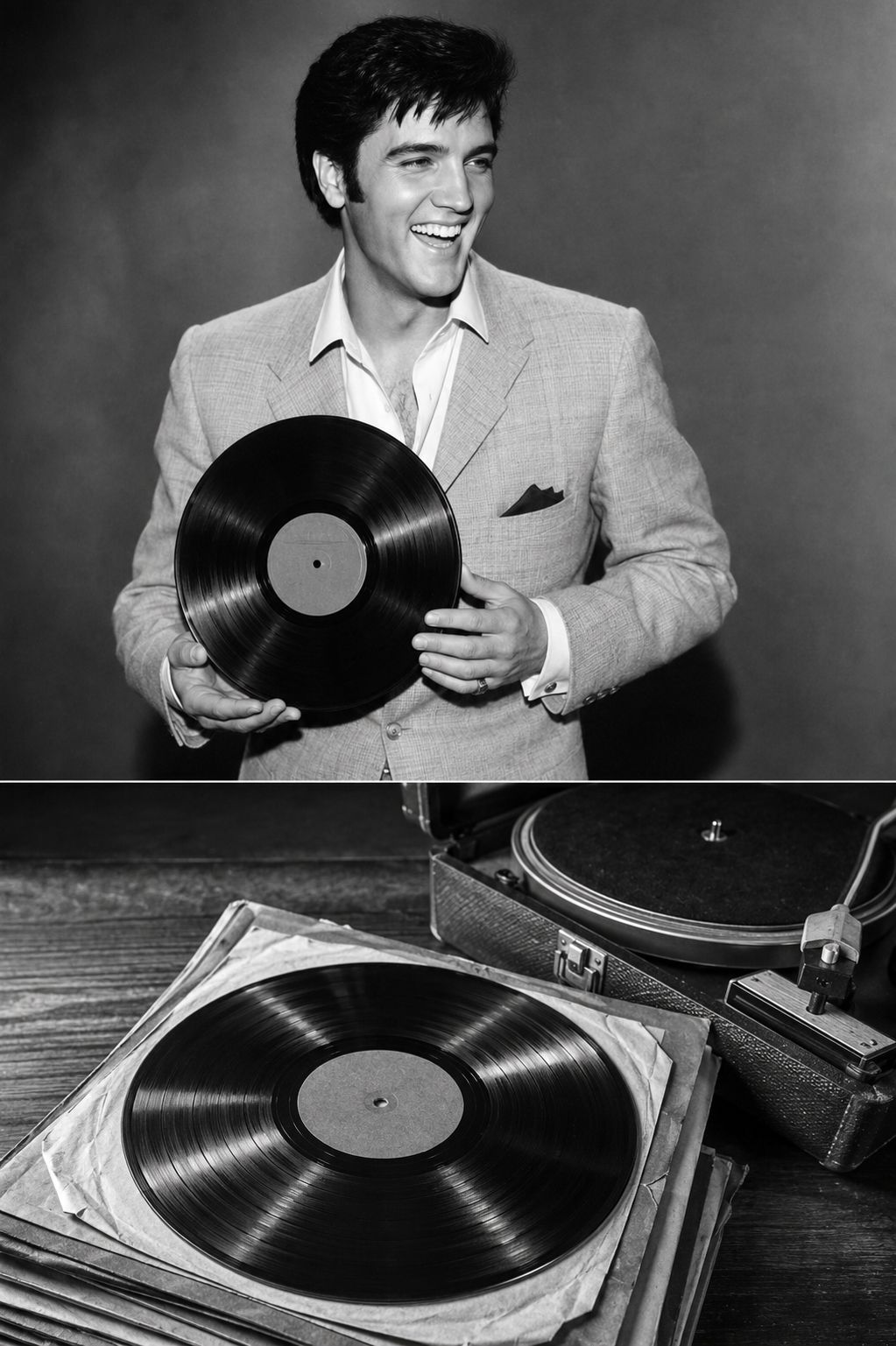
Introduction
There are rare records.
There are valuable records.
And then there are records so legendary that their owners sometimes refuse to reveal they even possess them.
In the world of music memorabilia, few artifacts inspire as much fascination as the earliest vinyl pressings associated with the rise of Elvis Presley. While countless Elvis albums have become collectible over the decades, one particular pressing occupies a mythical place among collectors—a record that represents not merely a song, but the very moment rock and roll changed forever.
For many serious collectors, losing this first pressing would feel like losing a piece of music history itself.
The Birth of a Revolution
In the summer of 1954, few people could have imagined that a shy young truck driver from Memphis would soon become the most recognizable entertainer on the planet.
At the time, Elvis Presley was simply a young singer recording at Sun Studio under the guidance of legendary producer Sam Phillips. The music industry had no blueprint for what was about to happen.
Then came a recording session that would alter popular culture forever.
The record was simple.
One side featured “That’s All Right.”
The other side carried “Blue Moon of Kentucky.”
What emerged from those grooves wasn’t merely a country record, a blues record, or a pop record.
It was something entirely new.
A collision of musical worlds.
A spark.
A revolution pressed into vinyl.
“The first time people heard that record, they knew something had changed.”
Today, original Sun Records pressings from that era are among the most coveted artifacts in music collecting.
But the fear surrounding them isn’t only about monetary value.
It’s about what they represent.
Why the First Pressing Matters So Much
To the casual listener, a song is a song.
A reissue sounds much like an original.
A digital stream carries the same melody.
Collectors, however, understand that first pressings are time capsules.
Every scratch, every label variation, every manufacturing detail tells a story about the exact moment the music entered the world.
The earliest Elvis Sun releases weren’t manufactured in massive quantities.
Nobody expected history.
Nobody predicted global superstardom.
The records were produced for local distribution and radio promotion.
Many copies were played repeatedly on inexpensive turntables.
Others were discarded.
Some broke.
Many simply vanished.
As Elvis became a cultural phenomenon, surviving originals became increasingly scarce.
And scarcity creates legends.
The Hunt That Never Ends
Talk to serious Elvis collectors and you’ll discover a fascinating truth.
Most are not chasing perfection.
They’re chasing authenticity.
A worn original pressing often generates more excitement than a pristine modern reissue.
Why?
Because that worn record may have sat inside a Memphis jukebox.
It may have spun at a teenage dance in 1954.
It may have been played by someone hearing Elvis for the very first time.
Those possibilities create emotional value impossible to replicate.
“You’re not buying vinyl. You’re buying a moment in history.”
Collectors often describe finding an authentic early Elvis pressing as the equivalent of uncovering buried treasure.
Stories circulate about forgotten records discovered in attics, estate sales, and dusty storage boxes.
Some owners don’t even realize what they possess until an expert examines the label.
Then the shock arrives.
What appeared to be an old record suddenly becomes a priceless artifact.
When Value Becomes Fear
Perhaps the most fascinating aspect of these records is the anxiety they create.
Most collectibles appreciate over time.
Few generate the emotional attachment seen among Elvis enthusiasts.
Collectors frequently describe feelings of responsibility rather than ownership.
The record becomes a caretaker’s burden.
Insurance policies are updated.
Climate-controlled storage is installed.
Protective sleeves are upgraded.
Some collectors rarely even play the record.
The fear isn’t irrational.
One accident.
One flood.
One careless movement.
And a unique piece of cultural history could disappear forever.
Imagine owning a physical object directly connected to the birth of rock and roll.
Now imagine dropping it.
The thought alone is enough to make collectors nervous.
The Emotional Connection
The value of early Elvis pressings extends far beyond auction prices.
Their true significance lies in the stories they preserve.
Consider the world of 1954.
America was changing.
Youth culture was emerging.
Country music and rhythm-and-blues traditions were beginning to intersect in unexpected ways.
Then a young singer arrived with a sound nobody could categorize.
That first pressing captured uncertainty.
Excitement.
Possibility.
Every groove contains evidence of a future nobody yet understood.
When collectors hold these records, they’re touching the starting point of one of the greatest careers in entertainment history.
That’s a powerful emotional experience.
“Before the movies, before Graceland, before the global fame, there was just this record.”
That reality transforms a collectible into something almost sacred.
The Auction Room Silence
Stories from major auctions reveal just how deeply collectors value these records.
As bidding begins, the room often grows unusually quiet.
Veteran collectors understand what they’re seeing.
Opportunities to acquire authentic early Elvis pressings don’t appear every day.
When one surfaces, emotions intensify.
The competition becomes less about money and more about legacy.
Some bidders grew up listening to Elvis with their parents.
Others spent decades building collections.
Many believe they may never encounter another example of the same rarity.
The result is often dramatic.
Bids climb.
Hearts race.
History changes hands.
And somewhere in the audience, another collector wonders if they just missed their only chance.
Why New Generations Care
Perhaps the most surprising development is how younger collectors continue entering the Elvis market.
Many weren’t alive during Elvis’s lifetime.
Some weren’t even alive during the vinyl revival.
Yet they remain captivated by these artifacts.
The appeal is understandable.
In a digital world, physical history feels increasingly precious.
A streaming file can be duplicated infinitely.
An original Elvis Sun pressing cannot.
It exists in a specific place.
It has a unique journey.
It bears the marks of decades.
That authenticity resonates with modern collectors seeking tangible connections to cultural milestones.
The record becomes proof that history happened.
Not as a story.
Not as a documentary.
But as an object you can hold.
More Than a Record
Ultimately, the terror collectors feel about losing an early Elvis pressing isn’t rooted solely in financial value.
Money can be replaced.
History cannot.
These records represent a singular moment when music transformed forever.
They remind us that legends begin humbly.
Before sold-out arenas.
Before television appearances.
Before international fame.
There was simply a young musician, a recording studio, and a few pieces of vinyl.
Nobody knew the world was changing.
Yet it was.
That is why collectors guard these records so carefully.
That is why auction rooms fall silent when one appears.
And that is why the first vinyl pressings of Elvis Presley continue to inspire fascination generations later.
Because hidden within those fragile grooves is something far greater than music.
It is the sound of history taking its first breath.
And for the fortunate few who own one, the possibility of losing it feels almost unthinkable.
Video