Introduction
There are moments in music history that seem almost too small to matter.
A singer clears his throat.
A drummer taps a stick against a snare.
A guitarist brushes a few strings.
And yet, somehow, the world changes.
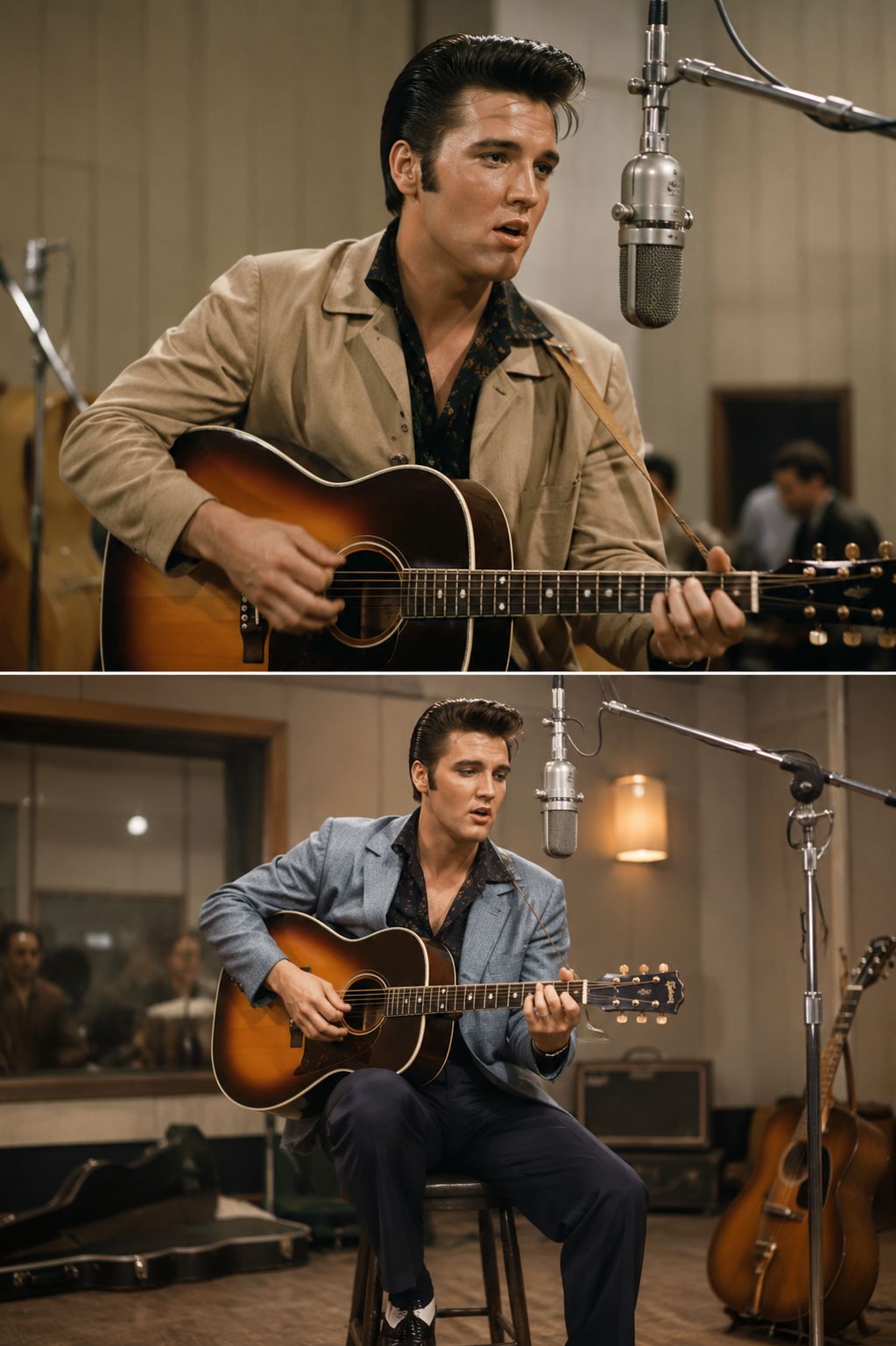
For millions of fans and historians, one of those moments happened when a young, unknown truck driver named Elvis Presley picked up an acoustic guitar and delivered a strum that would help ignite an entire generation.
The sound itself wasn’t complicated.
It wasn’t technically revolutionary.
But it carried something far more powerful: freedom.
The Summer of Possibility
In the early 1950s, America was a nation standing at a crossroads.
The Second World War was over. Prosperity was growing. Families moved into suburbs. Teenagers suddenly had spending money and a sense of identity separate from their parents.
But culturally, much of popular music remained safe and predictable.
Then came Elvis.


Before he became the King of Rock and Roll, Elvis was simply a young man from Memphis who loved gospel, blues, country, and rhythm & blues. Unlike many performers of his era, he didn’t see musical genres as walls.
He heard possibility everywhere.
That openness would become his greatest weapon.
At a time when America often separated music along cultural and racial lines, Elvis absorbed sounds from every corner of the musical landscape and transformed them into something electrifying.
A Night Inside Sun Records
The legend begins inside Sun Studio in Memphis.
Producer Sam Phillips had been searching for something different.
He famously believed there was a huge audience waiting for a performer who could bridge musical worlds.
Yet finding that performer seemed impossible.
Then Elvis walked through the door.
The early recording sessions were hardly magical at first.
Musicians experimented.
Songs stumbled.
Nothing seemed to click.
Hours passed.
Frustration grew.
And then, during a break, something unexpected happened.
Elvis began fooling around with a blues number.
His guitar came alive.
The rhythm loosened.
The energy shifted.
The room suddenly felt different.
Guitarist Scotty Moore and bassist Bill Black immediately joined in.
What followed wasn’t carefully planned.
It wasn’t rehearsed.
It wasn’t engineered by executives.
It was spontaneous combustion.
“Everybody just kind of jumped in.”
That spirit—raw, unfiltered, and joyful—became the foundation of rock and roll.
More Than a Chord
The famous guitar strum wasn’t important because of musical complexity.
Many guitarists before Elvis possessed greater technical skill.
What made the moment extraordinary was emotional energy.
Listen to early Presley recordings and you’ll hear something impossible to fake.
Excitement.
Urgency.
Movement.
The guitar doesn’t merely accompany the song.
It pushes it forward.
It invites listeners to leave the old world behind.
For teenagers hearing these sounds through radios and jukeboxes, the effect was immediate.
Suddenly music felt younger.
Faster.
More alive.
Parents often didn’t understand it.
That only made it more appealing.
The guitar strum became a declaration of independence.
Not political independence.
Generational independence.
The Birth of a New Identity
Before Elvis, many young Americans consumed entertainment created largely for adults.
After Elvis, youth culture became a force of its own.
His music helped define what it meant to be a teenager in modern America.


The remarkable thing is that this transformation wasn’t driven by speeches or manifestos.
It happened through sound.
One energetic strum led to another.
One song led to another.
One fan became thousands.
Then millions.
The ripple effect spread across the globe.
Future icons listened carefully.
Young musicians realized they didn’t need orchestras or elaborate arrangements.
Sometimes all they needed was a guitar, conviction, and the courage to sound different.
Why the Guitar Mattered
The guitar occupied a unique place in postwar culture.
Unlike a piano, it was portable.
Unlike a full band, it was accessible.
A teenager could save money, buy a guitar, and begin creating music immediately.
When Elvis held a guitar, he wasn’t presenting an unattainable dream.
He was presenting a possibility.
Young people looked at him and thought:
“Maybe I could do that.”
That simple idea changed music forever.
Within a few years, garages across America filled with aspiring musicians.
Bands emerged everywhere.
The guitar became the defining instrument of youth culture.
From rock and roll to country-rock, folk-rock, and beyond, the influence of that early Presley energy remained unmistakable.
The Emotional Spark
Historians often focus on record sales, chart positions, and television appearances.
Those achievements matter.
But they don’t fully explain Elvis’s impact.
His true power came from emotion.
When he strummed a guitar, audiences sensed authenticity.
He wasn’t performing from a distance.
He seemed to be living every note.
That emotional connection transcended geography.
It transcended class.
It transcended age.
Fans weren’t simply hearing songs.
They were hearing possibility.
They were hearing change.
Most importantly, they were hearing themselves.
The Legacy That Never Faded
More than seventy years later, that spirit remains alive.
New artists continue discovering Elvis’s early recordings.
Young guitar players still study the energy of those performances.
Country musicians, rock artists, Americana performers, and singer-songwriters all carry traces of the path he helped create.
The sound may evolve.
Technology may change.
Streaming may replace radio.
But the essential feeling remains remarkably similar.
A musician picks up a guitar.
A few chords ring out.
Something connects.
Something sparks.
And suddenly listeners feel part of something larger than themselves.
That is the true legacy of Elvis Presley.
Not merely fame.
Not merely records.
Not merely celebrity.
The legacy is ignition.
The Strum Heard Around a Generation
Looking back, it is tempting to search for a single defining moment.
History is rarely that simple.
Yet there is undeniable symbolism in imagining that first guitar strum echoing through the walls of a modest Memphis studio.
At the time, nobody knew what would follow.
No one could foresee sold-out concerts, cultural revolutions, or the birth of modern rock stardom.
They simply heard music.
But sometimes music arrives carrying more than melody.
Sometimes it carries a generation.
And that is why the guitar strum associated with Elvis Presley remains one of the most powerful symbols in popular music history.
It represented a young artist discovering his voice.
It represented a culture ready for change.
And it represented the exact moment when possibility became reality.
A guitar was lifted.
A chord was struck.
A generation listened.
And the world was never quite the same again.
Video