In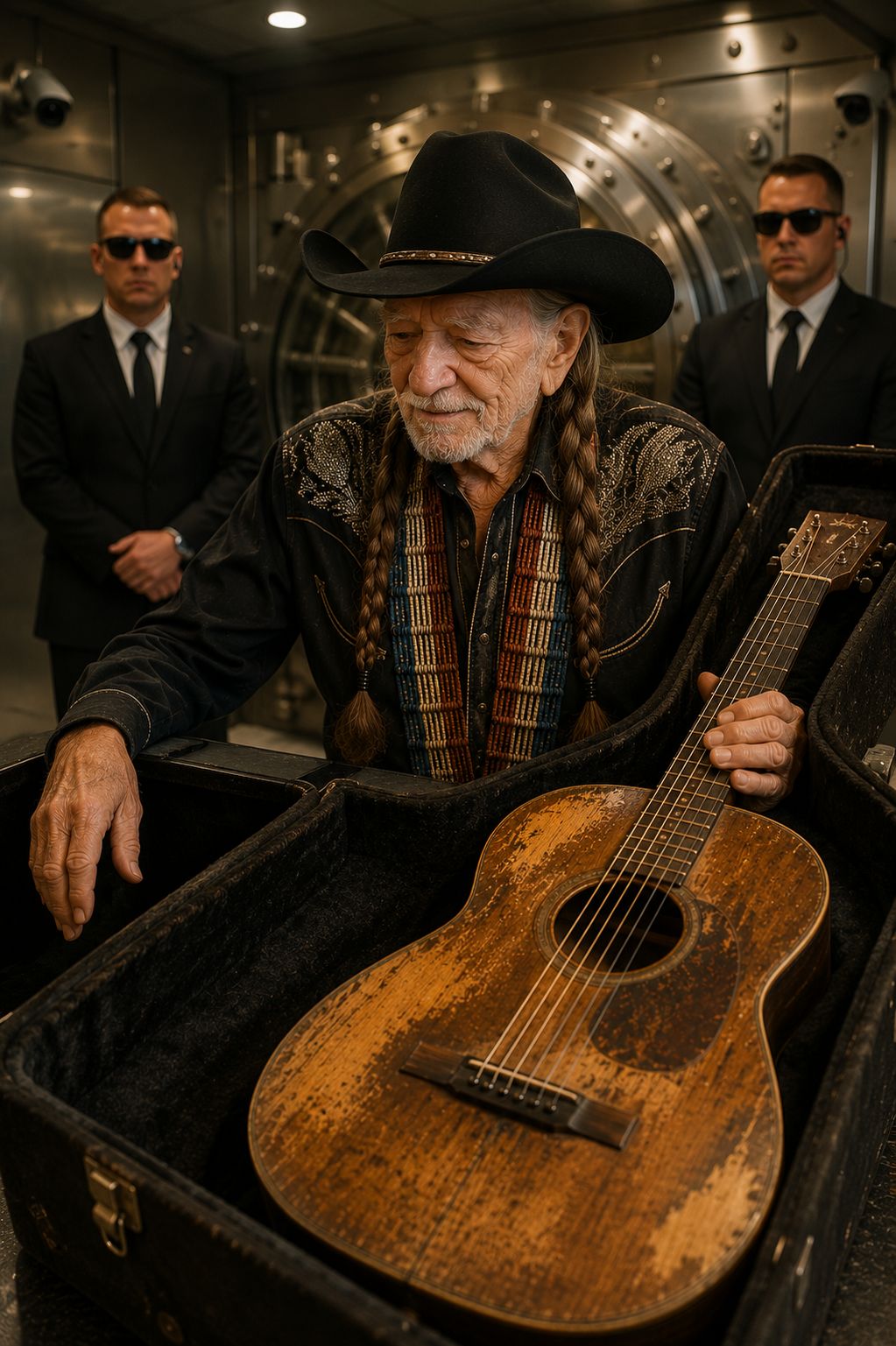 troduction
There are priceless Stradivarius violins locked behind museum glass.
There are royal crowns protected by armed guards.
There are diamonds stored in vaults beneath layers of steel.
Yet somewhere backstage before nearly every concert, surrounded by trusted technicians and watched over with almost ceremonial care, sits an object that many country music fans would argue is even more irreplaceable.
It isn’t made of gold.
It isn’t covered in jewels.
It isn’t even beautiful by traditional standards.
Instead, it is scarred, weathered, worn almost beyond recognition.
Its surface bears decades of abuse. Its finish disappeared long ago. The wood has been rubbed smooth by millions of touches. A massive hole stretches through its body, the result of thousands upon thousands of performances.
And yet no insurance company can truly calculate its worth.
Because this single guitar carries the entire musical legacy of Willie Nelson.
“If Trigger is gone, a part of me is gone.”
That simple statement from Willie Nelson explains everything.
To outsiders, Trigger looks like a guitar that should have been retired sometime during the Nixon administration.
Most musicians would have replaced it decades ago.
Collectors would recommend preserving it inside a climate-controlled display case.
Manufacturers would happily build Willie an exact duplicate using modern craftsmanship.
He has been offered countless alternatives over the years.
He has politely declined them all.
Because Trigger is no ordinary instrument.
It has become an extension of the man himself.
The guitar’s story began in 1969, shortly after Willie purchased a Martin N-20 classical guitar. Named after Roy Rogers’ famous horse, Trigger quickly became more than a tool—it became a lifelong companion.
From that day forward, virtually every important performance, every historic recording, every unforgettable concert, and every legendary jam session featured the same guitar.
Generations changed.
Musical trends shifted.
Record labels came and went.
But Trigger remained.
If guitars could speak, Trigger would tell the complete history of American country music.
It witnessed the birth of the Outlaw Movement.
It traveled dusty Texas highways.
It survived endless tour buses.
It crossed oceans.
It stood beside Waylon Jennings.
It shared stages with Johnny Cash.
It accompanied Merle Haggard.
It joined unexpected collaborations with artists from rock, jazz, blues, and pop.
Every scratch became a timestamp.
Every dent became another chapter.
Every worn edge became another memory permanently carved into history.
Every performance didn’t merely wear down the guitar.
Every performance added another page to its autobiography.
Perhaps the most remarkable feature of Trigger is the enormous hole worn directly into its body.
Most guitars eventually develop minor cosmetic damage.
Trigger developed a crater.
Years of aggressive fingerpicking slowly erased the protective wood surrounding the sound hole until little remained.
Many experts feared the guitar would eventually collapse.
Luthiers reinforced it.
Technicians carefully monitored it.
But no one dared restore it to “like new.”
Doing so would erase its history.
Each inch of missing wood represents thousands of hours spent creating music that connected generations.
That damage isn’t destruction.
It’s documentation.
Because of Trigger’s extraordinary importance, its protection has become almost legendary.
While Willie Nelson has always projected an easygoing, laid-back personality, those closest to him understand one unbreakable rule:
You don’t casually handle Trigger.
The guitar is carefully transported.
Its condition is constantly monitored.
Trusted crew members oversee its safety.
Temperature, humidity, and travel conditions matter.
After all, replacing strings is easy.
Replacing nearly sixty years of musical history is impossible.
The value isn’t found in the materials.
It’s found in what those materials have experienced.
There is something beautifully symbolic about Trigger’s condition.
Modern culture often celebrates perfection.
Shiny finishes.
Brand-new equipment.
Flawless appearances.
Trigger represents the opposite philosophy.
Its beauty comes directly from imperfection.
Every scar tells a story.
Every crack reflects perseverance.
Every faded section reminds us that greatness isn’t polished.
Greatness is earned.
The guitar looks exactly like a life devoted entirely to music should look.
Used.
Loved.
Exhausted.
Still singing.
Fans often notice that Willie rarely appears separated from Trigger.
That’s no coincidence.
For decades, audiences haven’t simply come to hear Willie Nelson.
They’ve come to hear Willie and Trigger together.
It’s a partnership unlike almost any other in popular music.
Some singers rely on expensive stage productions.
Others rely on elaborate visual effects.
Willie needed only one guitar and one unmistakable voice.
Everything else became secondary.
Together, Willie and Trigger created something no factory could ever manufacture:
Authenticity.
Many legendary musicians own extensive guitar collections.
Rooms filled with rare instruments.
Vaults containing priceless vintage models.
Willie Nelson certainly could have assembled such a collection.
Instead, he built his career around loyalty.
Why search endlessly for something better when perfection had already found him?
That relationship says something profound about both the musician and the instrument.
In an industry obsessed with constant upgrades, Willie chose commitment.
Trigger wasn’t replaced because memories cannot be replaced.
Music historians often describe Trigger as one of the world’s most recognizable guitars.
Not because it remains pristine.
Because it doesn’t.
The guitar visually represents endurance.
Every photograph tells the same story.
No explanations required.
One glance reveals decades of performances.
Few objects in entertainment history wear their history so openly.
Elvis Presley had Graceland.
Johnny Cash had his unmistakable black attire.
Dolly Parton has her dazzling stage presence.
Willie Nelson has Trigger.
Each became an instantly recognizable symbol.
But Trigger may be the only one that literally carries fingerprints from an entire lifetime.
Perhaps that’s why audiences become emotional whenever they see Willie step onto a stage carrying the guitar.
They’re not simply witnessing another concert.
They’re witnessing living history.
That same instrument has comforted grieving families.
Celebrated weddings.
Inspired young musicians.
United strangers through song.
Accompanied countless first dances.
Helped veterans remember home.
Offered hope during difficult times.
The notes may disappear into the night air.
The memories remain inside the wood.
Even today, as Willie Nelson continues to perform well into his later years, Trigger remains beside him.
Its appearance grows rougher.
Its history grows richer.
Its legend grows larger.
Every additional performance adds another invisible layer to an already unimaginable legacy.
Few partnerships survive five decades.
Even fewer survive six.
Willie and Trigger continue proving that true artistry isn’t measured by flawless appearances but by unwavering dedication.
Someday, the music will finally fall silent.
Stages will empty.
Spotlights will dim.
Crowds will go home.
But Trigger’s journey won’t truly end.
Whether displayed in a museum or preserved for future generations, it will continue telling the story of one of country music’s greatest icons.
Visitors won’t see merely an old guitar.
They’ll see the instrument that traveled nearly every mile of Willie Nelson’s extraordinary career.
They’ll see the scars left by countless unforgettable performances.
They’ll see the fingerprints of history.
Most importantly, they’ll understand why this weathered guitar became one of the most heavily protected objects in American music.
Because Trigger doesn’t simply belong to Willie Nelson.
It belongs to country music itself.
And perhaps that’s the greatest legacy any instrument could ever carry.