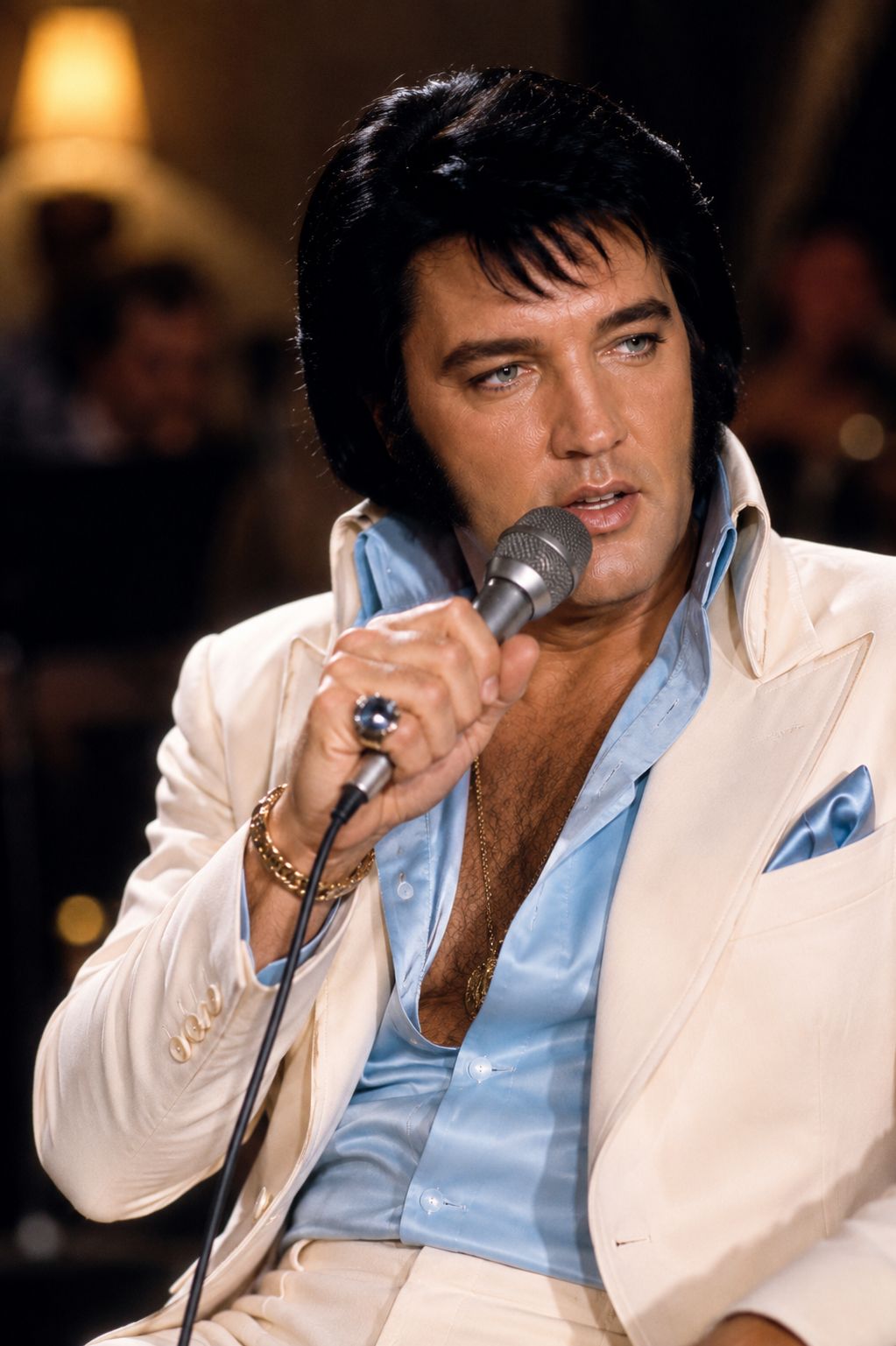
Introduction
In the summer of 1977, the world still saw Elvis Presley as larger than life.
He was only 42 years old, yet he looked decades older. His once-electric movements had become slower. His legendary smile appeared forced. Fans packed arenas hoping to witness the magic one more time, but many left heartbroken after seeing a man clearly exhausted, medicated, and emotionally drained.
Still, nobody wanted to believe the truth.
Because how could Elvis Presley — the man who revolutionized rock and roll — be falling apart before the world’s eyes?
The tragedy of Elvis wasn’t simply his death.
It was the lonely road that led him there.
The Boy Who Became a King
Long before the fame, Elvis was just a shy boy from Tupelo, Mississippi, raised in poverty by deeply loving parents. Music became his escape from hardship. Gospel hymns, blues records, and country radio shaped the sound that would later shock America.
When Elvis exploded onto the scene in the 1950s, it felt like lightning had struck the culture itself.
Women screamed.
Parents panicked.
Television networks feared him.
But fans adored him because Elvis represented freedom. He moved differently. Sang differently. Lived differently.
And for a while, fame seemed like a dream come true.
Yet fame has a cruel habit: it gives the world everything while quietly taking the artist apart piece by piece.
The Hollywood Trap
By the 1960s, Elvis had become more product than person.
Colonel Tom Parker — the controversial manager who controlled nearly every aspect of Elvis’s career — pushed him into a nonstop cycle of movies, merchandise, and appearances. Financially, it worked. Emotionally, it destroyed Elvis’s artistic spirit.
Many of his films became repetitive and forgettable. The young rebel who once terrified conservative America was now trapped singing lightweight soundtrack songs in predictable Hollywood productions.
Friends later described Elvis as deeply frustrated during these years.
“He wanted to be taken seriously again.”
That frustration slowly turned inward.
The pressure never stopped. The expectations only grew heavier.
And behind closed doors, Elvis began relying more heavily on prescription medications to cope with stress, insomnia, anxiety, and physical exhaustion.
At first, it seemed manageable.
Then it became a dependency.
The Comeback That Saved Him — Briefly
In 1968, Elvis shocked the world with what many still consider one of the greatest comebacks in music history: the legendary NBC Comeback Special.
Dressed in black leather, armed only with charisma and raw talent, Elvis looked reborn. The hunger was back. The fire returned to his voice.
For the first time in years, audiences saw the real Elvis again.
Not the movie star.
Not the commercial product.
The artist.
The performances reignited his career and reminded everyone why he became a global phenomenon in the first place.
Soon came sold-out concerts in Las Vegas, chart success, and renewed admiration from younger audiences.
But beneath the comeback was a painful reality:
Elvis was physically and emotionally deteriorating faster than anyone realized.
The Loneliness Inside Graceland
At the center of Elvis’s final years stood Graceland — the mansion that symbolized both unimaginable success and heartbreaking isolation.
To fans, Graceland looked magical.
To Elvis, it increasingly became a prison.
He surrounded himself with friends, bodyguards, assistants, and family members, yet loneliness consumed him. Fame had made genuine trust almost impossible. Everyone depended on Elvis financially. Very few could truly challenge him or tell him “no.”
As his health declined, so did his emotional stability.
His marriage to Priscilla Presley had collapsed. The divorce devastated him more deeply than many realized. Friends said he became increasingly withdrawn afterward.
The man who once commanded the attention of entire nations now spent long nights awake, wandering Graceland hallways in silence.
Eating excessively.
Sleeping irregularly.
Taking more medications.
Searching for peace he could never fully find.
Fans Began Noticing the Change
By 1976 and 1977, concert audiences could no longer ignore Elvis’s condition.
Some nights, he still delivered flashes of brilliance — moments where the old magic returned and crowds erupted with emotion. His voice, even weakened, could still shake an arena.
But other nights were painful.
He forgot lyrics.
Slurred words.
Sweated heavily under stage lights.
Moved slowly across the stage.
Fans who idolized him often left concerts worried rather than inspired.
Yet even then, audiences continued showing up in massive numbers.
Because they loved him.
And because part of them hoped the King would somehow recover.
“Every time Elvis walked onstage, people prayed they were seeing the old Elvis return.”
Sadly, the damage had already gone too far.
The Final Summer
In August 1977, Elvis was preparing for another tour.
Despite worsening health issues, chronic fatigue, and severe prescription drug use, the machine surrounding him never truly stopped. There were always more performances scheduled. More appearances. More obligations.
Those close to Elvis later admitted they feared for his life.
But nobody fully intervened in time.
On August 16, 1977, Elvis Presley was found unresponsive at Graceland.
The world froze.
News stations interrupted programming.
Fans cried openly in the streets.
Radio stations played his songs nonstop.
For millions, it felt impossible.
Elvis Presley couldn’t be dead.
Not Elvis.
But he was gone.
And with him disappeared one of the most extraordinary cultural figures America had ever produced.
The Tragedy Was Bigger Than Death
The heartbreaking truth about Elvis Presley’s final chapter is that his death wasn’t caused by one single moment.
It was years of pressure.
Years of isolation.
Years of addiction.
Years of carrying the impossible burden of being “The King.”
People often remember the spectacle of Elvis — the white jumpsuits, the fame, the screaming crowds.
But the deeper tragedy is that the world rarely allowed him to simply be human.
He became an icon so enormous that even his suffering turned invisible.
And that happens far too often with legends.
We celebrate them while they entertain us.
We mythologize them while they silently break apart.
Then we mourn them when it’s already too late.
Why Elvis Still Matters Today
Decades after his death, Elvis Presley remains one of the most influential entertainers in history.
Artists across rock, country, pop, and even hip-hop still reference him. His voice, style, and stage presence permanently altered popular culture.
But perhaps his final years leave behind an even more important lesson:
Fame cannot heal loneliness.
Money cannot erase emotional pain.
And success cannot protect someone from self-destruction.
That is why Elvis’s story continues to resonate across generations.
Because beneath the legend was a man desperately searching for peace.
A man who gave the world unforgettable music while privately fighting battles few understood.
“The King of Rock and Roll conquered the world… but never fully escaped the sadness inside himself.”
And maybe that is why people still can’t let him go.
Not because he was perfect.
But because he was heartbreakingly human.