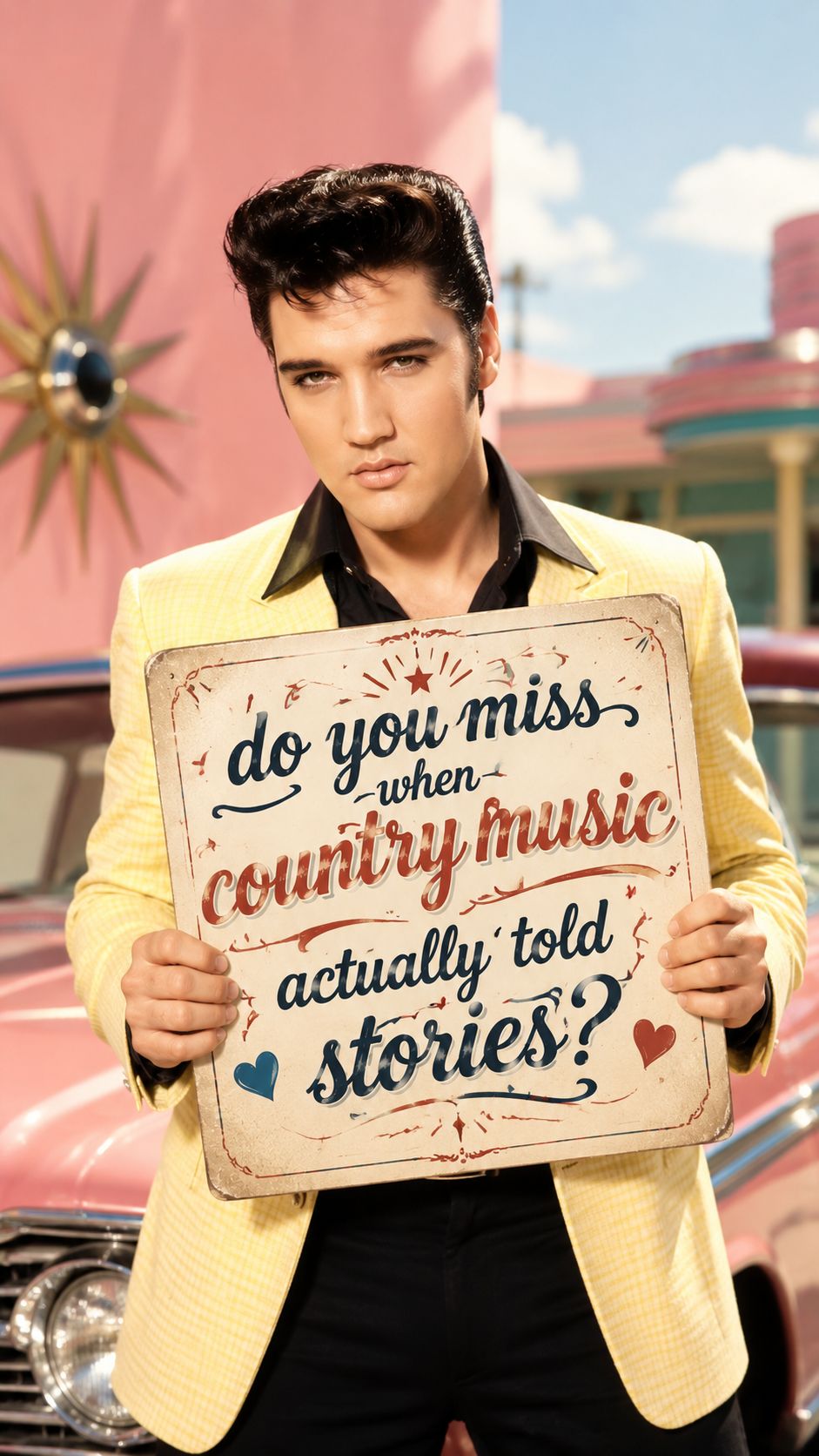
Introduction
When people talk about the history of American music, one name rises above every era, every genre, and every generation: Elvis Presley.
He wasn’t just a singer.
He wasn’t just “The King.”
He became something far bigger — a feeling. A memory. A voice that somehow survived long after the records stopped spinning.
The Legacy Elvis Presley Left Behind
There are legends… and then there is Elvis.
Even now, decades after his death, people still stand outside Graceland holding flowers, vinyl records, old photographs, and tears they still cannot explain. Teenagers who never lived during his era still discover his music and feel something ancient awaken inside them. Older fans still remember exactly where they were the first time they heard his voice.
That kind of legacy cannot be manufactured.
It has to be lived.
And Elvis lived louder than almost anyone who ever stepped onto a stage.
A Boy From Mississippi Who Changed Everything
Before the screaming crowds… before the white jumpsuits… before the gold records and television specials… Elvis was simply a poor boy from Tupelo, Mississippi.
He grew up surrounded by gospel music, country radio, and blues rhythms pouring from the streets of the South. Those sounds would eventually merge inside him and create something America had never truly heard before.
At a time when music was heavily divided by race and culture, Elvis blurred the lines.
He took the emotional storytelling of country music, the soul of gospel, and the fire of rhythm and blues — then delivered it with a charisma so explosive that the world could not look away.
“He didn’t just sing songs. He made people feel alive.”
When Elvis appeared on television in the 1950s, parents panicked.
His movements were called dangerous.
His style was called rebellious.
His music was called shocking.
But young people saw something entirely different.
Freedom.
For the first time, music looked fearless.
And country music would never be the same again.
The Moment America Fell In Love
There are certain artists who become successful.
Then there are artists who become woven into the identity of a nation.
Elvis achieved that almost overnight.
Songs like Heartbreak Hotel, Hound Dog, and Love Me Tender transformed him into a global phenomenon. Women screamed. Men copied his hair. Television ratings exploded whenever he appeared.
But behind all the fame was something deeper that fans connected to:
Loneliness.
Even at the height of his stardom, Elvis often looked like a man searching for peace he could never fully reach.
That emotional vulnerability became part of his magic.
He could sing a love song like his heart was breaking in real time.
He could sing gospel like he was praying for salvation.
And when he performed country ballads, audiences believed every word.
Elvis and Country Music’s Soul
Many people remember Elvis as the King of Rock and Roll.
But country music fans know the truth:
Country music lived inside him from the beginning.
His phrasing, storytelling, and emotional delivery carried the DNA of classic Southern country music. Artists across Nashville studied the way he interpreted lyrics and connected emotionally with audiences.
Without Elvis, the emotional blueprint for modern country performance might look completely different today.
You can still hear traces of him in countless stars who came after him.
From Willie Nelson to Dolly Parton, from Garth Brooks to Chris Stapleton — the emotional honesty Elvis brought into performance never disappeared.
Because Elvis taught artists that perfection mattered less than feeling.
And audiences never forgot it.
The Loneliness Behind The Crown
The most heartbreaking part of Elvis Presley’s story is that the man who gave joy to millions often struggled to find it himself.
Fame surrounded him constantly, but isolation followed him everywhere.
Inside Graceland, behind the gates and flashing cameras, Elvis battled pressure, exhaustion, and deep emotional emptiness. The world demanded more performances, more appearances, more records, more smiles.
But nobody can carry the weight of being a symbol forever.
“The crowd saw a king.
But sometimes Elvis felt like a prisoner inside his own legend.”
As the years passed, fans watched changes happen.
The energy remained.
The voice remained.
But the sadness became harder to hide.
Yet even during his most difficult years, Elvis still gave everything he had to audiences.
That is part of why fans remain so emotionally attached to him today.
People don’t just remember the superstar.
They remember the human being underneath the spotlight.
The 1968 Comeback That Became Immortal
If one performance captured Elvis Presley’s legacy forever, it was the legendary 1968 Comeback Special.
Dressed in black leather, surrounded by musicians, Elvis looked reborn.
There were no giant movie sets.
No distractions.
No Hollywood illusions.
Just Elvis and the music.
And for one unforgettable night, the world remembered exactly why he mattered.
The raw power in his voice.
The confidence in his presence.
The electricity in every movement.
It felt less like a concert and more like witnessing a man reclaim his soul.
Many artists have comeback stories.
Very few become mythology.
Why Fans Still Cry Over Elvis Today
Elvis Presley died in 1977.
Yet somehow, he never truly left.
His records still sell.
Documentaries still break streaming records.
Young artists still cite him as inspiration.
Fans still gather every year holding candles in the dark outside Graceland.
That kind of devotion cannot be explained by nostalgia alone.
It comes from emotional connection.
Elvis represented dreams for ordinary people.
He proved that a poor Southern kid could change the world through music.
But he also reminded people that fame does not erase pain.
That combination — greatness mixed with vulnerability — is what keeps his story alive generation after generation.
“Legends entertain us.
Elvis made people feel understood.”
And maybe that is why people still miss him so deeply.
Because his music carried heartbreak without shame.
It carried longing.
Faith.
Loneliness.
Hope.
The emotions were real.
The Legacy He Truly Left Behind
The greatest legacy Elvis Presley left behind was not his mansion, his fame, or even his record sales.
It was emotional truth.
He showed future musicians that audiences don’t fall in love with perfection.
They fall in love with humanity.
Every trembling note in a ballad…
Every vulnerable lyric…
Every emotional performance from modern country artists today still carries echoes of Elvis Presley somewhere inside it.
His influence stretches far beyond genre.
He changed how artists perform.
How music feels.
How audiences connect emotionally to songs.
And perhaps most importantly, he proved that music could make people feel less alone.
That is why the world still remembers him.
Not because he was flawless.
But because he was human.
And because somewhere inside that legendary voice, millions of people heard pieces of their own lives.
Elvis Presley may have left this world nearly fifty years ago…
…but the legacy he left behind still sings.