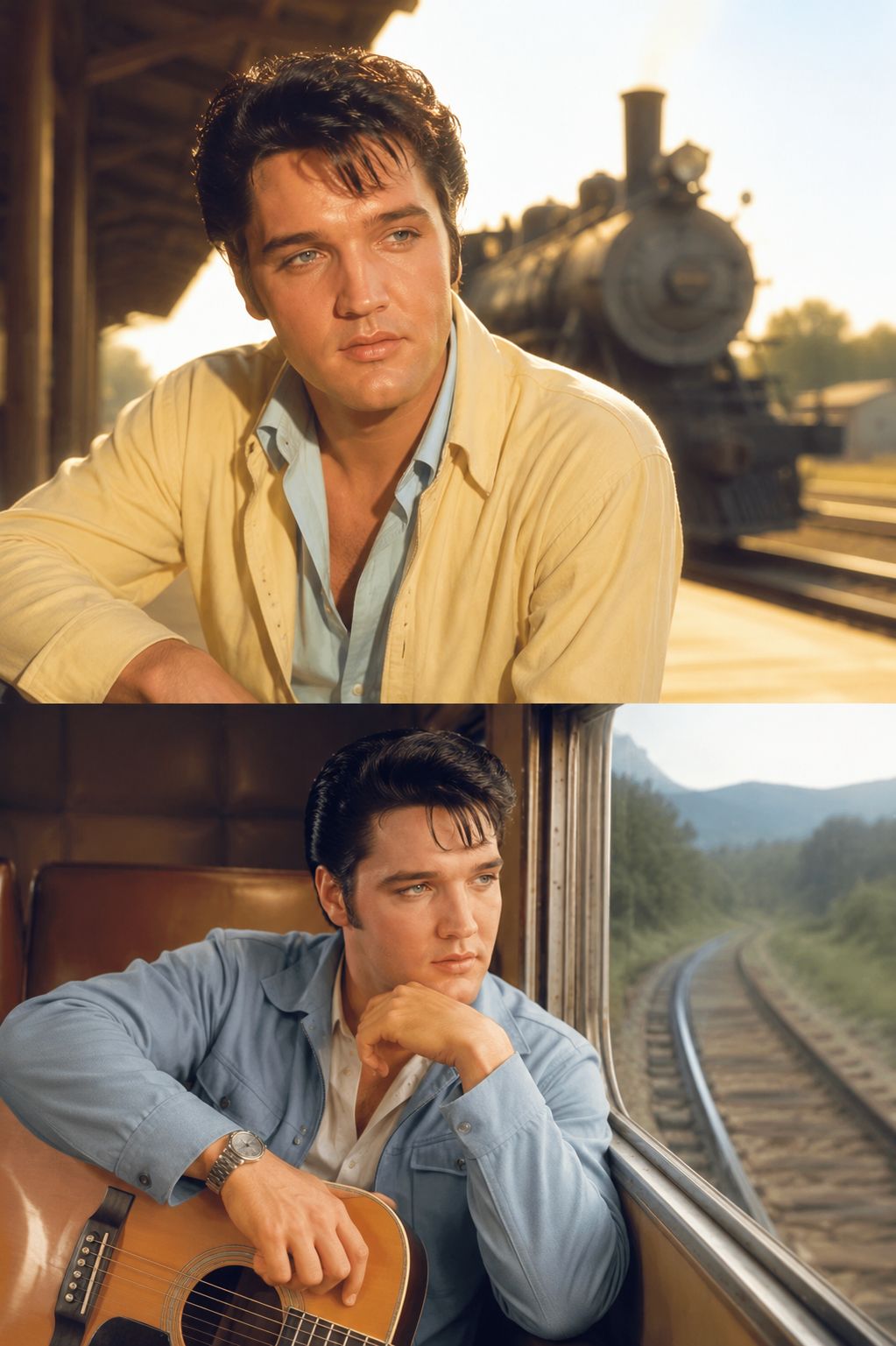
Introduction
Long before stadiums erupted at the sight of him, before the gold records and Hollywood spotlights, there was a sound that haunted the American South.
It was the cry of a train whistle cutting through the darkness.
For a young boy growing up in Mississippi, that lonely sound was more than background noise. It was a soundtrack to dreams, heartbreak, escape, and possibility. And years later, when the world came to know Elvis Presley, traces of that mournful whistle could still be heard echoing through his music.
The story of Elvis is often told through the lens of rock and roll. Historians point to his electrifying performances, his revolutionary blend of musical styles, and the cultural earthquake he unleashed in the 1950s.
But beneath the excitement was something older.
Something deeply Southern.
Something that sounded remarkably like a train disappearing into the night.
The Sound of the South
In the rural South of the 1930s and 1940s, trains were impossible to ignore.
They carried workers to distant cities. They reunited families. They separated lovers. They transported soldiers to war and brought them home again. Every whistle represented movement in a world where many people rarely traveled far from home.
For poor families like the Presleys, trains symbolized opportunity.
Young Elvis grew up in Tupelo, where railroad tracks were part of everyday life. The sounds drifting through the air became woven into his understanding of music long before he ever stepped into a recording studio.
Country songs of the era frequently borrowed train imagery. Blues musicians did the same. Gospel singers transformed the railroad into a metaphor for salvation.
Without realizing it, Elvis was absorbing all of it.
The rhythmic clatter of wheels.
The distant whistle.
The emotional weight attached to every departure.
Years later, those influences would emerge in his singing.
A Voice That Traveled Like a Train
Many singers rely on precision.
Elvis relied on emotion.
Listen carefully to some of his earliest recordings, and you’ll notice something unusual. His voice often glides between notes instead of landing directly on them. He bends phrases. He stretches syllables. He creates tension before releasing it.
The effect feels remarkably similar to a train whistle rising and fading across the countryside.
It wasn’t an accident.
Elvis grew up listening to country artists whose music was saturated with railroad imagery. He also absorbed the blues traditions of Mississippi, where trains were recurring symbols of longing and freedom.
The result was a vocal style unlike anything popular radio had heard.
“He didn’t just sing the song. He sounded like he was traveling through it.”
That quality became one of Elvis’s greatest strengths.
Even on upbeat recordings, there was often a trace of loneliness beneath the surface.
A sense that he was reaching for something just beyond the horizon.
Much like the sound of a train disappearing into the distance.
The Mystery of Heartbreak
One reason train whistles became such a powerful symbol in American music is simple: they sound emotional.
Even people who have never ridden a locomotive understand the feeling.
The sound can be mournful.
It can be hopeful.
Sometimes it feels like both at once.
Elvis tapped into that emotional contradiction better than almost anyone.
Songs such as Blue Moon of Kentucky, Mystery Train, and That’s All Right showcased a young performer who understood how to balance excitement with yearning.
Among these, Mystery Train remains particularly revealing.
The song itself revolves around railroad imagery, but Elvis transformed it into something larger than a simple train song.
His vocal delivery captured movement, anticipation, and loneliness simultaneously.
Listeners weren’t just hearing a train.
They were hearing the feeling of chasing a dream.
Memphis and the Railroad Spirit
When Elvis eventually moved to Memphis, he found himself in one of America’s great musical crossroads.
Memphis was a city built on movement.
People arrived from every direction.
Musical traditions collided daily.
Country met blues.
Gospel met rhythm and blues.
And everywhere, railroads connected communities and cultures.
The environment intensified the influences Elvis had already absorbed as a child.
At Sun Records, producer Sam Phillips recognized that Elvis possessed something extraordinary.
He carried the sounds of multiple musical worlds at once.
The train whistle symbolism embedded within Southern music became part of that blend.
It helped give Elvis’s recordings a restless energy that separated him from traditional country performers and conventional pop singers alike.
Why Fans Still Feel It Today
Modern listeners often struggle to explain why Elvis’s earliest recordings remain so powerful.
The production is simple.
The arrangements are sparse.
There are no elaborate studio effects.
Yet the recordings continue to resonate.
Part of the answer lies in authenticity.
Elvis wasn’t manufacturing emotion.
He was channeling sounds and experiences that had surrounded him since childhood.
When audiences heard him sing, they sensed something genuine.
The lonesome quality in his voice felt lived-in.
Real.
Earned.
“Every great singer leaves fingerprints on a song. Elvis left footprints.”
His performances carried the emotional DNA of Southern railroad towns, church gatherings, front porches, and long nights beneath open skies.
Those influences connected with listeners because they reflected universal experiences.
Everyone knows what it’s like to leave.
Everyone knows what it’s like to wait.
Everyone knows what it’s like to miss someone.
The train whistle became a perfect musical shorthand for those emotions.
And Elvis knew exactly how to use it.
The Echo Behind the Revolution
Much has been written about Elvis as a cultural revolutionary.
And rightly so.
His arrival changed popular music forever.
But revolutions rarely emerge from nowhere.
They grow from roots that run deep.
Before Elvis became a global phenomenon, he was a Southern boy listening carefully to the world around him.
The sounds that shaped him weren’t glamorous.
They were ordinary.
Church choirs.
Blues records.
Country radio.
And somewhere in the distance, the cry of passing trains.
Those sounds fused together inside him until they became something entirely new.
When audiences first heard Elvis, they recognized the excitement immediately.
What many didn’t recognize was the loneliness hidden underneath.
That emotional depth gave his music staying power.
It transformed catchy songs into lasting memories.
The Lasting Legacy of the Whistle
Today, decades after his passing, Elvis remains one of the most studied figures in music history.
Fans continue to analyze his voice, his recordings, and his influence on generations of artists.
Yet one of the most important clues to understanding him may be one of the simplest.
Listen closely.
Beneath the swagger.
Beneath the energy.
Beneath the revolutionary sound.
You can still hear it.
The distant echo of a train whistle drifting across the Mississippi night.
It carries traces of longing, faith, uncertainty, and hope.
It reminds us that before Elvis Presley became the King of Rock and Roll, he was a dreamer listening to the sounds of the South.
And in many ways, he never stopped listening.
That is why his earliest recordings continue to feel alive.
That is why they still move listeners generations later.
Because hidden within those songs is the same haunting sound that once floated through the darkness of his childhood—a lonesome train whistle calling from somewhere beyond the horizon, inviting a young boy to imagine a bigger world.
Elvis answered that call.
The rest is music history.