Introduction
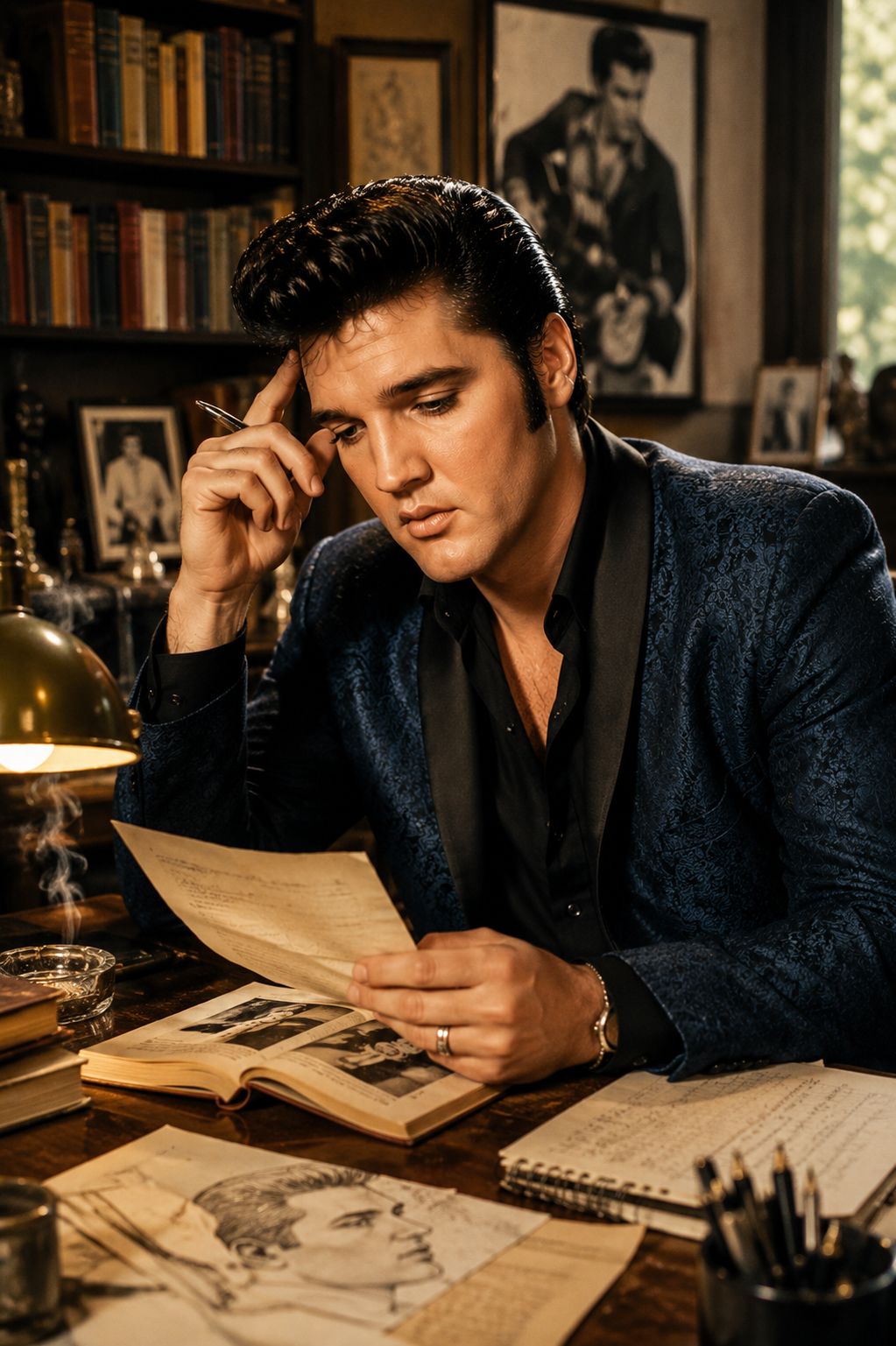
When most people think of Elvis Presley, they picture the dazzling jumpsuits, the swiveling hips, the unforgettable smile, and of course, the towering pompadour that became one of the most recognizable hairstyles in history.
But what if the most fascinating thing about Elvis wasn’t what sat on top of his head?
What if beneath that legendary pompadour lived a restless, searching intellect that the world never fully understood?
For decades, popular culture has reduced Elvis to a caricature—a handsome Southern boy blessed with extraordinary charisma and a once-in-a-generation voice. Yet those who spent meaningful time with him often described a very different man: a thinker, a reader, a spiritual seeker, and someone whose curiosity stretched far beyond music.
The truth is that Elvis Presley may have been one of the most intellectually underestimated figures in entertainment history.
The Dangerous Myth of the “Simple” Elvis
The public version of Elvis was carefully constructed.
Television producers wanted excitement.
Hollywood wanted a heartthrob.
Record executives wanted a phenomenon.
Few people had any interest in presenting Elvis as a deep thinker.
The image was easier to sell if audiences believed he was driven purely by instinct and talent.
Yet those closest to him repeatedly painted another picture.
Behind closed doors, Elvis spent countless hours discussing philosophy, religion, human consciousness, history, and the mysteries of life itself.
Friends often recalled conversations that stretched until sunrise.
These weren’t the discussions of someone uninterested in ideas.
These were the obsessions of a man searching for answers.
“He wanted to understand why people were here.”
That simple observation appears again and again in recollections from people who knew him.
While critics focused on his hair and wardrobe, Elvis was wrestling with questions that have challenged humanity for centuries.
The Library Hidden Behind the Spotlight
One of the most overlooked aspects of Elvis’s life was his voracious reading habit.
Visitors to Graceland frequently discovered books scattered throughout the mansion.
Not just biographies or entertainment magazines.
Books about spirituality.
Books about comparative religion.
Books about metaphysics.
Books exploring the nature of existence.
His personal collection reportedly grew into the hundreds, perhaps even thousands, over the years.
The image clashes with the stereotype.
After all, society often struggles to believe that someone can be both enormously famous and deeply intellectual.
Yet Elvis embodied that contradiction.
He could command an arena filled with screaming fans one night and spend the next quietly reading about ancient wisdom traditions.
That duality fascinated those around him.
It also confused them.
Many couldn’t reconcile the electrifying rock-and-roll rebel with the contemplative student of philosophy.
But perhaps those two identities were never separate.
Perhaps they were the same person.
The Rebel Was Smarter Than Anyone Realized
Part of Elvis’s genius came from his ability to absorb influences.
Long before cultural fusion became fashionable, he was listening to gospel, country, blues, rhythm and blues, and pop music simultaneously.
He wasn’t simply copying sounds.
He was analyzing them.
Combining them.
Transforming them.
Creating something entirely new.
That process required more than talent.
It required intellectual creativity.
The young man from Memphis instinctively understood musical structures that many formally trained musicians struggled to grasp.
He recognized emotional truths hidden inside songs.
He knew how to reshape material so audiences felt it more deeply.
This wasn’t accidental.
It was evidence of an extraordinarily agile mind.
Elvis wasn’t merely performing culture—he was synthesizing it.
That distinction matters.
A performer reproduces.
An innovator reimagines.
Elvis consistently did the latter.
The Spiritual Search That Never Ended
As his fame grew, so did his questions.
Success failed to satisfy the deeper hunger inside him.
Millions adored him.
Yet he remained intensely curious about life’s larger meaning.
Throughout the 1960s and 1970s, Elvis immersed himself in spiritual studies.
He explored Christianity, Eastern philosophies, meditation practices, and countless alternative perspectives.
Some observers dismissed this as eccentric behavior.
Others recognized something more profound.
He was searching.
Searching for peace.
Searching for understanding.
Searching for something that fame could never provide.
The irony is striking.
The world saw a man who appeared to have everything.
Elvis often felt like someone still looking for the most important thing of all.
The Conversations Nobody Expected
Members of the Memphis Mafia frequently described long discussions that surprised newcomers.
Guests arrived expecting jokes, stories, and celebrity glamour.
Instead, they found conversations about destiny, consciousness, and personal transformation.
Elvis had a remarkable ability to move from casual humor into profound reflection within moments.
One minute he was laughing.
The next he was questioning the nature of reality.
These intellectual detours weren’t performances.
They weren’t publicity stunts.
There were no cameras present.
No headlines to gain.
Just genuine curiosity.
That’s often how you identify authentic thinkers.
They ask difficult questions even when nobody is watching.
The Burden of Being Misunderstood
Perhaps one of the saddest aspects of Elvis’s story is how often his intelligence was overlooked.
The more famous he became, the harder it became for people to see beyond the image.
His appearance became the story.
His celebrity became the story.
His excesses became the story.
Meanwhile, the thoughtful man beneath the surface disappeared from public view.
This created a strange loneliness.
Imagine possessing deep interests and profound questions while living inside a global brand.
Imagine knowing that millions recognize your face but very few understand your mind.
That was part of Elvis’s reality.
The pompadour became both a crown and a disguise.
It symbolized his power.
But it also concealed parts of him from the world.
The Legacy Hidden in Plain Sight
Today, more than four decades after his death, Elvis Presley continues to inspire fascination.
New generations discover the music.
They admire the performances.
They study the cultural impact.
Yet many still overlook the intellectual dimension of his life.
And that may be one of the final frontiers in understanding Elvis.
The rebel wasn’t just challenging musical conventions.
He was challenging assumptions about what a superstar could be.
He proved that charisma and contemplation could coexist.
That popular entertainment and intellectual curiosity weren’t enemies.
That a rock-and-roll icon could also be a lifelong student.
The greatest secret beneath Elvis Presley’s pompadour wasn’t rebellion. It was curiosity.
That curiosity fueled everything.
His music.
His creativity.
His spiritual exploration.
His endless desire to understand the world around him.
The hair became legendary.
The voice became immortal.
But the mind behind both remains one of the most underrated aspects of the Elvis story.
Perhaps that’s why the fascination endures.
Because beneath the rhinestones, beneath the fame, beneath the larger-than-life mythology, there was a man asking the same questions we all ask.
Who am I?
Why am I here?
What matters most?
The world saw a king.
The people closest to him saw a seeker.
And hidden beneath that famous pompadour was a rebel intellect still waiting to be fully appreciated.
Video