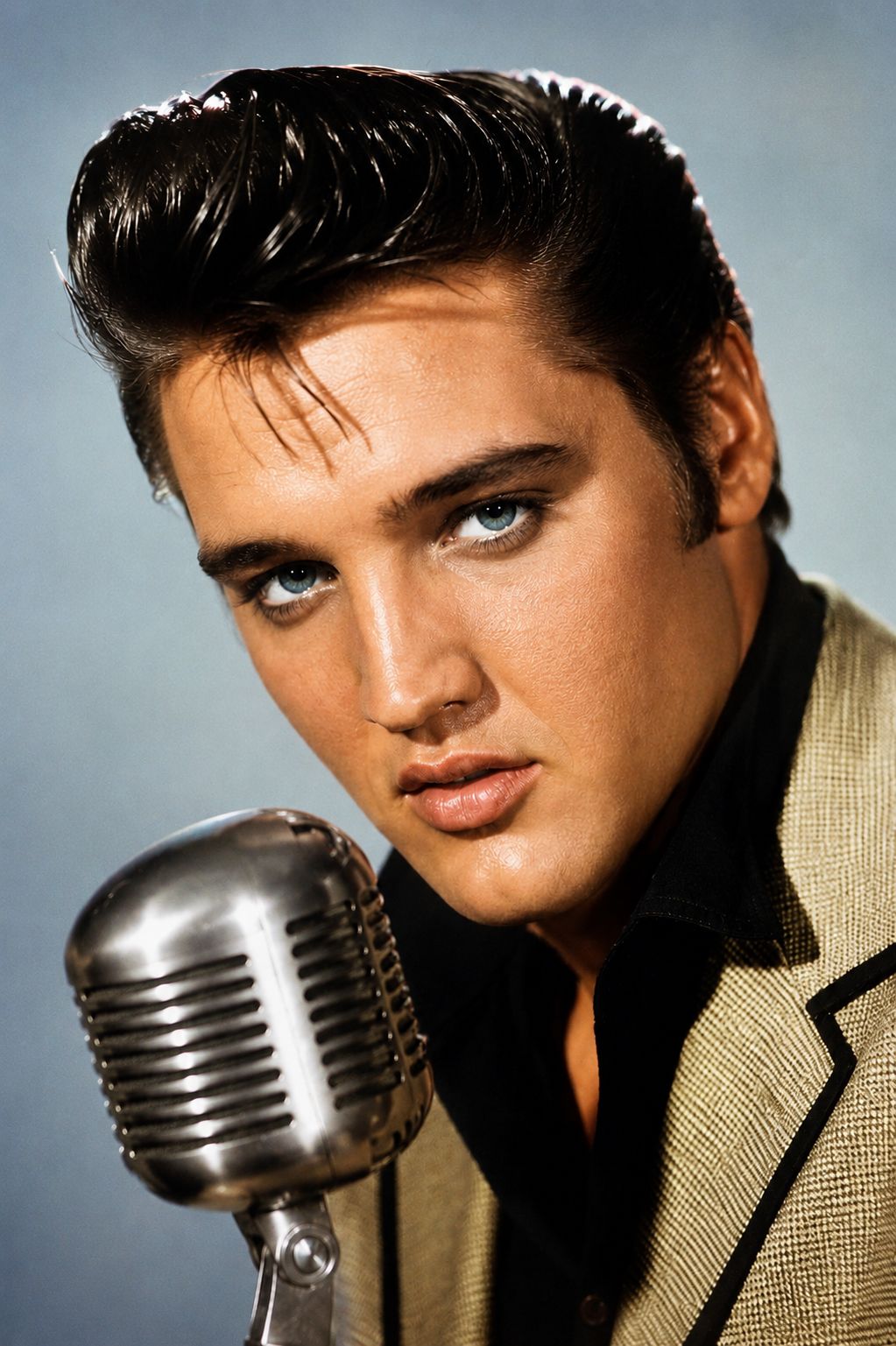
Introduction
Long before the screaming crowds, the gold records, and the legend of Elvis Presley became immortal, there was just a nervous young man from Mississippi walking into a tiny recording studio with four dollars in his pocket and a dream nobody around him fully understood.
America in the early 1950s was clean-cut, conservative, and predictable. Country music had rules. Pop music had rules. Even the way men stood on stage had rules.
Then Elvis arrived.
And nothing would ever be the same again.
A Boy Raised Between Poverty and Gospel
Elvis Presley wasn’t born into glamour. He was born in a small two-room house in Tupelo during the Great Depression. His family struggled constantly. Money disappeared as fast as it came. His father worked odd jobs. His mother, Gladys, protected Elvis like he was the last fragile piece of light in a difficult world.
But even as a child, Elvis absorbed music like oxygen.
He listened to gospel music in Black churches. He heard country songs on the radio. Blues drifted through the streets and small clubs of the South. While many white artists of the era stayed safely inside one musical tradition, Elvis grew up hearing them all blend together naturally.
That mixture would eventually terrify America.
Because Elvis didn’t sound “acceptable.”
He sounded dangerous.
“He wasn’t singing music the way America expected it to be sung. He was feeling it.”
The Quiet Recording That Started a Revolution
In 1953, an 18-year-old Elvis walked into Sun Records in Memphis.
The studio secretary asked why he wanted to record a song.
Elvis reportedly answered:
“I don’t sound like nobody.”
At the time, that sounded like confidence.
In reality, it was prophecy.
He recorded a simple acetate disc as a gift for his mother. Nothing about the session seemed historic. No reporters showed up. No executives rushed into the room. No audience waited outside.
But studio owner Sam Phillips noticed something unusual.
Phillips had spent years searching for a white singer who could capture the emotional depth and rhythm of Black music without imitation feeling forced or artificial.
Then Elvis appeared.
Not polished.
Not refined.
But real.
That authenticity became the spark.
The Night Everything Changed
Months later, during a casual studio session with guitarist Scotty Moore and bassist Bill Black, Elvis began fooling around between takes.
He launched into an energetic version of the blues song That’s All Right.
Suddenly, the room changed.
The rhythm was wild. The sound was loose. Country mixed with blues. Gospel energy collided with raw Southern swagger.
Sam Phillips reportedly ran into the room asking:
“What are you doing?”
Nobody fully knew.
But they knew it sounded alive.
The recording of That’s All Right became the moment Elvis Presley stopped being a poor Southern kid and started becoming a phenomenon.
America Didn’t Know Whether to Love Him or Fear Him
When local radio stations first played Elvis’s music, listeners flooded the phone lines.
Some thought the singer was Black.
Others were shocked to discover he was white.
That confusion revealed something deeper about America in the 1950s. The country was deeply segregated — socially, culturally, and musically. Genres had invisible racial boundaries.
Elvis shattered them accidentally.
His voice carried the emotional grit of rhythm and blues, but his appearance allowed white audiences to embrace sounds they had previously ignored or rejected.
To younger listeners, he felt thrilling.
To older generations, he felt threatening.
And controversy only made him bigger.
“Parents heard rebellion. Teenagers heard freedom.”
The Body Movements That Shocked the Nation
It wasn’t just the music.
It was the way Elvis moved.
By modern standards, his performances seem tame. But in the conservative climate of 1950s America, Elvis Presley’s dancing looked scandalous. His hips swayed. His legs shook. His performances felt emotionally uncontrolled.
Television executives panicked.
Religious groups criticized him.
Newspapers attacked him.
Ironically, every attempt to shame Elvis only expanded his fame.
Young people saw someone finally breaking the rigid rules they had grown tired of following.
He represented rebellion before rebellion became fashionable.
The Explosion of Teenage Identity
Before Elvis Presley, teenagers existed mostly as children waiting to become adults. The entertainment industry rarely focused entirely on them.
Elvis changed that overnight.
Teenagers suddenly had music that belonged to them.
Not their parents.
Not teachers.
Not polite society.
The rise of Elvis helped create modern youth culture itself. Fans screamed at concerts with a level of hysteria America had never witnessed before. Girls cried, fainted, and chased him through crowds.
Adults were horrified.
But the more society tried to suppress Elvis, the stronger the connection between him and young audiences became.
He wasn’t just a singer anymore.
He became an emotional escape.
Country Music Was Never the Same Again
As a Country Music analyst, one truth becomes impossible to ignore:
Elvis Presley permanently altered the DNA of country music.
Before Elvis, country music largely stayed inside traditional boundaries — heartbreak ballads, fiddle tunes, cowboy imagery, and polished vocal restraint.
Elvis introduced rhythm.
Danger.
Swagger.
Sex appeal.
He proved country-rooted music could become explosive popular culture.
Without Elvis Presley’s breakthrough, it’s difficult to imagine later artists like Johnny Cash, Waylon Jennings, or even modern crossover stars finding the courage to challenge Nashville traditions.
Elvis opened the gate.
Everyone else walked through it afterward.
“He didn’t just break into music. He broke the walls around it.”
Fame Came Fast — But So Did Pressure
After the success of That’s All Right, Elvis’s rise accelerated at unbelievable speed.
Concerts grew bigger.
Radio stations demanded more songs.
Crowds became uncontrollable.
But underneath the fame remained a young man still trying to understand what was happening to his life.
Friends from the era often described Elvis as both deeply confident on stage and painfully insecure off stage. He feared failure constantly. He wanted approval desperately, especially from his mother.
That emotional vulnerability made fans love him even more.
Because beneath the rebellion was a lonely Southern boy terrified of losing everything he had finally gained.
Why Elvis’s First Breakthrough Still Matters Today
Modern audiences sometimes forget how radical Elvis Presley truly was when he first appeared.
Today, genre blending is normal.
Artists mix country, rap, rock, and pop every day.
But Elvis did it when America itself was culturally divided and emotionally rigid.
His first breakthrough wasn’t merely about becoming famous.
It was about changing what American music could become.
He represented the collision of cultures, generations, and emotions. He frightened traditionalists because he exposed how quickly the world was changing.
And deep down, they knew they could not stop it.
That’s why Elvis Presley remains more than a celebrity.
He became a symbol of transformation itself.
The Rebel Became a Legend
The young man who once walked nervously into a Memphis studio eventually became the King of Rock and Roll.
But the most powerful part of Elvis Presley’s story may always be the beginning.
The uncertainty.
The hunger.
The rebellion.
Because before the fame, before the movies, before the white jumpsuits and worldwide superstardom…
There was simply a young rebel with a different sound — and the courage to let the world hear it.
And America has never sounded the same since.