Introduction
There are moments in music history when an artist stands at a crossroads. One road leads toward reinvention. The other leads toward irrelevance. For Elvis Presley, the undisputed King of Rock and Roll, one such moment arrived during the late 1960s—a period when critics were beginning to wonder if his reign had quietly come to an end.
The world that Elvis had once dominated was changing at lightning speed.
The British Invasion had transformed popular music. New stars emerged every month. Psychedelic rock filled the airwaves. Younger audiences were looking elsewhere for excitement. Meanwhile, Elvis was trapped in a cycle of Hollywood films and soundtrack albums that many believed had diluted the raw energy that had made him a legend.
By 1968, some industry insiders were whispering an uncomfortable question:
“Had the King lost his crown?”
The answer would come from an unexpected source—not a massive arena show, not a chart-topping single, and not a Hollywood blockbuster.
It would come from a simple sit-down acoustic jam session.
And in many ways, it would save Elvis Presley’s legacy forever.
A Star Lost in His Own Image
For years, Elvis had become a prisoner of his own success.
The rebellious young man who had shocked America in the 1950s had slowly been transformed into a polished movie star. While his films remained commercially successful, critics increasingly viewed them as formulaic. The soundtrack songs rarely carried the emotional depth of his earlier recordings.
Fans who remembered the fire of “Heartbreak Hotel,” “That’s All Right,” and “Jailhouse Rock” longed to see the authentic Elvis again.
The problem was that even Elvis himself felt disconnected from the artist he once was.
Friends close to him later described a growing frustration. He knew he was capable of more. He knew there was still greatness inside him. But the machinery surrounding his career seemed content to keep him on autopilot.
What Elvis needed wasn’t another script.
He needed a reminder of who he really was.
The Gathering That Changed Everything
When preparations began for what would eventually become the legendary 1968 television special, something remarkable happened.
Instead of focusing solely on elaborate production numbers, Elvis found himself surrounded by old friends, musicians, and bandmates who had been there during the earliest chapters of his career.
The atmosphere was informal.
No giant stage.
No special effects.
No elaborate costumes.
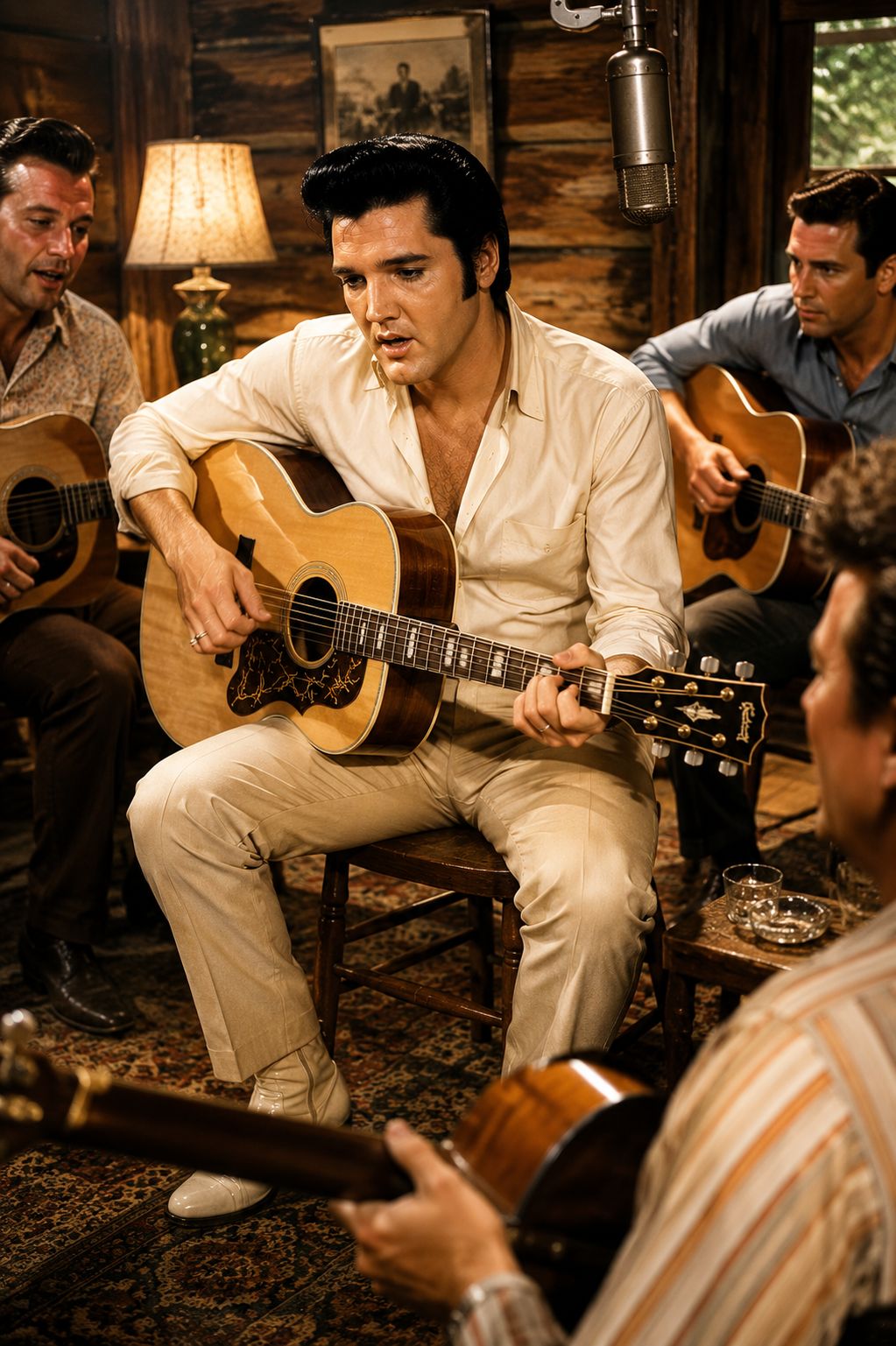
Just guitars.
Just musicians.
Just songs.
As cameras rolled, Elvis sat among fellow performers in a circle that felt more like a family reunion than a television production.
Something magical happened almost immediately.
The tension disappeared.
The movie star vanished.
The real Elvis emerged.
“For the first time in years, he wasn’t playing a role. He was simply being Elvis.”
Viewers could see it in his smile.
The musicians could hear it in his voice.
The energy was impossible to fake.
The Return of the Memphis Rebel
What made the acoustic jam session so powerful wasn’t technical perfection.
It was authenticity.
The performances felt alive.
Elvis laughed when mistakes happened.
He exchanged playful comments with the musicians.
He fed off their energy, and they fed off his.
This wasn’t a carefully rehearsed production designed to manufacture emotion.
The emotion was real.
Every note seemed to reconnect him with the young man who had once walked into Sun Studio with nothing but a dream and a voice unlike any other.
As the guitars rang out, audiences witnessed something rare:
An icon rediscovering himself in real time.
The confidence that had once electrified audiences began returning.
The swagger came back.
The joy came back.
Most importantly, the hunger came back.
You can almost see the transformation happening minute by minute.
It’s as if Elvis suddenly remembered that before he was a celebrity, before he was a movie star, before he was the King, he was simply a musician who loved making music.
Why Fans Couldn’t Look Away
The acoustic setting stripped away every barrier between Elvis and his audience.
For years, fans had seen polished performances crafted by studios and producers.
This was different.
This felt personal.
People weren’t watching a distant superstar.
They were sitting in the room with him.
That intimacy created an emotional connection that many viewers had not experienced in years.
The special revealed vulnerability.
It revealed humor.
It revealed spontaneity.
Most importantly, it revealed humanity.
“The audience didn’t fall in love with a legend that night. They fell in love with the man behind the legend.”
The response was immediate.
Critics who had dismissed Elvis suddenly changed their tune.
Fans who feared his best days were behind him felt renewed excitement.
Even younger listeners who had never fully understood the Elvis phenomenon began paying attention.
The King was back.
A Career Reborn
The success of the sit-down sessions became the emotional centerpiece of the 1968 comeback.
The performances generated enormous buzz.
More importantly, they reminded the music industry that Elvis still possessed something many newer artists lacked:
Genuine star power.
Not manufactured charisma.
Not marketing hype.
Authentic magnetism.
The momentum created by those performances opened the door for the next chapter of his career.
Soon came his return to live performance.
Soon came Las Vegas.
Soon came a renewed recording career that produced some of the strongest vocal performances of his life.
Songs like “Suspicious Minds,” “In the Ghetto,” and “Kentucky Rain” would help define a remarkable artistic resurgence.
None of that momentum happens without the acoustic sessions.
Those intimate performances served as the spark that reignited everything.
The Hidden Lesson Behind the Jam Session
The deeper significance of the sit-down session extends beyond Elvis Presley.
It offers a timeless lesson about artistry.
Sometimes greatness isn’t recovered through reinvention.
Sometimes greatness is recovered through rediscovery.
At a moment when many expected Elvis to chase trends, he instead returned to his roots.
He didn’t try to become somebody else.
He became himself again.
That decision transformed the trajectory of his career.
The irony is almost poetic.
The biggest comeback of Elvis Presley’s life didn’t begin with spectacle.
It began with simplicity.
A chair.
A guitar.
A few friends.
And a collection of songs that reminded everyone—including Elvis himself—why he became a legend in the first place.
The Legacy That Lives On
Today, decades after Elvis Presley left this world, the sit-down acoustic jam session remains one of the most celebrated moments of his career.
Music historians continue to study it.
Fans continue to watch it.
New generations continue to discover it.
Why?
Because it captures something rare.
It captures truth.
In an industry often built on illusion, audiences witnessed a genuine artistic awakening.
The session showed that beneath the fame, beneath the headlines, beneath the myth, there was still an extraordinary musician hungry to connect with people through music.
And perhaps that’s why the moment endures.
Not because it was flashy.
Not because it was expensive.
Not because it was carefully engineered.
It endures because it was real.
“The sit-down jam session didn’t just revive Elvis Presley’s career—it reminded the world why Elvis Presley mattered.”
Many stars experience comebacks.
Few experience resurrections.
That night, surrounded by guitars, old friends, and the songs that shaped his life, Elvis Presley achieved exactly that.
The King reclaimed his throne—not through spectacle, but through authenticity.
And in doing so, he secured a legacy that would outlive generations.
The acoustic jam session wasn’t merely a television segment.
It was a turning point in music history.
It was the moment Elvis found himself again.
And it was the moment the world remembered why no one could ever truly replace the King of Rock and Roll.