Introduction
In the world of country music, some instruments are valuable because of their rarity. Others are treasured because of who played them. But every once in a generation, an instrument becomes something more than wood, wire, and craftsmanship.
It becomes a living witness.
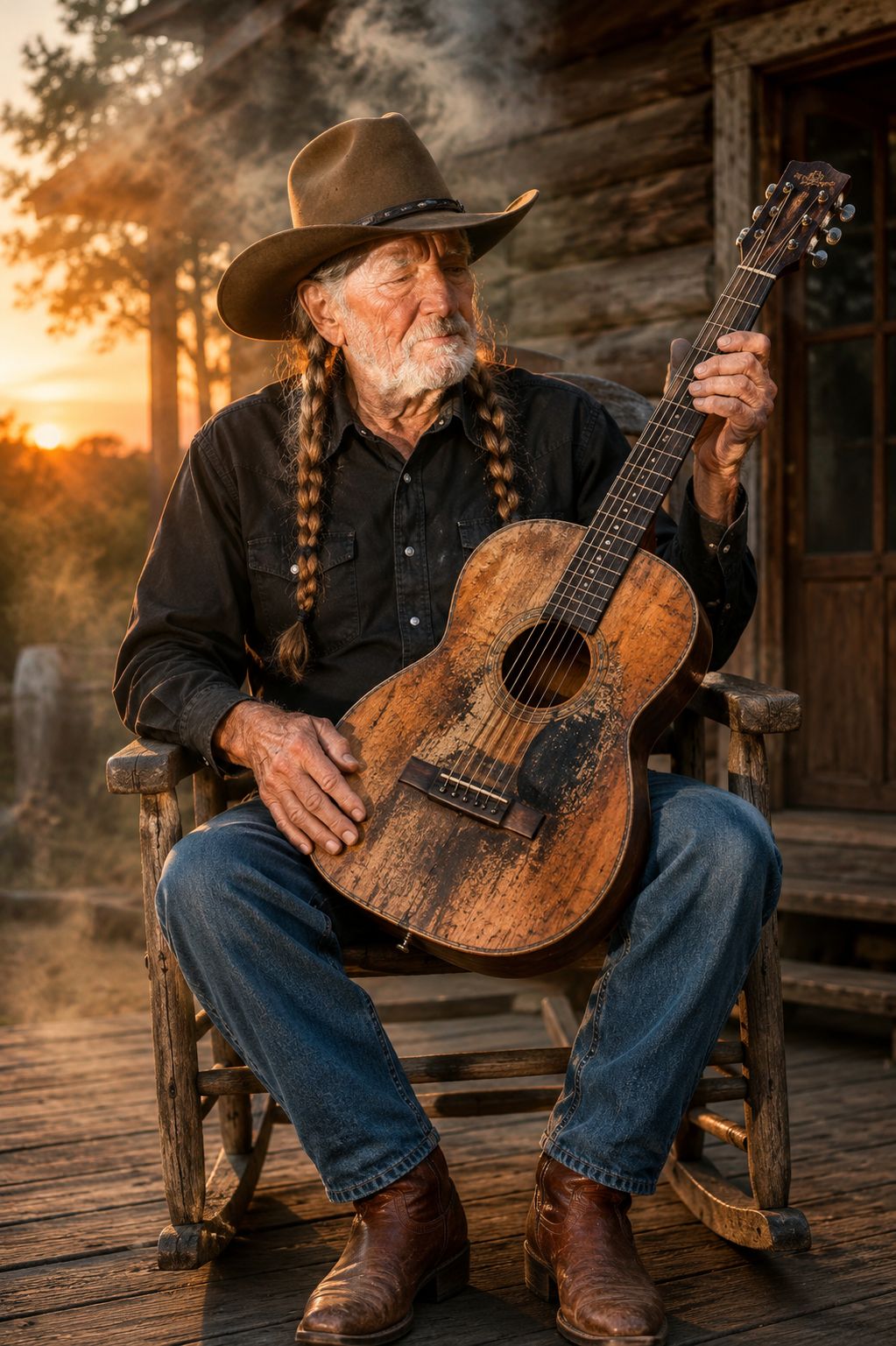
For decades, one battered acoustic guitar has traveled through smoky bars, sold-out arenas, late-night recording sessions, and countless miles of American highways. Its surface is scarred. Its body is worn almost beyond recognition. The finish has long since faded beneath decades of sweat, smoke, and relentless use.
Yet to millions of fans, that guitar remains one of the most recognizable objects in music history.
Its name is Trigger.
And in many ways, Trigger still carries the soul of Willie Nelson.
The Night a Fire Changed Everything
The story begins in 1969.
At the time, Willie Nelson was already a respected songwriter, but he had not yet become the legendary outlaw icon the world would come to know. He was searching for his own voice, his own path, and perhaps unknowingly, his lifelong musical companion.
That companion arrived in the form of a Martin N-20 classical guitar.
But shortly after Willie acquired it, disaster struck.
A fire broke out at his home near Nashville. As flames spread through the building, Willie rushed inside.
Most people would have grabbed family photos, cash, or valuables.
Willie had something else on his mind.
Inside the burning structure sat his beloved guitar and a stash of song manuscripts.
He later recalled charging into danger to rescue them both.
“If I lose my guitar and songs, that’s all I got.”
The image feels almost mythical now.
A young Willie Nelson emerging from smoke and flames carrying the tools of his future destiny.
The guitar survived.
The fire left its mark.
And the journey truly began.
A Guitar Unlike Any Other
When people first see Trigger up close, they are often shocked.
It doesn’t resemble a priceless museum artifact.
It looks exhausted.
The large hole worn into the body is impossible to ignore. Decades of aggressive picking have literally eaten through the wood. Scratches cover nearly every visible surface. Signatures from friends and fellow musicians decorate portions of the instrument like historical graffiti.
Many guitar experts estimate that Trigger would be nearly unplayable in the hands of anyone else.
Yet somehow, Willie has continued performing with it year after year.
The guitar and the musician seem permanently fused together.
One cannot be understood without the other.
Trigger isn’t merely a tool.
It’s a collaborator.
The Name That Came From a Horse
The guitar’s famous nickname reveals another layer of Willie’s personality.
After purchasing the instrument, he named it Trigger after Roy Rogers’ legendary horse.
The choice was fitting.
Willie has always been drawn to symbols of freedom, independence, and the American frontier spirit.
A horse carries a cowboy through life.
Trigger carried Willie through music.
And just like a trusted horse, the guitar accompanied him through triumphs and hardships alike.
Financial struggles.
Career setbacks.
Creative breakthroughs.
Family milestones.
Everything happened with Trigger nearby.
More Than 10,000 Performances
Imagine the stories embedded within the wood.
Trigger has appeared in thousands upon thousands of performances.
Some estimates place the number well above 10,000 live appearances.
Every dent tells a story.
Every scratch reflects a moment.
Perhaps one mark came from a tiny Texas dance hall where only a few dozen people showed up.
Another may have been earned during a massive festival attended by tens of thousands.
The guitar has heard crowds roar and rooms fall silent.
It has accompanied heartbreak ballads and rebellious anthems.
It has been present during moments that shaped country music history.
Most instruments eventually retire.
Trigger simply kept going.
And so did Willie.
The Sound No Replacement Could Recreate
Many musicians own dozens of guitars.
Willie Nelson never needed that approach.
Over the years, countless manufacturers offered replacements, upgrades, and custom instruments.
Most players would have accepted.
Willie refused.
Why?
Because Trigger didn’t just produce notes.
It produced memories.
The unique sound listeners associate with Willie Nelson comes partly from the extraordinary wear accumulated over decades.
Every scar subtly changed the instrument’s voice.
Every year added character.
Every performance left fingerprints on its tone.
Replacing Trigger would have been like asking Willie to replace part of himself.
The technical specifications didn’t matter.
The relationship did.
“That guitar has been with me through everything.”
And fans believed it.
Because they could hear it.
The Soul Inside the Wood
Country music has always celebrated authenticity.
Listeners can detect when something is real.
That’s one reason Trigger became such a powerful symbol.
In an industry often obsessed with shiny new things, Trigger represented the opposite.
Age.
Experience.
Imperfection.
Truth.
The guitar looked exactly how a life in music should look.
Weathered.
Tested.
Surviving.
Its condition became a visual metaphor for Willie Nelson himself.
The wrinkles.
The braids.
The unmistakable voice.
None of these signs reflected weakness.
They reflected endurance.
The same was true of Trigger.
Every scar represented survival.
The Emotional Bond Fans Feel
What makes people emotional when they see Trigger isn’t the instrument itself.
It’s what the guitar represents.
Fans see a lifetime of songs.
They see roads traveled.
They remember concerts attended with parents who are no longer alive.
They think about first dances, breakups, weddings, and long drives accompanied by Willie’s voice.
Trigger became intertwined with those memories.
That’s incredibly rare.
Most famous instruments remain objects.
Trigger became a symbol.
A symbol of continuity in a world that constantly changes.
As trends came and went, Willie and Trigger remained.
Together.
A Living Piece of Country Music History
Today, Trigger is valued at amounts that experts can barely calculate.
Its worth goes far beyond money.
Collectors cannot truly purchase what makes the guitar special.
The value isn’t in the wood.
It’s in the story.
Every time Willie walked onto a stage carrying Trigger, he brought decades of history with him.
Fans weren’t simply watching a performance.
They were witnessing a conversation between artist and instrument that had lasted more than half a century.
That relationship became one of the most enduring partnerships in all of music.
Why Trigger Still Matters
Perhaps the greatest lesson of Trigger is that beauty doesn’t require perfection.
The guitar is cracked.
Scarred.
Smoke-marked.
Worn almost beyond recognition.
Yet those flaws are precisely what transformed it into a legend.
Modern culture often celebrates what’s new.
Country music has always understood the value of what’s endured.
Trigger endured.
The guitar survived fire, endless travel, changing musical eras, and the passage of time itself.
And through it all, it continued to sing.
When fans look at Trigger today, they don’t merely see an instrument.
They see resilience.
They see authenticity.
They see the life story of Willie Nelson carved into wood and steel.
Most importantly, they see proof that the soul of great music doesn’t fade with age.
Sometimes it grows stronger.
And that’s why the smoke-scarred instrument called Trigger remains far more than a guitar.
It is a survivor.
It is a witness.
It is a companion.
And in every meaningful way imaginable, it still carries the soul of Willie Nelson.