Introduction
Before he became a cultural earthquake, before screaming crowds chased his Cadillac through city streets, before his name became synonymous with rock and roll itself, Elvis Presley was just another teenager trying to make a living.
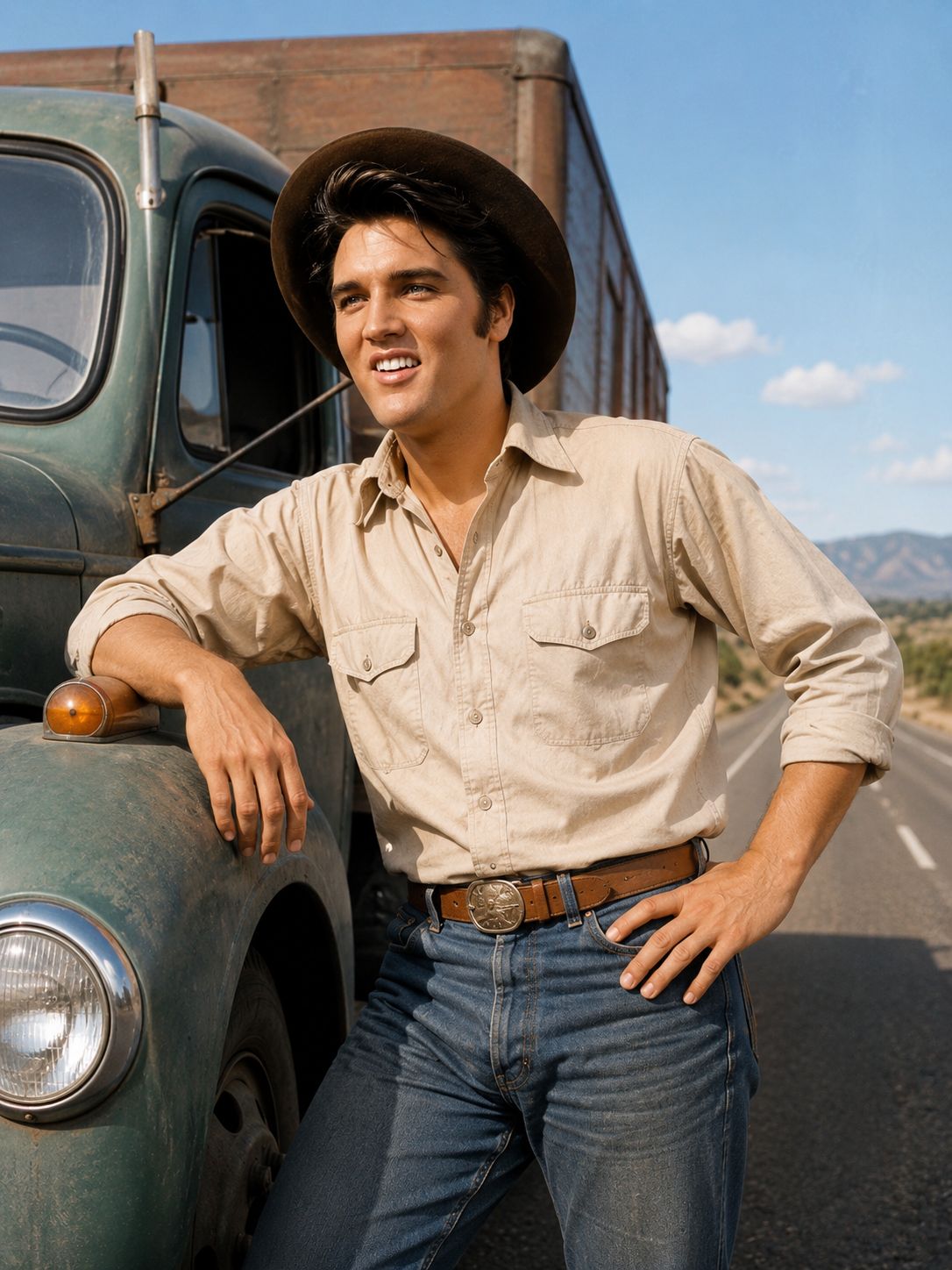
He drove trucks.
He hauled supplies through the sweltering Southern heat, earning little money and carrying even less certainty about the future. The young man who would eventually reshape American music was, at that moment, invisible to the world.
No one could have imagined that this shy truck driver from Memphis would soon challenge an entire entertainment establishment—and win.
The story of Elvis Presley is not simply the rise of a star.
It is the story of a revolution.
A Boy Nobody Expected
In the early 1950s, the music business operated like an exclusive club.
The biggest labels controlled the radio stations. Established crooners dominated the charts. Industry executives decided who could become famous and who would remain unknown.
Young Elvis Presley looked nothing like the polished stars of the era.
He was awkward.
He was poor.
He dressed differently.
Most importantly, he sounded different.
His musical influences came from places the mainstream industry often ignored. He absorbed gospel music from church, country music from local radio, and rhythm and blues from neighborhoods many executives never visited.
That mixture created something entirely new.
But in a world obsessed with fitting into categories, nobody knew where to place him.
Was he country?
Was he pop?
Was he rhythm and blues?
The answer was all of the above.
And that terrified the gatekeepers.
“The most dangerous thing Elvis brought wasn’t his voice—it was that nobody could put him in a box.”
The Truck Driver Walks Into Sun Records
The moment that changed everything seemed insignificant at the time.
In 1953, Elvis entered Sun Records in Memphis.
The studio was run by the visionary producer Sam Phillips, who believed that American music was ready for something different.
Elvis paid a few dollars to record a personal acetate.
The session wasn’t intended to launch a career.
It was just a young man singing into a microphone.
Yet Phillips noticed something.
Not perfection.
Potential.
Even then, Elvis possessed an emotional honesty that couldn’t be taught.
His voice carried vulnerability and power at the same time.
Months later, Phillips invited him back.
During a casual studio session, Elvis began fooling around with an old blues song called “That’s All Right.”
The room changed instantly.
The sound that emerged was unlike anything anyone had heard before.
Country energy collided with blues rhythm.
Traditional boundaries vanished.
American music suddenly had a new future.
The Giants Laugh
The established music industry wasn’t impressed.
At first.
Many executives believed Elvis would disappear within months.
His style was too strange.
His voice was too unconventional.
His performances were too wild.
Television commentators criticized him.
Parents worried about him.
Critics dismissed him.
The old guard assumed they were witnessing a temporary fad.
They had seen young stars come and go before.
What they failed to understand was that Elvis wasn’t simply selling records.
He was giving an entire generation a voice.
Teenagers across America saw themselves in him.
Unlike the polished entertainers dominating television, Elvis felt real.
He wasn’t born into privilege.
He wasn’t carefully manufactured.
He was one of them.
A working-class kid with a dream.
“Every teenager who felt ignored suddenly had a champion.”
The Earthquake Begins
By 1956, the revolution could no longer be ignored.
Elvis exploded onto the national stage.
Songs like Heartbreak Hotel became massive hits.
Record sales soared.
Concert attendance shattered expectations.
Every appearance triggered headlines.
Every performance sparked debate.
The more critics attacked him, the more young audiences loved him.
His television appearances became cultural events.
Millions tuned in.
Millions talked.
Millions copied his hairstyle, his clothing, and even his mannerisms.
The entertainment giants who once dismissed him now faced a terrifying reality:
They were losing control.
For decades, they had dictated popular culture.
Now a former truck driver from Memphis was setting the agenda.
The audience had chosen its own king.
More Than Music
Many people reduce Elvis’s story to record sales and chart positions.
That misses the point entirely.
His impact extended far beyond music.
Elvis helped break down cultural barriers that had existed for generations.
At a time when American society remained deeply divided, his music blended traditions that the industry had long kept separate.
Country fans listened.
R&B fans listened.
Pop audiences listened.
The walls began to crack.
Young listeners cared less about categories and more about emotion.
The old music giants built their business around divisions.
Elvis built his career by destroying them.
“He didn’t ask permission to change music. He simply changed it.”
The Price of Being King
Success, however, came with consequences.
The same fame that elevated Elvis also isolated him.
The shy teenager who once drove a truck suddenly found himself trapped inside a global phenomenon.
Privacy disappeared.
Expectations multiplied.
Every move became news.
Every decision generated controversy.
The pressure was relentless.
Behind the dazzling headlines stood a human being struggling to navigate a reality no one had prepared him for.
Fans saw the legend.
Few saw the burden.
Yet even during his most difficult years, Elvis remained one of the most magnetic performers the world had ever witnessed.
The connection he forged with audiences never vanished.
That connection was authentic because it originated long before fame arrived.
It began when he was just a kid hoping someone would listen.
Why the Story Still Matters
More than half a century later, the image remains powerful.
A teenage truck driver.
A small recording studio.
A dream that seemed impossible.
Modern audiences often assume icons were destined for greatness from the beginning.
Elvis’s story reminds us that history rarely works that way.
Great revolutions frequently start in ordinary places.
The people who change the world are often the people nobody expects.
When Elvis climbed into that truck each morning, he wasn’t planning to overthrow an industry.
He wasn’t trying to become a legend.
He was simply chasing an opportunity.
But opportunity met preparation.
Talent met timing.
And a young man with an unusual voice met a generation desperate for change.
The result transformed popular music forever.
The Legacy of the Teenager Who Won
Today, Elvis Presley remains one of the most influential figures in entertainment history.
His records continue to sell.
His performances continue to inspire.
His story continues to fascinate.
Yet perhaps the most remarkable part of his journey isn’t the fame.
It’s the fact that he achieved it against overwhelming odds.
The old music giants possessed money, power, and influence.
Elvis possessed belief.
One side had the system.
The other had a sound.
In the end, the sound won.
And that is why the legend endures.
Because buried beneath the gold records, sold-out arenas, and worldwide fame is a timeless truth:
A teenage truck driver from Memphis proved that the future doesn’t belong to the powerful.
It belongs to the people bold enough to imagine something different.
And when Elvis Presley picked up a microphone, the future arrived all at once.
Video