Introduction
The world remembers the glitter.
The gold records. The screaming fans. The custom Cadillacs. The mansion gates. The sold-out arenas. The cameras flashing like lightning every time he stepped into public view.
To millions, Elvis Presley was the embodiment of the American dream—a poor boy from Mississippi who became the most famous entertainer on Earth.
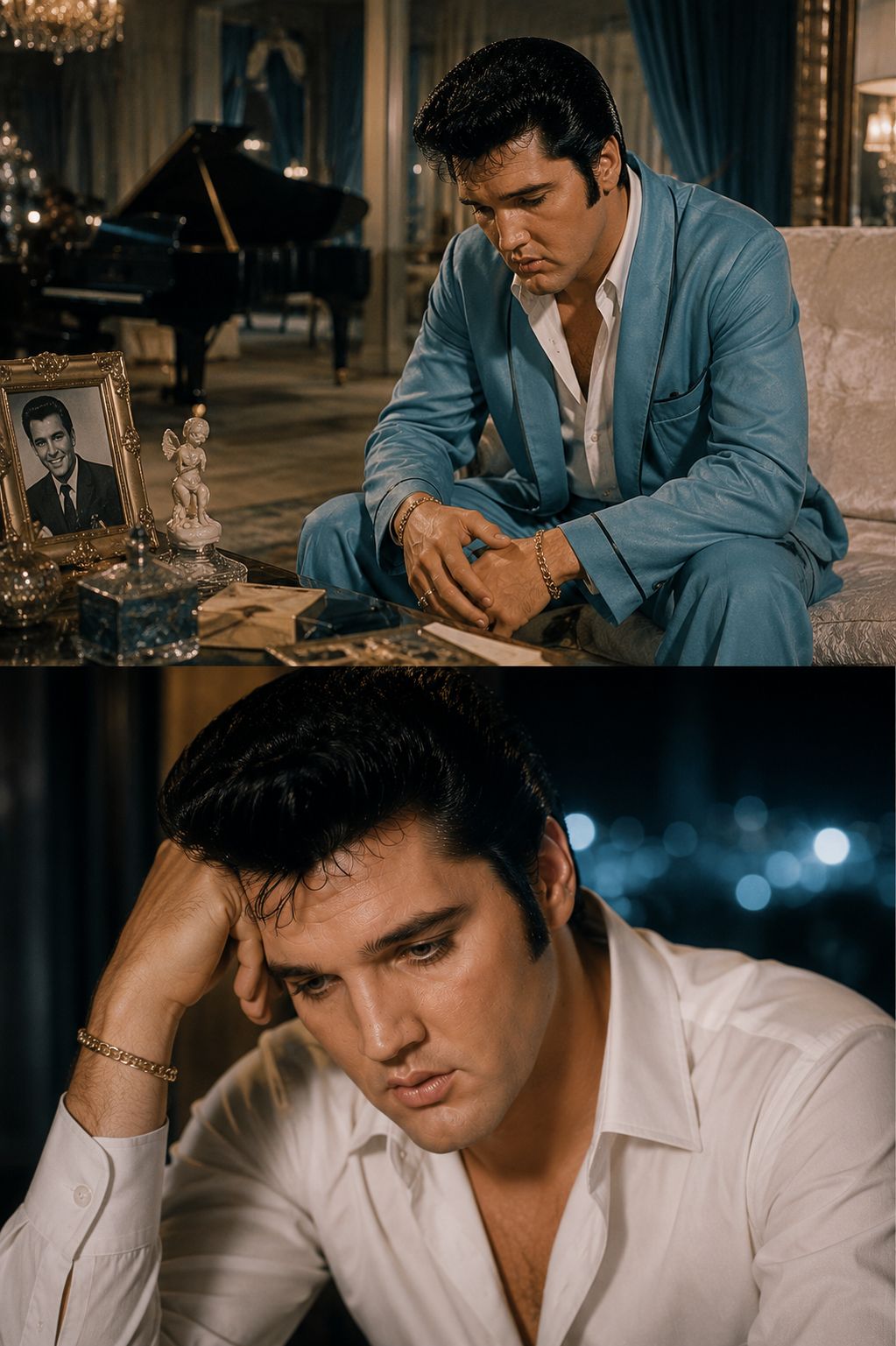
But hidden behind the rhinestone jumpsuits and the dazzling spotlight was a man carrying a sadness few truly understood.
This is the story of the traumatic melancholy of a man who seemingly had everything.
And yet, somehow, remained haunted by what he could never possess.
The Boy Who Never Forgot Poverty
Long before Graceland became a symbol of wealth, Elvis knew hardship.
Born in a tiny two-room house in Tupelo, Mississippi, he grew up in a family that struggled constantly to make ends meet. His parents, Vernon and Gladys Presley, often worried about food, rent, and survival.
Those early years left permanent scars.
Even after becoming a millionaire, Elvis never completely escaped the mindset of a poor child afraid that everything could disappear overnight.
Friends often recalled his unusual generosity. He bought cars for strangers, paid medical bills, and handed out money without hesitation.
Some viewed it as kindness.
Others saw something deeper.
A desperate attempt to make sure nobody around him experienced the insecurity he had endured.
“Money never meant much to Elvis. What mattered was making people happy.”
But sometimes generosity becomes a shield.
And behind that shield, loneliness can quietly grow.
Fame Arrived Faster Than Any Human Could Handle
History had never seen anything quite like Elvis Presley.
When his records exploded across America in the mid-1950s, the reaction bordered on hysteria.
Teenagers cried.
Parents panicked.
Church leaders condemned him.
Television executives worried about his influence.
Suddenly, a young man barely out of adolescence became the center of a cultural earthquake.
Most artists spend years gradually adjusting to success.
Elvis was launched into another universe almost overnight.
The pressure was unimaginable.
Every movement became news.
Every relationship became public property.
Every mistake became a headline.
The world saw a king.
But kings often live in isolation.
“The higher he climbed, the fewer people truly knew him.”
The crowds grew larger.
Yet genuine connection became harder to find.
The Heartbreak That Never Fully Healed
Among the many emotional wounds Elvis carried, none may have cut deeper than the loss of his mother, Gladys Presley.
Their bond was extraordinary.
By nearly every account, Gladys was the emotional center of Elvis’s world.
She believed in him before anyone else did.
She protected him.
She understood him.
When she died in 1958 at just 46 years old, Elvis was devastated.
Witnesses described scenes of overwhelming grief.
He reportedly clung to her body and struggled to accept the reality of her death.
Some close observers believed a part of Elvis never recovered.
The timing made the tragedy even worse.
At the height of his meteoric rise, just as the world celebrated his success, the person he loved most was suddenly gone.
Money couldn’t save her.
Fame couldn’t protect her.
Success couldn’t ease the pain.
“The King learned a painful truth: there are some losses even greatness cannot overcome.”
For the rest of his life, traces of that grief seemed to follow him.
Trapped Inside the Golden Cage
The irony of superstardom is that freedom often disappears the moment success arrives.
Elvis became one of the most recognizable faces in history.
That sounds glamorous.
Until you realize what it means.
Simple activities became impossible.
A walk through a shopping center.
Dinner at a restaurant.
A quiet afternoon in public.
All vanished.
His world grew smaller.
The gates around Graceland offered protection, but they also created isolation.
The mansion became both sanctuary and prison.
Visitors frequently described strange scenes.
Rooms filled with people.
Friends everywhere.
Employees constantly moving about.
Yet beneath the activity lingered a profound sense of loneliness.
Because being surrounded by people is not the same as being understood.
The Burden of Being Elvis Presley
Imagine waking up every day knowing millions expect you to be larger than life.
Imagine knowing your image has become more important than your humanity.
That was Elvis’s reality.
The public didn’t simply want a singer.
They wanted a legend.
A symbol.
An icon.
The challenge was that legends are not allowed to have ordinary struggles.
But Elvis did.
He experienced insecurity.
Fear.
Heartbreak.
Exhaustion.
Doubt.
Yet those emotions often had to remain hidden behind the image.
Many performers can leave work behind after a show.
Elvis could not.
He was Elvis Presley twenty-four hours a day.
Every day.
For decades.
The psychological weight of carrying such an identity would be immense for anyone.
The Endless Search for Meaning
As the years passed, Elvis increasingly explored spirituality, philosophy, and religion.
Friends described lengthy conversations about life, purpose, and existence.
He read extensively.
He searched constantly.
Many people assume extraordinary success automatically creates happiness.
Elvis’s life suggested otherwise.
Success can solve financial problems.
It cannot answer existential questions.
It cannot explain suffering.
It cannot guarantee peace.
Perhaps that is why Elvis seemed forever searching.
Looking beyond fame.
Beyond applause.
Beyond material wealth.
Seeking something deeper.
Something permanent.
Something capable of filling the emptiness that often followed the cheers.
“The crowds could give him adoration. They could not give him inner peace.”
The Final Years and the Weight of Expectations
By the 1970s, the demands had become relentless.
Tours.
Performances.
Appearances.
Expectations.
The machine never stopped.
Fans still adored him.
His concerts continued drawing enormous crowds.
Yet behind the scenes, physical exhaustion and emotional strain were becoming increasingly visible.
The contradiction was heartbreaking.
At moments when audiences saw triumph, those closest to him sometimes saw struggle.
The image remained magnificent.
The man beneath it was carrying a tremendous burden.
And perhaps that is what makes Elvis Presley such a compelling figure decades after his passing.
Not simply because he achieved greatness.
But because he revealed the limitations of greatness itself.
Why Elvis Still Resonates Today
The enduring fascination with Elvis is not really about fame.
It is about humanity.
People recognize something familiar in his story.
The pursuit of success.
The longing for love.
The fear of loss.
The search for meaning.
The realization that external achievement does not automatically create internal happiness.
Elvis Presley became one of the richest, most celebrated entertainers in history.
He conquered stages.
He transformed music.
He changed culture forever.
Yet his life remains a powerful reminder that even extraordinary success cannot erase emotional wounds.
The boy from Tupelo became a king.
But beneath the crown remained a human being.
A son grieving his mother.
A dreamer searching for peace.
A lonely soul navigating unimaginable fame.
And perhaps that is the deepest tragedy—and the deepest beauty—of Elvis Presley’s story.
Because when we look beyond the legend, beyond the gold records and flashing cameras, we discover something profoundly moving:
A man who had everything the world could offer.
And spent much of his life searching for the one thing it could not.
Peace.