Introduction
The stage lights burned hot inside the studio of The Milton Berle Show on June 5, 1956.
Millions of Americans sat in front of glowing black-and-white televisions after dinner, expecting clean entertainment — comedians, polite singers, maybe a few dance routines. Television in the 1950s was safe. Controlled. Predictable.
Then Elvis walked out.
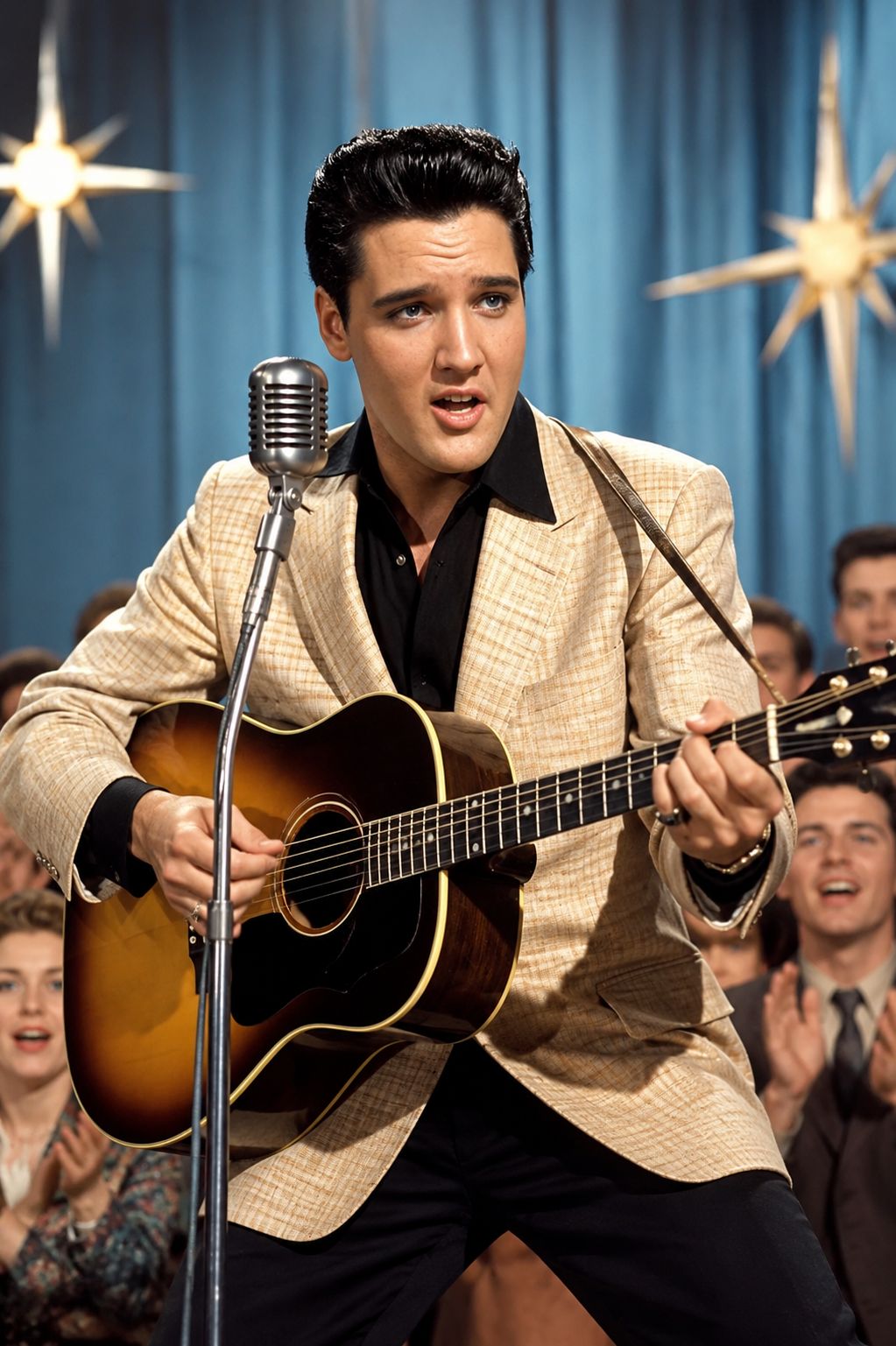
At first, nothing seemed unusual. He smiled awkwardly. Adjusted his guitar strap. The crowd screamed before he even sang a note, mostly teenage girls who already sensed something electric about him.
But then the music started.
Not polished big-band music.
Not smooth crooner ballads.
This was raw. Southern. Dangerous.
When Elvis launched into “Hound Dog,” he abandoned the guitar halfway through the performance and let his body move freely with the rhythm. His hips twisted. His legs shook. His face burned with emotion.
America froze.
Some viewers were thrilled.
Others were horrified.
But nobody could look away.
“It was like watching a fuse being lit in real time.”
That single performance detonated a generation gap overnight.
Parents called it vulgar.
Church leaders called it sinful.
Newspapers called it “animalistic.”
Teenagers called it freedom.
And that was the moment rock and roll stopped being a regional youth craze and became a national revolution.
Before Elvis, America Was Controlled
To understand why that performance mattered so much, you have to understand America in the mid-1950s.
The country was obsessed with order.
Men wore hats and ties.
Women were expected to behave politely.
Music was carefully packaged and sanitized.
Popular singers like Perry Como and Frank Sinatra represented sophistication and control.
Then Elvis arrived like a lightning strike from another world.
He blended Black rhythm and blues with country music from the South. He sang with gospel emotion. He performed with explosive physical energy no mainstream white performer had ever shown on national television.
That terrified people.
Not just because of the dancing.
Because Elvis symbolized change.
He represented young people refusing to behave like their parents.
And once America saw that energy on live television, there was no putting it back in the box.
The Performance That Created Panic
The reaction after The Milton Berle Show performance was immediate and explosive.
Critics attacked Elvis relentlessly.
One newspaper described his act as:
“A strange, frantic, jungle-like exhibition.”
Television commentators debated whether he was corrupting American youth. Religious groups condemned him publicly. Adults feared the country was morally collapsing because girls screamed uncontrollably when Elvis performed.
The backlash only made him bigger.
Teenagers rushed to buy his records. Crowds became wilder at every appearance. Radio stations couldn’t stop playing his songs even when critics demanded boycotts.
And Elvis understood something powerful:
Controversy creates mythology.
Every angry headline turned him into an outlaw hero.
Every television appearance became an event.
Every performance felt dangerous.
That danger became the heartbeat of rock and roll.
The Night Television Changed Forever
After the backlash from The Milton Berle Show, television executives panicked.
When Elvis later appeared on The Steve Allen Show, producers tried to tame him. They dressed him in formal clothing and even forced him to sing “Hound Dog” to an actual basset hound in a ridiculous comedy segment.
But the damage — or magic — was already done.
America had already seen the real Elvis.
The rebellion.
The sexuality.
The freedom.
Then came the historic appearances on The Ed Sullivan Show later that year.
Over 60 million people tuned in.
That number is almost impossible to comprehend today.
Entire families gathered around televisions just to witness this young man everyone was talking about.
By then, network executives were so nervous that cameras famously filmed Elvis mostly from the waist up during certain performances to hide his dancing.
Think about that for a moment.
A singer’s hips had become a national controversy.
But censorship only intensified the fascination.
Teenagers imagined what adults were trying to hide.
And Elvis became larger than life.
Elvis Wasn’t Just Singing — He Was Releasing Emotion
What made Elvis different wasn’t only the music.
It was emotional honesty.
When he sang, he looked possessed by the song itself. His voice cracked with vulnerability one second and exploded with swagger the next.
Young Americans had never seen a performer so emotionally exposed.
Previous stars appeared polished and untouchable.
Elvis looked human.
He sweated.
He trembled.
He lost himself in the rhythm.
That authenticity connected with millions of teenagers who felt trapped inside the rigid expectations of 1950s America.
Elvis didn’t invent rebellion.
He gave rebellion a soundtrack.
And suddenly, teenagers realized they had cultural power.
That idea would reshape music forever.
The Birth of Modern Rock Stardom
Before Elvis, singers were performers.
After Elvis, they became icons.
Every future rock star borrowed something from him:
- The Beatles copied his charisma.
- Mick Jagger embraced his sexuality.
- Bruce Springsteen studied his emotional intensity.
- Prince expanded his fearless stage presence.
Even artists who sounded nothing like Elvis inherited the blueprint he created in 1956.
The screaming crowds.
The media outrage.
The dangerous image.
The emotional obsession.
Modern celebrity culture was born the moment Elvis shocked America on live television.
But Behind the Fame Was a Nervous Young Man
One of the most fascinating parts of Elvis’s rise is that he wasn’t trying to start a revolution.
He was shy offstage.
Friends described him as polite, humble, and deeply insecure about his success. He often seemed shocked by the hysteria surrounding him.
Yet the moment music started, something transformed inside him.
That contradiction made Elvis magnetic.
He looked like someone discovering his own power in real time.
And audiences felt it.
The famous movements that scandalized America weren’t carefully choreographed. They came naturally from his love of gospel music, blues rhythms, and live performance energy.
In many ways, Elvis wasn’t calculating rebellion.
He simply refused to hide himself.
And that honesty changed everything.
The Night Rock and Roll Became Unstoppable
By the end of 1956, Elvis Presley was no longer just a singer.
He was a symbol.
Adults feared him.
Teenagers worshipped him.
The media couldn’t stop talking about him.
Most importantly, the music industry realized youth culture could no longer be controlled.
That one shocking performance cracked open the door for every musical revolution that followed:
- Rock bands in the 1960s
- Counterculture movements
- Punk rebellion
- Stadium rock
- Pop superstardom
- Modern celebrity obsession
It all traces back to that moment America watched Elvis Presley move across a television stage and realized the future had arrived.
History sometimes changes through wars or politics.
Sometimes it changes because one young man sings “Hound Dog” with too much fire in his soul.
In 1956, Elvis Presley didn’t just perform.
He unleashed rock and roll onto America.
And the world has been dancing to the aftermath ever since.