Introduction
In 1975, country music didn’t just evolve.
It exploded.
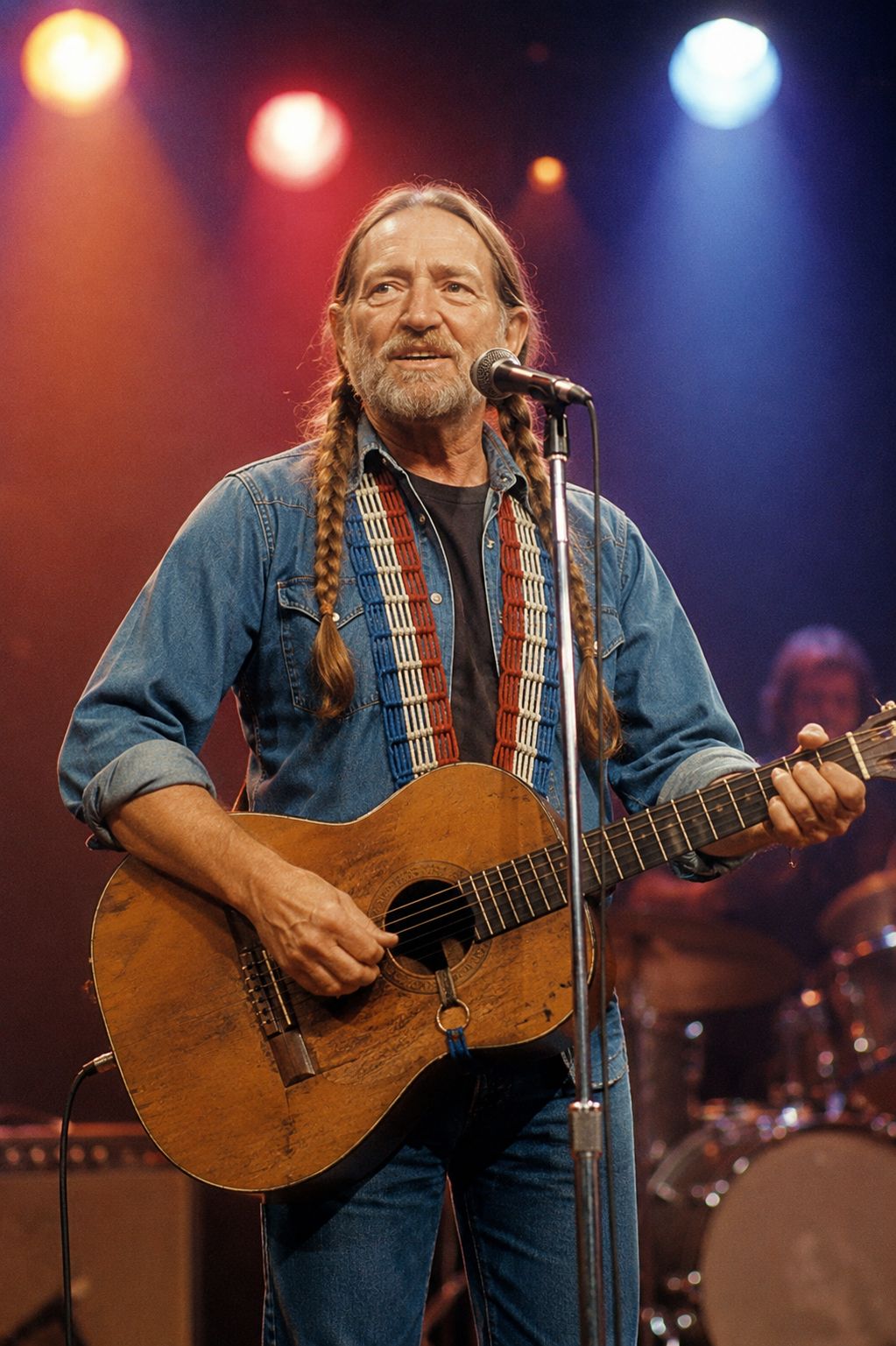
And at the center of that explosion stood Willie Nelson — a long-haired outlaw with a battered guitar named Trigger, a voice Nashville executives once mocked, and a vision powerful enough to change country music forever.
The industry didn’t see it coming.
But by the end of that year, nothing sounded the same anymore.
1975 — The Year Willie Nelson Changed Country Music Forever
There was a time when Nashville tried to control everything.
The suits controlled the songs.
The producers controlled the sound.
The labels controlled the image.
Country artists were expected to smile on command, wear polished outfits, and sing songs manufactured inside expensive studios.
But Willie Nelson never fit that mold.
Not in the 1950s.
Not in the 1960s.
And certainly not by 1975.
By then, Willie had already spent years struggling through rejection. He had written hits for other artists, survived poverty, endured failed records, and watched the music industry overlook him again and again.
Most artists would’ve surrendered.
Willie transformed himself instead.
He grew his hair long.
He wore bandanas and denim instead of rhinestone suits.
He abandoned the polished “Nashville Sound” and embraced something rawer… freer… more honest.
And in 1975, America finally listened.
The Album That Shocked Nashville
When Willie released Red Headed Stranger in 1975, many executives believed it would fail.
The album sounded too sparse.
Too stripped down.
Too emotional.
There were no giant orchestrations.
No glossy production tricks.
Just Willie’s weathered voice, simple instrumentation, and storytelling so intimate it felt almost uncomfortable.
Executives reportedly thought the recordings sounded like unfinished demos.
But Willie refused to change it.
“This is the way the story sounds,” he essentially told them.
That decision changed country music history.
Red Headed Stranger became a phenomenon.
And then came the song that would shake the entire industry:
“Blue Eyes Crying in the Rain.”
The track was hauntingly simple. No vocal gymnastics. No overproduction. Just heartbreak, memory, and silence placed perfectly between the notes.
Listeners believed every word.
Because Willie wasn’t performing emotion anymore.
He was the emotion.
Suddenly, fans realized country music didn’t need to sound polished to feel powerful.
It just needed to feel true.
America Was Ready for an Outlaw
The timing mattered.
In the mid-1970s, America was exhausted.
The Vietnam War had scarred the country.
Political trust was collapsing after Watergate.
Young people rejected old systems and polished authority figures.
And then Willie Nelson appeared looking nothing like a traditional Nashville star.
Long braids. Beard. Jeans. Sneakers.
He looked closer to a drifter than a country celebrity.
And people loved him for it.
Because Willie represented freedom.
Not manufactured rebellion. Real rebellion.
He sang for outsiders.
For broken dreamers.
For people who felt ignored by polished institutions.
Country music suddenly became dangerous again.
Alive again.
The Outlaw Movement Became a Revolution
1975 wasn’t just Willie’s breakthrough year.
It was the year the “Outlaw Country” movement exploded into mainstream America.
Alongside artists like Waylon Jennings, Willie helped destroy the old Nashville rulebook.
Artists wanted creative control.
They wanted authentic songwriting.
They wanted freedom from corporate formulas.
And fans supported them.
The success of outlaw country proved something revolutionary:
People preferred honesty over perfection.
That realization changed the entire future of country music.
Without Willie Nelson’s success in 1975, countless future artists might never have existed in the same form.
From rebellious Texas country singers to modern Americana storytellers, the ripple effect never stopped.
Willie Didn’t Look Like a Star — And That Was the Point
One of the most fascinating things about Willie Nelson’s rise was how deeply he violated industry expectations.
He wasn’t young anymore.
He didn’t have a traditionally smooth voice.
He didn’t fit Nashville beauty standards.
And yet audiences connected with him more deeply than many polished stars ever could.
Because Willie felt real.
Every wrinkle in his voice sounded lived-in.
Every lyric carried scars.
When he sang about loneliness, people believed he had survived it.
When he sang about freedom, people believed he had fought for it.
That authenticity became his superpower.
Willie Nelson didn’t become famous by pretending to be someone else.
He became legendary by finally refusing to pretend at all.
The Sound of Silence
What made Red Headed Stranger so revolutionary wasn’t only the songwriting.
It was the silence.
Modern listeners sometimes forget how radical restraint can feel.
Most producers in the 1970s wanted bigger arrangements, fuller orchestration, and cleaner recordings.
Willie left space.
Space between notes.
Space inside stories.
Space for listeners to feel their own pain.
That minimalist style influenced generations of songwriters afterward.
Suddenly, vulnerability became commercially viable.
Country music no longer needed to hide emotion behind polished production.
Willie proved simplicity could be devastating.
“Blue Eyes Crying in the Rain” Changed Everything
Before 1975, Willie Nelson was respected.
After 1975, he became immortal.
“Blue Eyes Crying in the Rain” gave him his first No. 1 hit as a singer.
And it didn’t sound like anything dominating radio at the time.
The song moved slowly.
Tenderly.
Almost conversationally.
It sounded human.
Listeners weren’t hearing a performer.
They were hearing a memory.
And millions of Americans saw themselves inside it.
That song became more than a hit record.
It became proof that country music could survive without sacrificing soul.
The Industry Had No Choice But to Change
After Willie’s success, Nashville could no longer fully control artists the same way.
The gates had been broken open.
Suddenly, individuality mattered.
Songwriting mattered.
Authenticity mattered.
Artists realized they could reject the system and still succeed.
Maybe even succeed bigger.
That idea transformed not only country music but the business itself.
Willie Nelson didn’t just release successful songs in 1975.
He shifted power.
From executives… back to artists.
The Legacy Still Lives Today
Decades later, the fingerprints of Willie Nelson’s 1975 revolution are everywhere.
You hear it in stripped-down acoustic records.
You hear it in outlaw country revivals.
You hear it in every artist who chooses honesty over polish.
Even artists far outside country music borrowed from Willie’s philosophy:
Be real.
Be vulnerable.
Protect your creative freedom.
That became the blueprint.
And perhaps the most incredible part?
Willie never looked like he was trying to change history.
He simply refused to betray himself.
A Guitar Named Trigger… And a Man Who Refused to Break
By 1975, Willie Nelson had already endured years of rejection.
Many industry insiders had dismissed him as too strange, too unconventional, or too old-fashioned.
But while others chased trends, Willie chased truth.
And truth lasts longer.
That’s why decades later, people still speak about him with reverence.
Not merely because of the hits.
But because he reminded country music what it was supposed to be in the first place:
Stories.
Pain.
Freedom.
Humanity.
In 1975, Willie Nelson didn’t just change country music forever.
He gave it its soul back.
And country music has never sounded the same since.