Introduction
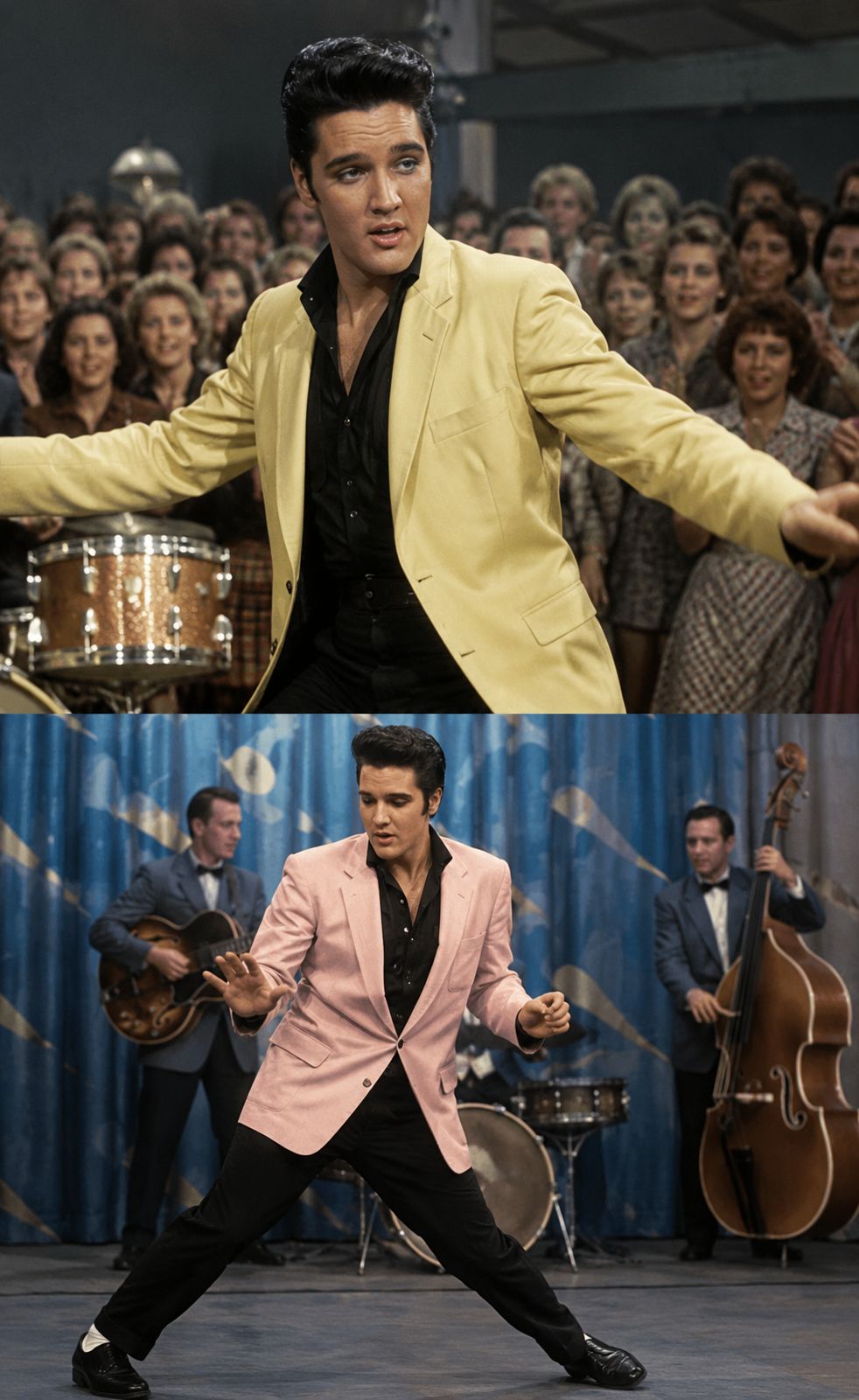
1956 — ELVIS PRESLEY’S DANCE MOVES CAUSED NATIONAL OUTRAGE ACROSS AMERICA
Today, it seems almost impossible to imagine.
A singer walks onto a stage, moves his hips to the rhythm of a song, and suddenly an entire nation erupts in controversy.
Yet that is exactly what happened in 1956 when a young man from Mississippi named Elvis Presley became the most talked-about figure in America—not because of politics, crime, or war, but because of the way he danced.
What many people now remember as harmless entertainment once triggered outrage, panic, and heated debates from coast to coast.
And that reaction says as much about America in 1956 as it does about Elvis himself.
The Boy Who Didn’t Fit the Rules
Before the fame, before the screaming crowds, Elvis was just a quiet Southern kid who loved music.
He grew up listening to gospel hymns in church, country songs on the radio, and rhythm-and-blues records that many white Americans rarely heard.
Without realizing it, he was absorbing sounds from different worlds.
When he stepped onto a stage, he didn’t perform like the polished crooners Americans were used to seeing.
He didn’t stand still.
He didn’t sing politely.
He didn’t act restrained.
Instead, he moved.
And when he moved, audiences couldn’t look away.
His body seemed to become part of the music itself.
What felt natural to Elvis looked shocking to millions of Americans.
America Was Already Changing
To understand the outrage, you have to understand the era.
The mid-1950s were a time when America valued conformity.
Parents had survived the Great Depression.
Families had endured World War II.
The nation was trying to build stability.
Young men were expected to behave a certain way.
Young women were expected to behave a certain way.
Entertainment followed strict standards.
Then Elvis arrived.
Suddenly teenagers saw someone who looked different.
Acted different.
Sounded different.
He wasn’t asking for permission.
He was creating his own rules.
For young people, that felt exciting.
For many adults, it felt dangerous.
“He wasn’t just singing songs. He was challenging expectations.”
The Television Appearances That Changed Everything
The explosion truly began when Elvis appeared on national television.
Millions of Americans gathered around their living-room TVs to see the young star everyone was talking about.
What they witnessed left many stunned.
As Elvis performed, his hips swayed with the beat.
His legs moved constantly.
His entire body seemed alive with energy.
Teenagers screamed with excitement.
Parents stared in disbelief.
Newspapers quickly filled with criticism.
Religious leaders condemned him.
Commentators called his performances inappropriate.
Some even described them as a threat to American morality.
The reaction became so intense that Elvis earned a nickname that followed him everywhere:
“Elvis the Pelvis.”
To his fans, it was a badge of honor.
To his critics, it was proof of everything they feared.
The Fear Behind the Outrage
The fascinating part is that the controversy was never really about dancing.
It was about fear.
Adults weren’t simply worried about Elvis moving his hips.
They were worried about what those movements represented.
They saw teenagers becoming more independent.
They saw traditional rules being questioned.
They saw cultural boundaries beginning to blur.
Rock and roll itself felt revolutionary.
The music combined influences from Black and white musical traditions during a period when America remained deeply segregated.
Many critics didn’t know how to respond.
Some attacked the music.
Others attacked Elvis.
His dancing became an easy target.
It was visible.
It was memorable.
And it became symbolic of a larger cultural shift.
“When people complained about Elvis, they were often complaining about change itself.”
Teenagers Saw Something Completely Different
While adults debated whether Elvis was corrupting America, young fans experienced something entirely different.
They saw freedom.
For the first time, many teenagers felt like popular culture belonged to them.
Not their parents.
Not their teachers.
Not authority figures.
Them.
Elvis represented youth, energy, and rebellion.
His concerts felt electric.
Girls screamed so loudly that performances often became difficult to hear.
Reporters struggled to explain the phenomenon.
How could one singer inspire this level of emotion?
The answer was simple.
Elvis wasn’t merely performing music.
He was giving an entire generation a voice.
Young people recognized something authentic in him.
They sensed that he wasn’t pretending.
He wasn’t manufactured.
He wasn’t following a script.
He was simply being himself.
And that authenticity proved irresistible.
Even Television Tried to Control Him
The backlash eventually became so strong that television producers attempted to limit what viewers could see.
During some broadcasts, cameras were instructed to avoid showing Elvis’s full body.
Instead of filming his movements, they focused on his face and upper torso.
Think about that for a moment.
One of the most famous entertainers in America was literally being censored because people believed his dancing was too controversial for television.
Today, the idea sounds almost unbelievable.
Modern performers routinely push boundaries far beyond anything Elvis ever did.
Yet in 1956, a few hip movements were enough to spark national headlines.
That contrast reveals just how dramatically society has changed.
The Irony of History
History has a funny way of rewriting controversies.
What once seems dangerous often appears harmless decades later.
Today, millions of people watch old Elvis performances and struggle to understand what all the outrage was about.
The dances look tame.
The movements seem mild.
The scandal feels almost quaint.
But that’s precisely why the story matters.
The outrage wasn’t really about the dance itself.
It was about a society confronting something new.
Every generation experiences moments like this.
A new sound.
A new style.
A new idea.
Something emerges that challenges existing norms, and people react.
Some embrace it.
Others resist it.
Elvis simply happened to become one of the most visible examples in American history.
The Legacy That Outlasted the Critics
The critics were loud.
The protests were real.
The outrage dominated headlines.
Yet none of it stopped Elvis Presley.
His popularity continued growing.
His records sold in massive numbers.
His influence spread around the world.
The young man who shocked America in 1956 eventually became one of the most important cultural figures of the twentieth century.
The controversy that once threatened his career became part of his legend.
Today, his dance moves are remembered not as a scandal but as a symbol of transformation.
They represent the moment when youth culture began reshaping America.
They remind us that innovation often looks threatening before it looks inevitable.
And perhaps that’s the most powerful lesson of all.
Because every cultural revolution starts the same way.
Someone breaks the rules.
Someone challenges expectations.
Someone makes people uncomfortable.
In 1956, that person was Elvis Presley.
A young singer with a guitar.
A voice unlike anything America had heard.
And dance moves so controversial that they sparked outrage across an entire nation.
Yet decades later, the outrage has faded.
The headlines have disappeared.
The criticism has been forgotten.
What remains is the music.
What remains is the influence.
What remains is the undeniable truth that Elvis Presley didn’t just change rock and roll.
He changed America.
And all it took was a few dance moves.
Video