Introduction
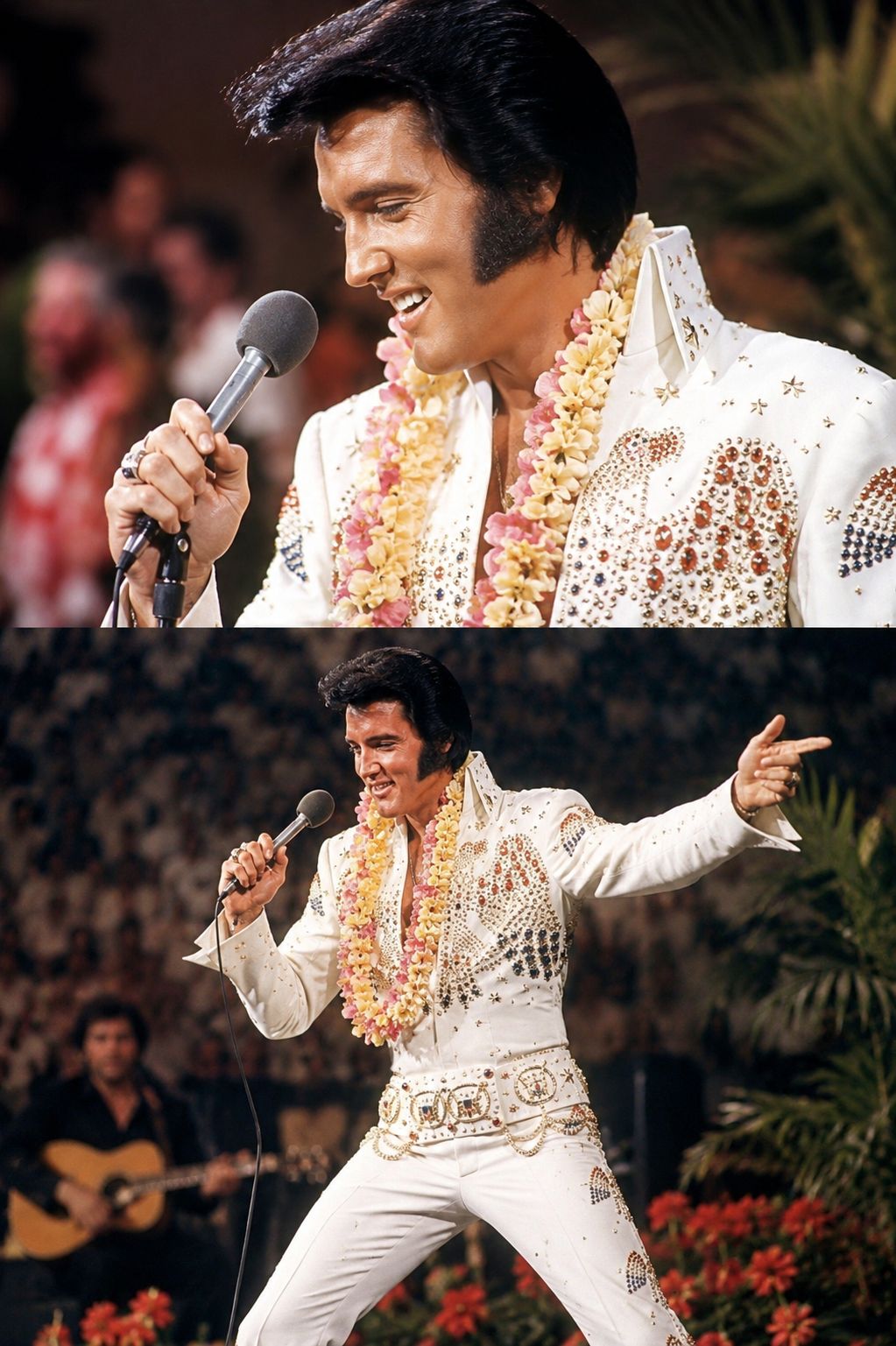
1973 — ELVIS PRESLEY PERFORMED ALOHA FROM HAWAII AND MADE HISTORY AGAIN
On a warm January night in 1973, the world stopped and watched.
Not a king.
Not a president.
Not an astronaut walking on the moon.
They watched a singer.
A man from Tupelo, Mississippi.
A man who had already changed music once before.
And on that night, he proved he could do it again.
That man was Elvis Presley.
And the event was the legendary Aloha from Hawaii concert.
More than fifty years later, it remains one of the most remarkable moments in entertainment history—not simply because of the numbers, but because of what it represented.
It was a comeback.
A victory lap.
A global celebration.
And perhaps most importantly, it was proof that Elvis Presley was still the King.
The World Had Changed—But Elvis Was Still Standing
By 1973, the world looked very different than it had in the 1950s.
The screaming teenagers who once shocked their parents by dancing to Elvis had grown older.
Rock music had evolved.
The Beatles had come and gone.
New stars filled the charts.
Many legends from the early days of rock and roll had faded into memory.
Yet Elvis remained.
Not without struggles.
Behind the glittering jumpsuits and sold-out arenas was a man carrying enormous pressure.
Years of relentless fame had taken a toll.
His personal life had become increasingly complicated.
His marriage to Priscilla Presley had ended only months earlier.
Critics wondered whether his best days were behind him.
But Elvis had never been interested in proving critics wrong.
He simply wanted to connect with people.
And when the opportunity arose to perform a concert unlike anything the world had ever seen, he embraced it.
An Idea That Seemed Impossible
Today, global livestreams happen every day.
In 1973, the concept was revolutionary.
The plan was ambitious:
Broadcast an Elvis Presley concert live from Hawaii via satellite to audiences across Asia and the Pacific.
No artist had ever attempted anything on this scale.
The technology itself felt futuristic.
Television executives weren’t entirely sure how smoothly it would work.
The logistics were staggering.
Every detail had to be perfect.
The stakes were enormous.
If something failed, the world would see it.
But if everything worked?
History would be made.
The White Jumpsuit Heard Around the World
January 14, 1973.
Honolulu.
The arena buzzed with anticipation.
Fans filled every seat.
Some had traveled thousands of miles just to witness the moment.
Backstage, Elvis prepared himself.
Then he stepped into one of the most iconic outfits ever worn by a performer.
The famous white eagle jumpsuit.
Decorated with patriotic imagery and dazzling embellishments, it looked larger than life.
Just like the man wearing it.
When Elvis walked onto that stage, the crowd erupted.
Not politely.
Not respectfully.
They exploded.
Because they knew they weren’t just attending a concert.
They were witnessing history.
“Ladies and gentlemen, Elvis Presley.”
Those words sent shockwaves through the arena.
And then the music began.
More Than a Concert
What followed wasn’t simply a performance.
It was a masterclass.
Elvis moved effortlessly through gospel, rock, country, blues, and pop.
Every song felt personal.
Every note carried weight.
His voice possessed a richness that only comes from experience.
The youthful rebellion of the 1950s had evolved into something deeper.
Something wiser.
Something more human.
Songs like “Burning Love,” Can’t Help Falling in Love, and “American Trilogy” showcased every side of his artistry.
Fans weren’t merely listening.
They were feeling.
Feeling nostalgia.
Feeling joy.
Feeling gratitude.
Feeling connected to a performer who had been part of their lives for decades.
The Moment the World Came Together
The true magic of Aloha from Hawaii wasn’t confined to the arena.
It extended far beyond Honolulu.
Across continents, millions tuned in.
Families gathered around television sets.
Friends invited neighbors over.
Entire communities watched together.
People who spoke different languages.
People who lived thousands of miles apart.
People from different cultures and backgrounds.
For a few hours, they shared the same experience.
The same music.
The same excitement.
The same emotional connection.
In many ways, Elvis accomplished something rare.
He united people.
Not through politics.
Not through ideology.
But through music.
Music was the language everyone understood that night.
And Elvis spoke it fluently.
The Numbers Were Staggering
Reports estimated that the satellite broadcast reached audiences in dozens of countries.
The eventual global audience was believed to exceed one billion viewers.
Whether every estimate was exact remains debated among historians.
What isn’t debated is the scale.
No entertainer had ever reached so many people through a single concert.
The achievement was unprecedented.
Imagine a world without social media.
Without YouTube.
Without streaming services.
Without smartphones.
Then imagine becoming one of the most watched performers on Earth.
That’s what Elvis achieved.
Again.
Because making history once wasn’t enough.
A Man Carrying Invisible Weight
One reason Aloha from Hawaii remains so emotional is what we now know about Elvis’s life.
Fans watching that night saw confidence.
Charisma.
Power.
But beneath the surface, challenges were growing.
The years ahead would become increasingly difficult.
Health issues would emerge.
The pressures of fame would intensify.
Yet on that January evening, none of those burdens seemed visible.
For those few hours, Elvis looked unstoppable.
He smiled.
He joked.
He sang with passion.
He gave everything he had.
And perhaps that’s what makes the performance so moving today.
Knowing what was coming makes the triumph feel even more meaningful.
Why Fans Still Watch It Today
Many legendary concerts fade with time.
Aloha from Hawaii never did.
New generations continue discovering it.
Not because they’re studying history.
Because they’re captivated.
The performance still feels alive.
The energy still feels electric.
The emotion still feels genuine.
And Elvis still feels larger than life.
When modern viewers watch the footage, they aren’t just seeing a concert.
They’re witnessing a moment when one performer stood at the center of the world and delivered exactly what people needed.
Hope.
Joy.
Connection.
Wonder.
The Night the King Reclaimed His Throne
Elvis Presley had already changed music forever.
He had already broken records.
He had already become a cultural icon.
Most artists would have been satisfied.
Not Elvis.
In 1973, he climbed another mountain.
He showed the world that greatness isn’t something you achieve once.
It’s something you keep proving.
Again and again.
The Aloha from Hawaii concert wasn’t merely another show.
It was a statement.
A reminder.
A declaration.
The King had not disappeared.
The King had not been replaced.
The King was still capable of making history.
And on that unforgettable night in Hawaii, with millions watching around the globe, Elvis Presley did exactly that.
Again.
And the world never forgot.
Video