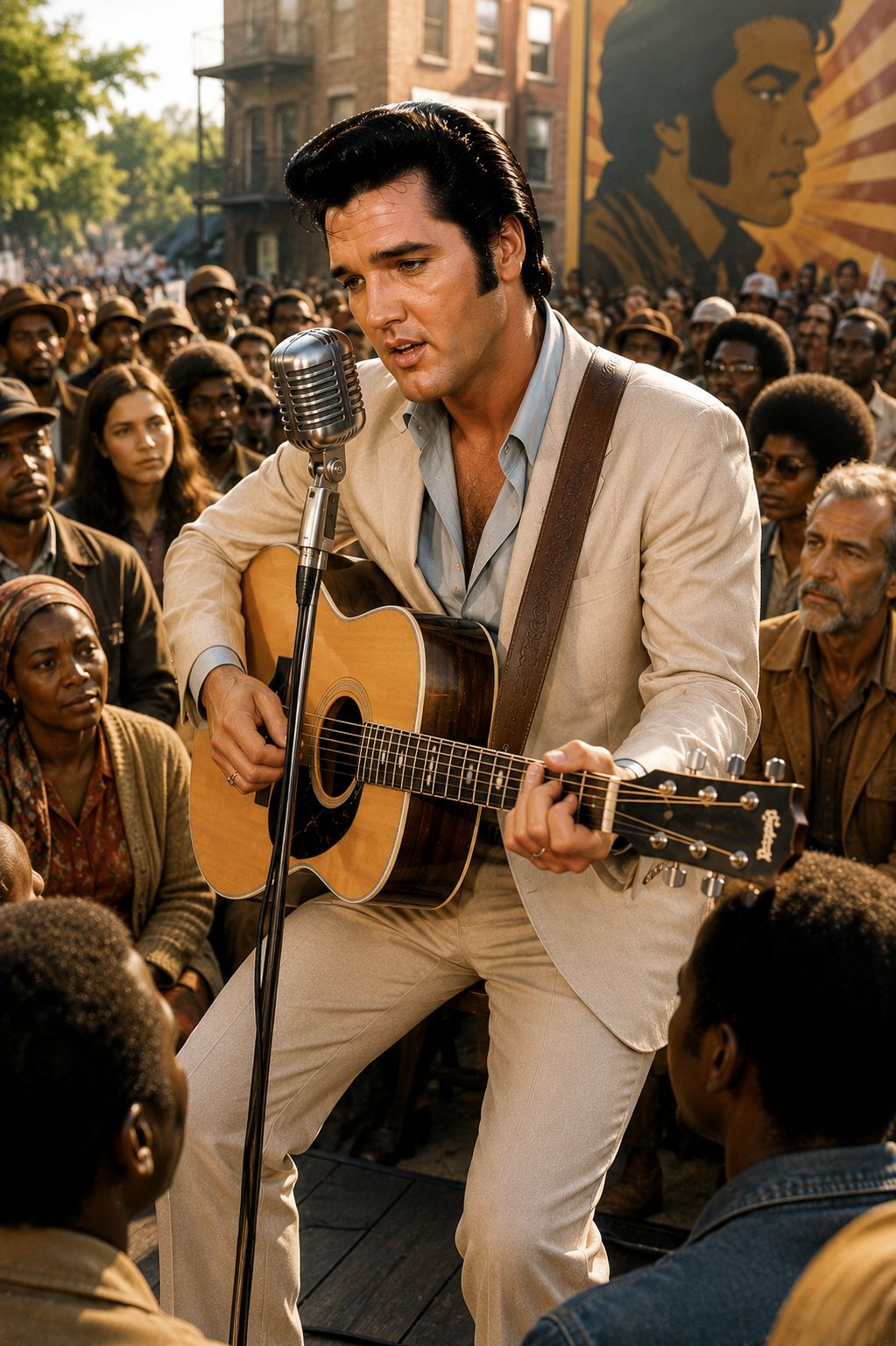
Introduction
There are songs that entertain. There are songs that become hits. And then there are songs that quietly reshape the way people see one another.
Among Elvis Presley’s vast catalog, one recording stands apart—not because it shattered sales records or inspired screaming crowds, but because it dared to ask listeners to look beyond prejudice, poverty, and social division. That song was “In the Ghetto.”
Released in 1969, it wasn’t merely another comeback single. It became one of the most compassionate moments in American popular music, proving that the King of Rock & Roll could also become one of its most humane storytellers.
More than half a century later, its message remains painfully relevant.
“A hungry child is another mouth to feed.”
Those words still echo because they describe more than one family. They describe a cycle that societies across generations have struggled to break.
Elvis Wasn’t Singing About Himself—He Was Singing for Those Rarely Heard
By the late 1960s, America was changing rapidly.
Civil rights demonstrations filled television screens. Cities wrestled with poverty and unrest. Political divisions deepened. Assassinations had shaken the nation’s confidence.
Many entertainers avoided these subjects altogether.
Elvis Presley could have done the same.
Fresh from his triumphant 1968 television comeback, he had every opportunity to continue recording safe love songs and energetic rock numbers. Commercially, that would have been the easiest path.
Instead, producer Chips Moman introduced him to songwriter Mac Davis’s emotionally devastating composition.
It wasn’t glamorous.
It wasn’t romantic.
It wasn’t designed to make audiences dance.
It was designed to make them think.
A Story Told Without Judgment
What makes “In the Ghetto” extraordinary isn’t that it addresses poverty.
Many songs have attempted that.
What makes it unforgettable is its refusal to assign blame.
The narrative begins quietly.
A baby is born into desperate circumstances.
The child grows up surrounded by hunger, neglect, and limited opportunity.
Eventually, violence consumes another generation.
The cycle repeats.
No speeches.
No political slogans.
No heroes.
Only compassion.
Rather than accusing listeners, the song gently asks one heartbreaking question:
What happens when society stops noticing its most vulnerable people?
Elvis Delivered the Lyrics Like a Witness
One reason the recording still resonates is Elvis’ vocal approach.
Instead of showcasing his enormous vocal power, he intentionally restrained himself.
His voice never dominates the story.
It accompanies it.
Listen closely, and you’ll hear subtle restraint throughout nearly every verse.
There are no explosive climaxes.
No theatrical embellishments.
Only quiet sadness.
That restraint transformed the recording into something unusually intimate.
It feels less like a performance and more like someone reading pages from real lives.
Great singers impress audiences.
Great storytellers make audiences forget they’re listening to music.
On “In the Ghetto,” Elvis became the latter.
Taking a Risk During a Career Rebirth
The timing couldn’t have been more significant.
Following years of lightweight movie soundtracks, many critics questioned whether Elvis still had artistic relevance.
His spectacular 1968 television special answered part of that question.
But choosing “In the Ghetto” answered the rest.
Rather than simply proving he could still sing, Elvis proved he still cared.
Commercially, it was hardly an obvious choice.
A somber ballad about urban poverty wasn’t typical radio material.
Yet audiences embraced it.
The record climbed charts around the world, becoming one of the defining songs of his post-comeback career.
Ironically, one of Elvis’ greatest commercial successes was also one of his quietest performances.
The Humanity Behind the Recording
Much has been written about Elvis’ generosity away from the spotlight.
Friends, musicians, hospital staff, police officers, and strangers often recalled unexpected acts of kindness.
He frequently gave away cars.
Paid medical bills.
Helped families privately.
Supported charities without publicity.
Whether every story has been embellished over time is impossible to know.
But his reputation for empathy was genuine enough that “In the Ghetto” never sounded performative.
Listeners believed him.
Not because he had lived every experience described in the song.
But because they sensed he genuinely cared about the people living them.
That authenticity cannot be manufactured.
The Arrangement Lets the Story Breathe
One of the recording’s greatest strengths is what it refuses to do.
The instrumentation never overwhelms the lyrics.
Soft orchestration creates atmosphere without becoming melodramatic.
Gentle rhythm supports the narrative rather than distracting from it.
Even the famous repeating chorus functions almost like a prayer.
As each verse unfolds, listeners already know tragedy is approaching.
Yet they continue listening, hoping somehow this child will escape the cycle.
He never does.
That inevitability is precisely what makes the ending so devastating.
Why the Song Still Feels Current
More than fifty years after its release, the issues explored in “In the Ghetto” remain familiar.
Communities continue to debate poverty.
Children still grow up facing unequal opportunities.
Violence often emerges from environments shaped by neglect rather than simple personal choice.
The song never claims to offer easy answers.
Instead, it offers something perhaps more valuable:
Empathy.
Today’s conversations often become polarized almost instantly.
People argue before listening.
“In the Ghetto” asks listeners to pause before judging.
It reminds us that every headline once began with a child.
That perspective remains extraordinarily powerful.
Critics Saw More Than a Hit
Many reviewers praised Elvis for embracing mature material.
For years, some critics had dismissed him as merely an entertainer.
This recording complicated that narrative.
Suddenly, Elvis wasn’t just the performer behind chart-topping rock songs.
He was interpreting sophisticated songwriting that addressed uncomfortable realities.
It expanded perceptions of what audiences expected from him.
Even listeners who disagreed with the song’s social implications often acknowledged the sincerity of his performance.
Respect replaced skepticism.
A Legacy Beyond Rock and Roll
When discussing Elvis’ greatest recordings, conversations often focus on explosive classics like “Jailhouse Rock,” “Hound Dog,” or “Suspicious Minds.”
Those songs deserve every accolade they receive.
But “In the Ghetto” occupies a different emotional category.
It doesn’t celebrate youth.
It doesn’t celebrate romance.
It doesn’t celebrate fame.
It celebrates compassion.
That distinction makes it one of the most important recordings in his entire catalog.
Long after trends fade and musical styles evolve, empathy never goes out of fashion.
The Ballad That Refused to Point Fingers
Perhaps that’s why the song continues reaching new generations.
It never lectures.
It never simplifies.
It never tells audiences what political conclusion they should reach.
Instead, it quietly asks them to care.
That may sound modest.
In reality, it is revolutionary.
History often remembers social change through speeches, marches, legislation, and protests.
Yet music has always possessed another kind of influence.
A song can soften hearts before minds are ready to change.
It can transform statistics into human faces.
It can make distant suffering feel personal.
“In the Ghetto” accomplished precisely that.
The Final Note
Elvis Presley built his legend through unforgettable charisma, groundbreaking performances, and one of the most recognizable voices in recording history.
But greatness is measured not only by volume.
Sometimes it is measured by restraint.
Sometimes it is measured by choosing compassion over spectacle.
Sometimes it is measured by singing about people who may never have had anyone sing for them.
“The Social Revolution Ballad Sung with Pure Empathy by Elvis Presley” wasn’t revolutionary because it shouted louder than anyone else.
It became revolutionary because it whispered something timeless:
Every child deserves to be seen.
Every life deserves dignity.
And sometimes, the most powerful voice in the room is the one willing to sing with understanding instead of judgment.
More than fifty years later, that message still resonates with remarkable clarity.
It remains one of Elvis Presley’s greatest gifts—not simply to music, but to humanity.