Introduction
There are moments in music history when an artist performs a great concert.
And then there are moments when an artist seems to step beyond music itself.
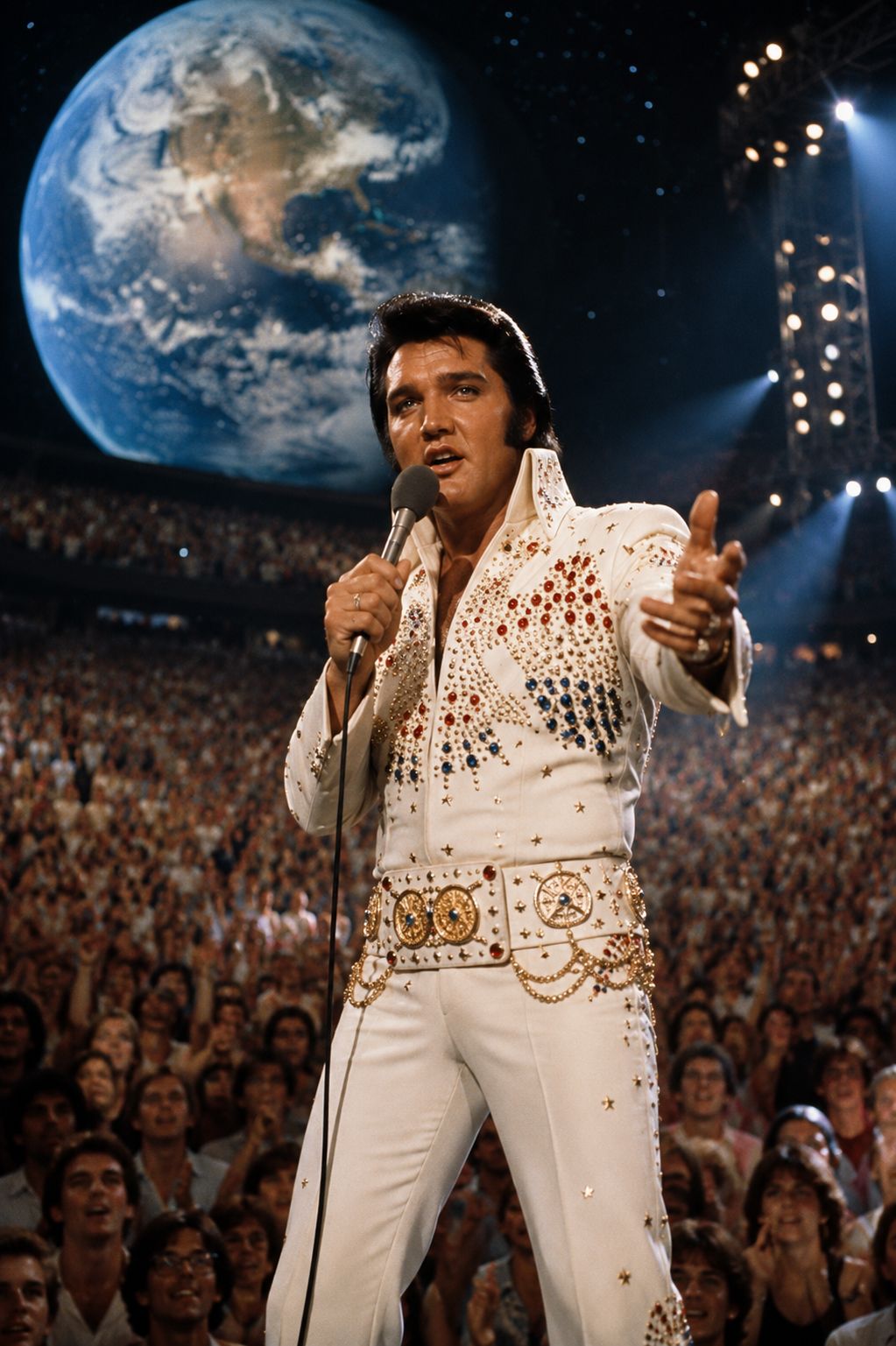
On January 14, 1973, in Honolulu, Hawaii, Elvis Presley walked onto the stage at the Honolulu International Center Arena and entered a different kind of history. He wasn’t simply performing for the thousands of people inside the arena. For the first time, a solo artist was using satellite technology to turn a concert into a global event, sending his performance across continents to television audiences around the world.
The concert became known as “Aloha from Hawaii via Satellite.”
And what happened next was almost impossible to comprehend.
An estimated 1 to 1.5 billion people eventually saw the special across roughly 40 countries.
Think about that number for a moment.
Elvis wasn’t standing in front of a billion people.
He was standing in Honolulu.
But through television and satellites, Honolulu suddenly became the center of the musical universe.
THE NIGHT THE WORLD CAME TO HAWAII
The stage was ready.
The cameras were positioned.
The orchestra was waiting.
The technology that would carry Elvis’s voice across the Pacific was prepared.
And somewhere behind the scenes was a man who had spent nearly two decades becoming one of the most recognizable human beings on Earth.
Elvis had turned 38 just six days earlier.
He wasn’t the rebellious young man who had shocked America in the 1950s.
He wasn’t the leather-clad comeback figure from the 1968 television special.
This was another Elvis.
Older.
More powerful.
More polished.
And, perhaps most importantly, aware that the world was watching.
The performance had enormous technical stakes. The January 12 rehearsal show was actually recorded as a backup in case something went wrong with the satellite transmission. (Graceland)
That detail makes the story even more fascinating.
Because behind the legendary images—the white jumpsuit, the lights, the orchestra, the screaming fans—was a production team operating on the edge of emerging technology.
One technical failure could have changed everything.
But Elvis didn’t look frightened.
He looked ready.
THEN HE WALKED INTO THE LIGHT
Imagine sitting in that Honolulu arena.
The lights go down.
The anticipation rises.
And then the opening strains of “Also Sprach Zarathustra” begin.
That dramatic introduction had already become associated with Elvis’s stage entrance.
Then he appears.
The white jumpsuit.
The cape.
The unmistakable silhouette.
And suddenly the room erupts.
But the people inside the arena were only a fraction of the audience.
The satellite signal was carrying Elvis into homes throughout Asia and Oceania, with the program later reaching Europe on a delayed basis.
Japan.
The Philippines.
Hong Kong.
South Korea.
Australia.
Thailand.
South Vietnam.
And many other places.
For millions of viewers, Elvis wasn’t a distant American celebrity anymore.
He was suddenly in their living room.
“For a few minutes, the distance between Honolulu and the rest of the world disappeared.”
That may be the most extraordinary part of Aloha from Hawaii.
It wasn’t simply a concert broadcast.
It was an early demonstration of what global entertainment could become.
Today, an artist can livestream a concert to millions of people with a smartphone.
In 1973, that idea was almost science fiction.
Elvis was helping prove that technology could transform a performance into something approaching a worldwide communal experience.
ELVIS DIDN’T JUST SING HIS HITS
One reason the concert remains so powerful is that Elvis didn’t treat it like a simple greatest-hits parade.
The setlist moved through rock and roll, country, ballads, blues, pop standards and dramatic showpieces.
He opened with “See See Rider” and moved into “Burning Love.”
Then came “Something,” “You Gave Me a Mountain,” “Steamroller Blues,” “My Way,” “Johnny B. Goode,” “Blue Suede Shoes,” “I’m So Lonesome I Could Cry,” “Hound Dog,” “Fever,” “Suspicious Minds,” “An American Trilogy,” and eventually “Can’t Help Falling in Love.” (Graceland)
That variety tells us something important about Elvis.
He had never been just one thing.
He had absorbed country music.
Gospel.
Blues.
Rhythm and blues.
Rockabilly.
Pop.
And by 1973, he had transformed those influences into a performance style that belonged almost entirely to him.
For country music fans in particular, there was something deeply familiar in the way Elvis approached songs like “I’m So Lonesome I Could Cry.”
He didn’t need to scream.
He didn’t need spectacle.
Sometimes his voice carried the emotion all by itself.
And that was the paradox of Elvis.
The man capable of commanding a billion-person television audience could still make a song feel like it was being sung to one lonely person.
THE MOMENT “AN AMERICAN TRILOGY” CHANGED THE MOOD
Then came “An American Trilogy.”
This was more than another song in the set.
It was a statement.
Elvis combined three pieces of American musical tradition into one dramatic performance, turning the arena into something closer to a national ceremony.
The global audience wasn’t merely watching a rock star anymore.
They were watching an American cultural symbol presenting his interpretation of America to the world.
And the famous American Eagle jumpsuit reinforced that imagery.
Graceland notes that Elvis specifically commissioned the American Eagle design for the performance, making it one of the most recognizable costumes of his career.
The image became immortal.
White.
Red.
Blue.
Gold.
An eagle spread across Elvis’s chest.
A symbol of America wrapped around one of the world’s most famous entertainers.
But beneath all that spectacle was something surprisingly human.
Elvis was still just a performer trying to deliver the best show of his life.
THE MOST AMAZING PART? HE WAS PERFORMING FOR PEOPLE HE COULDN’T SEE
That’s what makes Aloha from Hawaii emotionally different from an ordinary concert.
Elvis could see the fans in Honolulu.
He could hear them screaming.
He could feel the energy of the arena.
But he couldn’t see the millions of people watching from homes thousands of miles away.
He had to trust the technology.
Trust the cameras.
Trust the musicians.
Trust the audience.
And trust himself.
That takes a different kind of confidence.
Imagine singing while knowing that somewhere in Tokyo, someone is watching.
Someone in Manila.
Someone in Seoul.
Someone in Sydney.
Someone sitting alone in a small home, perhaps hearing Elvis Presley for the first time.
The performer can’t respond to those people individually.
But emotionally, he has to reach them anyway.
And somehow, Elvis did.
“The strange thing about Elvis that night was that the larger the audience became, the more personal the performance felt.”
That is the magic of great music.
Numbers don’t necessarily make music less intimate.
Sometimes they make the intimacy more astonishing.
AND THERE WAS A DEEPER PURPOSE BEHIND THE SHOW
There was another reason Aloha from Hawaii mattered.
It wasn’t created purely as a commercial spectacle.
The concert and merchandise sales raised $75,000 for the Kui Lee Cancer Fund, a Hawaiian charity connected to songwriter Kui Lee, who had died of cancer in 1966. Audience members were not charged a fixed ticket price; they were asked to contribute what they could.
That gives the night another dimension.
Elvis wasn’t simply saying:
“Look at me.”
He was also helping direct attention toward a cause.
And that generosity had precedent. Elvis had previously performed a benefit in Hawaii in 1961 that raised more than $65,000 toward the construction of the USS Arizona Memorial.
Hawaii wasn’t just another location on his tour calendar.
It had become an important part of Elvis’s history.
AMERICA HAD TO WAIT
Here’s another fascinating twist.
The United States didn’t watch the concert live on January 14.
Because of the Super Bowl, NBC aired the American version later, on April 4, 1973. (Graceland)
By then, the legend had already grown.
The international audience had experienced Elvis first.
America was watching afterward.
And when the American broadcast finally arrived, it became a major television event in its own right. Graceland records that it reached more American households than the first televised moon landing.
That’s an almost unbelievable comparison.
The man who had once been accused of being too dangerous for television had become the centerpiece of one of television’s greatest global spectacles.
THE IRONY OF ELVIS’S GREATEST GLOBAL MOMENT
There is something bittersweet about watching Aloha from Hawaii today.
Because we know what came afterward.
In January 1973, Elvis appeared to be at the absolute summit.
He had the fame.
The money.
The adoration.
The musicians.
The stage.
The technology.
The world.
Graceland itself describes the concert as one of the pinnacle moments of Elvis’s superstardom.
But history would eventually reveal the fragility behind the image.
Elvis’s personal life was becoming increasingly complicated.
His marriage to Priscilla would end later that year.
His health and lifestyle would become increasingly troubled.
And just four and a half years after Aloha from Hawaii, Elvis Presley would be dead.
That knowledge changes the way we watch him.
When Elvis smiles during the concert, we know something he didn’t.
When he raises his arms to the audience, we know how little time remained.
When he sings “I’ll Remember You,” the words seem heavier decades later.
And when he closes with “Can’t Help Falling in Love,” it becomes difficult not to hear something almost prophetic in the moment.
THE KING DIDN’T KNOW HE WAS CREATING A TIME CAPSULE
That’s perhaps the greatest legacy of Aloha from Hawaii.
Elvis wasn’t trying to create a memorial.
He was trying to perform.
But the cameras captured something that would eventually become precious:
Elvis Presley at the height of his global power.
Not a photograph.
Not a newspaper clipping.
Not a memory passed down by someone who had been there.
A living performance.
A voice.
A movement.
A smile.
A gesture.
Preserved forever.
The accompanying live album became Elvis’s first No. 1 album in years, while the television event established itself as a landmark in entertainment history. (Graceland)
More than five decades later, the performance still feels enormous.
But strangely, it also feels intimate.
Because technology has changed.
Television has changed.
Music has changed.
The world has changed.
Elvis’s voice remains.
WHEN THE WORLD WATCHED ELVIS, ELVIS WAS STILL LOOKING FOR THE AUDIENCE
That’s the final secret of Aloha from Hawaii.
The headline is about numbers:
One billion.
1.5 billion.
40 countries.
Satellite technology.
Television history.
But the emotional truth is much smaller.
One singer.
One microphone.
One stage.
One song at a time.
That’s what Elvis understood.
You don’t perform to a billion people.
You perform to one person—and somehow hope that the feeling reaches everyone else.
On that night in Honolulu, it did.
The satellites carried his voice across oceans.
The cameras carried his face into homes.
The orchestra carried the music.
But Elvis carried the emotion.
And for a few unforgettable hours, the distance between millions of strangers disappeared.
“Elvis didn’t need the world to come to Honolulu. For one night, he brought Honolulu to the world.”
That is why Aloha from Hawaii still matters.
It wasn’t merely the night Elvis Presley conquered television.
It was the night the modern global concert was born—and the night a performer at the absolute peak of his fame gave the world a glimpse of something that could never happen again in quite the same way.
The King stood beneath the Hawaiian lights.
The cameras rolled.
The satellites waited.
And then Elvis sang.
The entire planet was listening.