Introduction
There are some moments in country music that feel almost impossible to explain.
Two singers walk into a studio as individual artists. They have different histories, different personalities, different ways of phrasing a lyric. They have spent years developing voices that belong unmistakably to themselves.
And then they sing together.
Suddenly, something changes.
The two voices stop sounding separate.
They become a conversation.
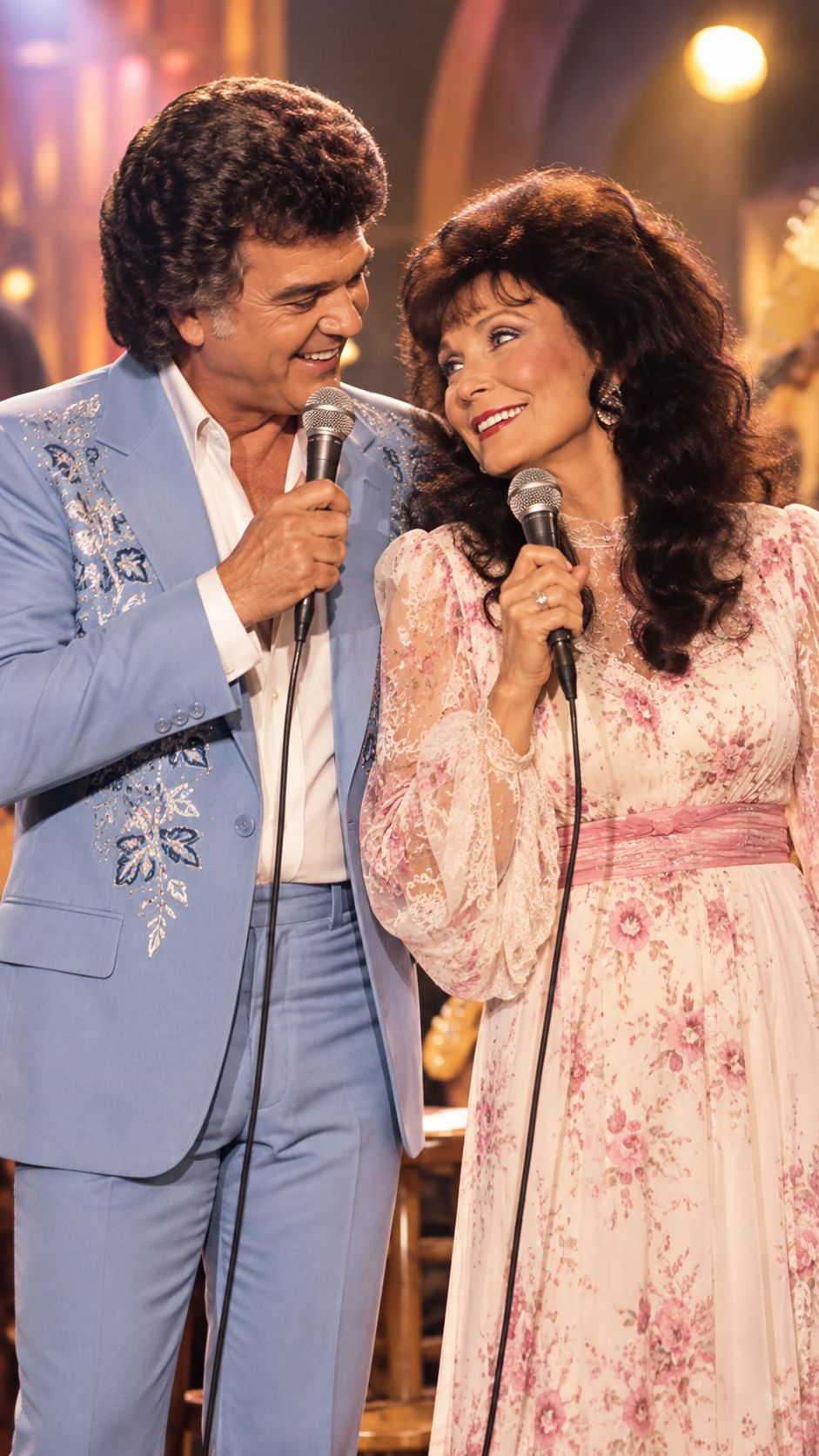
That is the magic that happened when Conway Twitty and Loretta Lynn found their way into the same musical world.
By the early 1970s, both were already established country stars. Conway had transformed himself from a rock-and-roll performer into one of country music’s most emotionally powerful singers. Loretta had become one of Nashville’s defining female voices, known for songs that could sound tough, vulnerable, rebellious, funny, and deeply personal all at once.
Separately, they were already extraordinary.
Together, they became something else entirely.
Their partnership eventually produced a remarkable run of recordings, including five consecutive No. 1 country singles between 1971 and 1975 and a decade-long series of albums. They also won the CMA Vocal Duo of the Year award four straight times from 1972 through 1975. (PBS)
But statistics don’t explain why their records still feel alive.
For that, you have to listen.
BEFORE THE DUETS, THERE WERE TWO VERY DIFFERENT VOICES
Conway Twitty’s voice had weight.
It could be smooth and almost conversational one second, then suddenly become intensely emotional. He understood something fundamental about country music: sometimes the most devastating line is the one delivered quietly.
His career had already become extraordinary before his partnership with Loretta. According to the Country Music Hall of Fame, Twitty ultimately collected 40 No. 1 Billboard country hits and became known for emotionally charged performances that frequently explored love, regret, temptation, and guilt. (Country Music Hall of Fame and Museum)
Loretta Lynn was different.
Her voice carried the feeling of somebody who had actually lived the stories she sang.
There was strength in it, but there was also vulnerability. She didn’t need to oversell a lyric. A slight change in emphasis could make a simple sentence sound like a confession.
And perhaps that was exactly why the pairing worked.
Conway could sound like the man trying to explain himself.
Loretta could sound like the woman who already knew the truth.
That tension became the engine of their music.
THEN CAME “AFTER THE FIRE IS GONE”
Their professional partnership began around 1970, with their first major duet, “After the Fire Is Gone,” arriving in 1971. The song became their first No. 1 country hit and later earned them a Grammy for Best Country Vocal Performance by a Duo or Group. (AllMusic)
Imagine hearing that recording for the first time.
There isn’t a huge wall of sound trying to convince you that something important is happening.
Instead, the drama comes from the voices.
Conway enters with that unmistakable controlled intensity.
Then Loretta answers.
And suddenly, the song feels less like two singers taking turns and more like two people caught in the same emotional situation.
That was the revelation.
Their voices didn’t simply sound good together.
They created tension together.
Conway sounded like the question. Loretta sounded like the answer.
That is one of the secrets behind great duet singing.
A great duet isn’t necessarily two beautiful voices singing at the same time.
It’s two personalities creating a third personality through music.
Conway and Loretta understood that almost instinctively.
THEY DIDN’T TRY TO SOUND THE SAME
This is what makes their partnership so fascinating.
They never needed to blend into one anonymous sound.
Loretta remained Loretta.
Conway remained Conway.
His lower, resonant tone created a foundation. Her sharper, expressive delivery could cut through it.
The contrast gave their recordings movement.
Think about the emotional architecture.
Conway could lean into a lyric with restraint.
Loretta could answer with fire.
He could sound regretful.
She could sound suspicious.
He could sound romantic.
She could sound unconvinced.
And when the song required them to surrender to each other emotionally, both voices could suddenly soften.
That contrast made their records feel like conversations between real people.
Not performances.
Conversations.
“LEAD ME ON” MADE THE FORMULA EVEN STRONGER
After “After the Fire Is Gone,” they quickly proved that their first success wasn’t an accident.
“Lead Me On” became another No. 1 hit in 1971. Then came “Louisiana Woman, Mississippi Man” in 1973, “As Soon as I Hang Up the Phone” in 1974, and “Feelins’” in 1975. (AllMusic)
Five consecutive No. 1 country singles.
That’s not simply a successful collaboration.
That’s a musical phenomenon.
And the albums kept coming.
Their partnership eventually produced 11 studio albums between 1971 and 1988, according to PBS, with multiple chart-topping projects along the way. (PBS)
But somewhere inside all those recordings was an important realization:
They had found a musical language that belonged to them.
THE MAGIC WAS IN THE SPACE BETWEEN THE WORDS
Listen closely to their best duets and you’ll notice something.
The magic isn’t always in the big notes.
It’s in the pauses.
It’s in the way one singer waits for the other.
It’s in the slight hesitation before a line.
It’s in the emotional response that happens after the other person sings.
That’s what makes their records feel intimate.
Conway didn’t simply sing to Loretta.
He sang with her.
And Loretta didn’t simply harmonize beneath Conway.
She challenged him.
She responded to him.
Sometimes she sounded as if she were daring him to say what he really meant.
That dynamic became one of the defining characteristics of their partnership.
Their greatest instrument wasn’t the microphone. It was chemistry.
And chemistry can’t be manufactured easily.
You can hire brilliant musicians.
You can write a perfect melody.
You can build an expensive studio.
But you cannot guarantee that two voices will emotionally understand each other.
Conway and Loretta had that rare quality.
“LOUISIANA WOMAN, MISSISSIPPI MAN” SHOWED JUST HOW BIG THEY COULD BECOME
By 1973, the partnership had become something larger than a successful duet experiment.
“Louisiana Woman, Mississippi Man” became a No. 1 country single, and the album of the same name also reached No. 1 on the country albums chart. (PBS)
The title itself almost feels like a movie.
Two people from different places.
Two strong personalities.
Two voices.
One story.
And that was precisely the appeal.
Country music has always understood the power of characters.
The best songs don’t simply tell you that two people are in love.
They tell you who those people are.
Where they came from.
What they want.
What they’re afraid of.
What they might lose.
Conway and Loretta brought those characters to life through their voices.
THEY BECAME A DUO PEOPLE BELIEVED IN
Perhaps the most remarkable part of the story is that fans didn’t merely enjoy their records.
They believed in the pairing.
They believed that these two voices belonged together.
The industry noticed too.
From 1972 through 1975, they won the Country Music Association’s Vocal Duo of the Year award four consecutive times. (PBS)
That kind of recognition confirmed what listeners were already hearing.
Something special was happening.
And it continued.
Albums such as Country Partners, Feelins’, United Talent, Dynamic Duo, and Honky Tonk Heroes followed. (Wikipedia)
Even years into their partnership, the formula hadn’t become stale.
Instead, the voices seemed to understand each other better.
THE BEAUTY OF THEIR PARTNERSHIP WAS THAT IT NEVER FELT PERFECT
Perfect voices can sometimes feel distant.
Conway and Loretta weren’t interesting because everything was polished into something flawless.
They were interesting because there was personality in the imperfections.
A little rasp.
A little strain.
A little vulnerability.
A little attitude.
Country music has always valued truth over perfection.
And their voices carried that philosophy.
When Loretta sang, you could hear someone who wasn’t afraid to say what she thought.
When Conway sang, you could hear someone who understood the complicated side of desire and regret.
Put those perspectives together, and suddenly even a simple love song could become a dramatic scene.
YEARS LATER, THE FORMULA STILL WORKS
That’s perhaps the strongest evidence that they really did discover something special.
The recordings haven’t become interesting merely because they are old.
They remain interesting because the emotional dynamic still works.
Listen to “After the Fire Is Gone” today.
Listen to “Lead Me On.”
Listen to “Louisiana Woman, Mississippi Man.”
Listen to “Feelins’.”
You can still hear the push and pull.
The attraction.
The uncertainty.
The vulnerability.
The argument.
The reconciliation.
Everything that makes human relationships complicated.
And that’s why their music survived.
They didn’t just sing love songs. They made love, conflict, temptation, regret, and reconciliation sound like two people standing in the same room.
PERHAPS THEY DIDN’T KNOW AT FIRST
Maybe there wasn’t one single dramatic second when Conway Twitty and Loretta Lynn looked at each other and thought, Our voices were meant to be together.
Maybe the realization came gradually.
One recording.
Then another.
Then another.
A song reaches No. 1.
Another follows.
The awards arrive.
The audiences grow.
And eventually, the evidence becomes impossible to ignore.
They weren’t simply successful collaborators.
They were a musical partnership.
A rare one.
The kind that happens when two artists stop trying to prove how good they are individually and start listening to what they can create together.
That’s the real lesson of Conway Twitty and Loretta Lynn.
Great country music isn’t always about having the biggest voice.
Sometimes it’s about finding the voice that makes your voice mean more.
Conway found that in Loretta.
Loretta found it in Conway.
And country music got one of the greatest male-female duet partnerships it has ever known.
Their collaboration ultimately stretched across more than a decade, with their final studio album of new material, Two’s a Party, arriving in 1981 and their final collaborative release, Making Believe, following in 1988. (Wikipedia)
But the years don’t really matter when the music still feels immediate.
Because the moment those voices meet, something happens.
Conway’s voice enters.
Loretta answers.
And for a few minutes, time disappears.
That is what the greatest duets do.
They don’t make you hear two singers.
They make you hear one story being told by two hearts.
And perhaps that’s why, decades later, Conway Twitty and Loretta Lynn still sound like they were always supposed to sing together.
Not because someone planned the perfect pairing.
Not because the charts demanded it.
But because when their voices finally met, country music discovered something neither voice could create alone.
A sound that belonged to both of them.
Video